Centre scientifique de la Main-d'œuvre
Square Jean Thébaud, Paris 15th arrondissement
Sources checked November 2026
- Year
- 1938
- Architect
- Le Corbusier
- Type
- Refit of existing premises (centre against unemployment)
- Access
- Lost: building demolished
In 1938 the association Centre d'Étude du Travail commissioned Le Corbusier to refit the former France Mutualiste premises in Paris for the Centre scientifique de la Main-d'œuvre, which the Minister of Labour and the Seine département both sponsored. The building, with two wings at right angles, held a reception hall, administrative offices and medical rooms on the ground floor, and mainly test and psychotechnical examination rooms upstairs. With little money available, Le Corbusier offered from the start to reduce his fees. The building has been demolished.
History
The Centre scientifique de la Main-d'œuvre was one of the first major initiatives against unemployment, with the Minister of Labour and the Seine département as its joint patrons. An association, the Centre d'Étude du Travail, ran it, with Philippe Serre, a former Under-Secretary of State for Labour, at its head.
In 1938 this Centre d'Étude du Travail commissioned Le Corbusier to refit the former France Mutualiste premises on the square Jean Thébaud, between 24 rue de Cambronne and rue Paul Chautard. The budget was small, and the architect offered from the outset to reduce his fees. The final plans were approved in the course of November.
The building, in Paris's 15th arrondissement, has been demolished.
Architecture
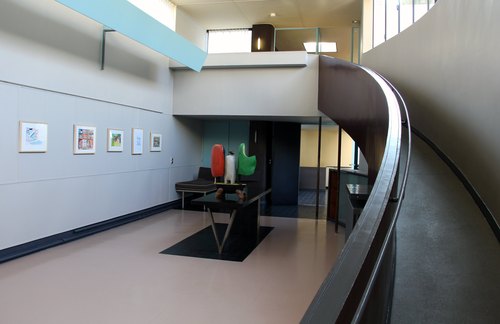
The building ran to two perpendicular wings and had a ground floor and one upper floor. On the ground floor a large reception hall sat in the middle, with the administrative offices on the left and the medical rooms on the right. The upper floor was given over mainly to test and psychotechnical examination rooms; in the left wing, the room for group examinations was made of tiered seating, five rows of four places.
Le Corbusier sought to cut costs, yet he insisted on soundproof partitions. The economics of the project also forced okoumé veneers on him; he judged the wood "out of fashion and withered" and turned to Joseph Savina, a sculptor from Tréguier whom he would later work with on his sculptures, to improve their appearance. To win him over, he wrote that it must be done "for the fatherland".
Square Jean Thébaud, Paris 15th arrondissement
Greenhouses nearby
Architecture nearby
By the same architect