Notre-Dame-du-Haut Chapel
Ronchamp, Haute-Saône
Sources checked October 2026
- Year
- 1955
- Architect
- Le Corbusier
- Type
- Catholic pilgrimage chapel
- Access
- Open to the public, paid admission, 10 am to 5 pm in winter (official website, October 2026)
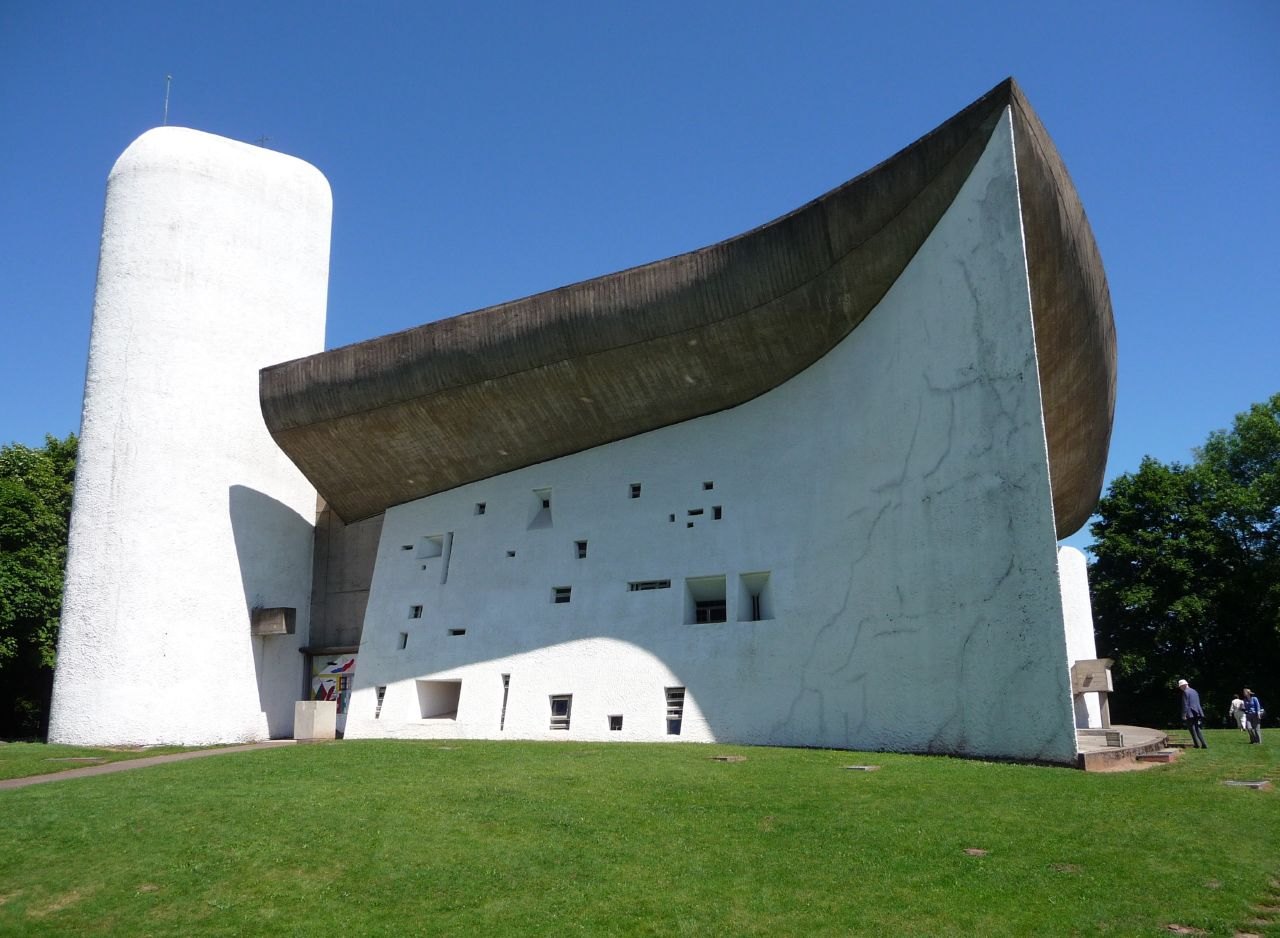
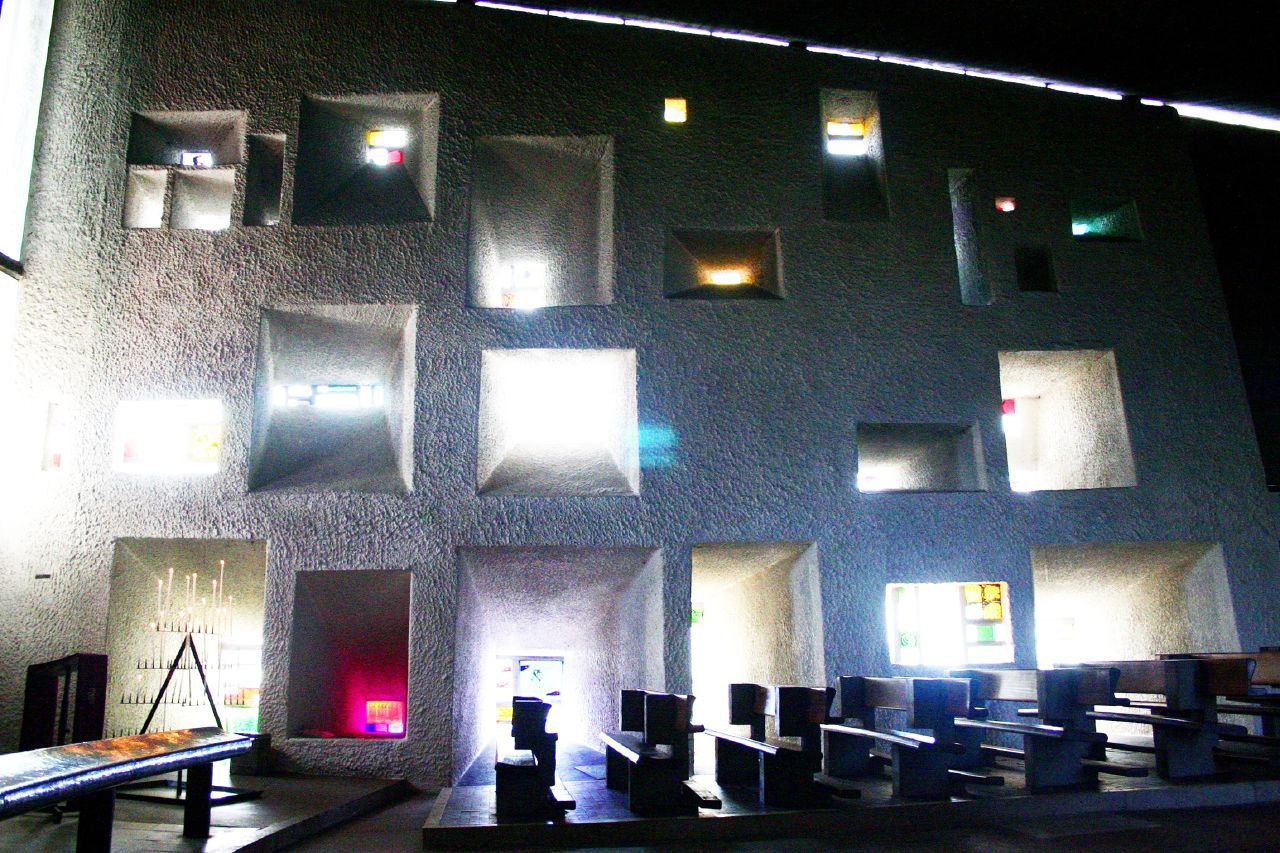
On the hill of Bourlémont, Le Corbusier rebuilt a pilgrimage chapel, inaugurated in 1955, with the stones of the old chapel destroyed by the bombings of 1944. The south wall, three metres thick, is pierced by openings of different sizes, and the white or coloured light that passes through it falls on the altar; the space opens like a funnel towards the choir. Inscribed on UNESCO's World Heritage List in 2016, it remains a Catholic place of worship; the neighbouring gatehouse and monastery are by Renzo Piano.
Affiliate links — booking through Verrière helps fund our research, at no extra cost to you.
History
A sanctuary dedicated to the Virgin Mary has crowned the hill of Bourlémont since the Middle Ages: in 1092, a legal document mentions a church consecrated to Mary there for the first time. Sold as national property in 1789, the chapel was bought back in 1799 by forty families from Ronchamp, and the top of the hill has remained private since. The Germans having dug in on the height, the chapel was bombed in 1944, during the fighting for the Liberation.
The destroyed building was largely a nineteenth- and twentieth-century church. The owners turned to the diocese of Besançon, whose Commission for Sacred Art had had many modern churches built in Franche-Comté; it took up the idea of two of its members: to approach Le Corbusier. He, who was not a believer, first refused to work for the Church, which he called a "dead institution". He came to Ronchamp in 1950 and was struck by the view over the landscapes, which he named the "four horizons". The plans were approved in 1951 and building began in late 1953, with no running water, no road fit for vehicles and a single generator: the concrete was mixed on site and carried in buckets, with rainwater collected on the hill. The chapel is made of stones from the old chapel, cement and steel. "Great art lives on poor means", Le Corbusier said. André Maisonnier, a young architect seconded from the office, ran the site; the inauguration took place on 25 June 1955.
The site was completed without him. Le Corbusier agreed in 1965 to draw a bell tower, then died a few weeks later; in 1975 the chaplain had the one designed by Jean Prouvé built. Renzo Piano built the visitors' gatehouse (2009-2011) and the Sainte-Claire monastery, for the Poor Clare sisters who came from Besançon; Michel Corajoud, associated with his studio, designed the reshaping of the landscape. The chapel was listed as a historic monument in 1967 and inscribed on the UNESCO World Heritage List on 17 July 2016, with sixteen other Le Corbusier sites. Restoration work took place from 2022 to 2025: façades, tower, glazing and interiors.
Architecture
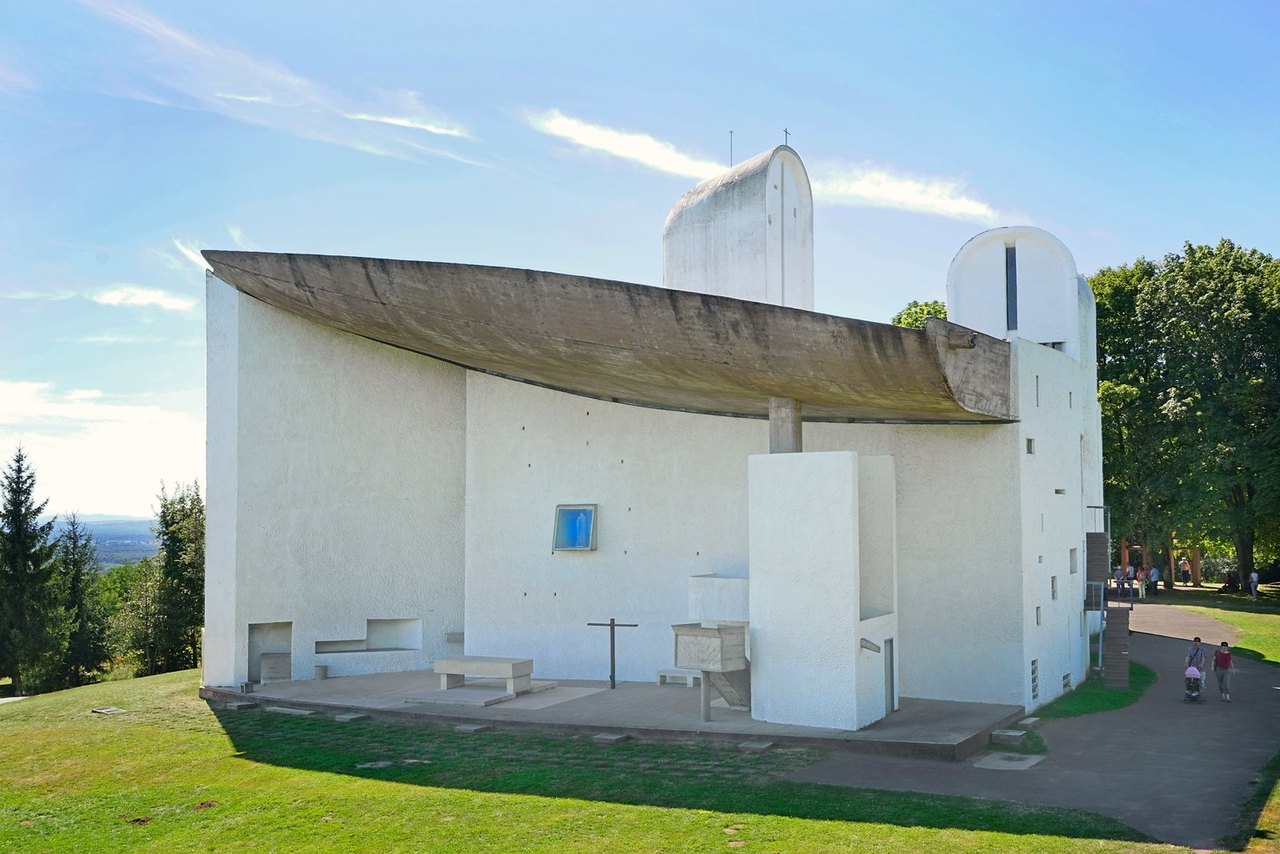
Le Corbusier designed the chapel from four façades facing the four cardinal points: to the south and east, the concave walls open to the world, in dialogue with the surrounding mountains; to the north and west, they close in. The asymmetrical plan is that of a single hall without aisles or transept, oriented to the east: it breaks with the cross. Three towers are side chapels, and the east wall carries an outdoor choir for pilgrimage masses. He composes with the horizon, and explained that the idea of the shape came to him from a crab shell found on a beach.
Fifteen reinforced-concrete piers, set into the walls, carry the roof. The enclosing walls are made of the stones of the old chapel, covered with rendering and whitewashed; only the great south wall is a hollow structure, covered with expanded metal and then rendered. The roof shell, two reinforced-concrete skins 6 cm thick, 2.26 m apart (Modulor) and held together by seven cross walls, is linked to the piers by discreet metal ball joints: a gap separates it from the walls, and from inside it seems to float above a thin ribbon of daylight.
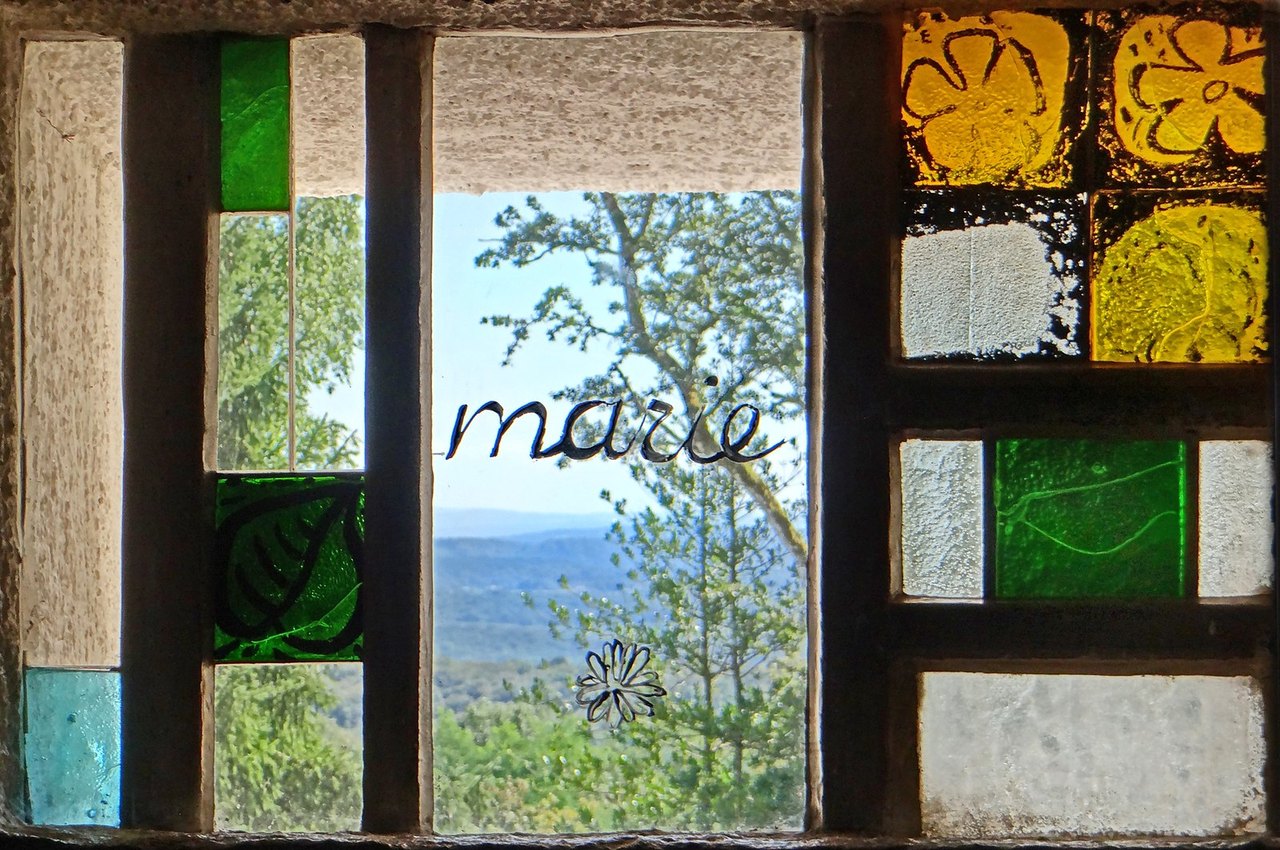
Inside, the space opens like a funnel towards the choir: the floor slopes down, the vault rises, the walls draw apart towards the altar. Three secondary chapels break it up; two are bathed in a soft light from a tower-shaped light well, and one of the three, painted red, blazes when the morning lights it. The high altar receives, through the south façade, a white or coloured light: the wall, three metres thick, is pierced by openings of different sizes, and Le Corbusier painted the glazing himself (cold paint, grisaille, stained glass), in a range of colours shared with the loggias of his housing blocks and his paintings of the 1950s. He drew all the furniture; the benches, the cross and the confessionals, in iroko, were made by the Breton cabinetmaker Joseph Savina.
Around it, Le Corbusier built in 1953 the pilgrims' shelter and the chaplain's house, then the Peace Pyramid, a war memorial raised with the remaining stones; at the end of the works, Maisonnier built a basin that collects the roof water. Jean Prouvé's steel bell tower follows the proportions of the Modulor; Renzo Piano's gatehouse and monastery, buried in the flank of the hill, remain invisible from the chapel.
Use today
It is a Catholic place of worship, a sanctuary dedicated to the Virgin Mary, owned by the association Œuvre Notre-Dame du Haut. Services are held every day in the chapel or in the monastery's oratory, and the Eucharist is celebrated there from Easter to All Saints; in winter, mass is said in the oratory, when the chapel is too cold. Two Marian pilgrimages, on 15 August and 8 September, remain the heart of religious activity.
The Poor Clare sisters, settled on the hill since 2009, offer spiritual hospitality. Since 2017, an annual interfaith meeting, open to non-believers too, has been held there. The gatehouse hosts exhibitions, talks and workshops.
Visiting
The hill is private property: admission is charged, and the ticket, valid for one day, covers the chapel, the pilgrims' shelter, the oratory of the Sainte-Claire monastery and the grounds, with the bell tower and the pyramid. Entry is free under 8. The site opens from 10 am to 5 pm or 6 pm depending on the season, with last entry 30 minutes before closing; the site is closed on 25 December and 1 January. Allow 1 h 30 for a guided visit, 1 to 2 hours for a free visit.
Photographing the interior is forbidden without specific permission; outside, photographs stay within private use, and filming or flying a drone requires permission. Animals are not allowed. Short shorts, dresses and skirts are not accepted, and shoulders must be covered before entering the chapel or the oratory. Services can be attended without a ticket, provided you report to reception at least 15 minutes beforehand; visiting is discouraged during the Sunday service, from 11 am to noon, and the oratory is closed to visitors during services.
The address is 13 rue de la Chapelle, 70250 Ronchamp. From Ronchamp TER station, a 20-minute walk leads to the top; the steep Way of the Cross calls for good physical condition and suitable shoes. A free, unsupervised car park is available. People with disabilities can drive to the visit points, following the instructions given at the gatehouse when buying the ticket.
Photos
47.70° N, 6.62° E
Greenhouses nearby
Architecture nearby
By the same architect
Sources (17)
- chapelle-lecorbusier-ronchamp.com/preparer-la-visite/informations-pratiques/
- chapelle-lecorbusier-ronchamp.com/preparer-la-visite/foire-aux-questions/
- chapelle-lecorbusier-ronchamp.com/decouvrir/les-batiments/la-chapelle-de-notre-dame-du-hau
- chapelle-lecorbusier-ronchamp.com/
- chapelle-lecorbusier-ronchamp.com/decouvrir/les-batiments/le-campanile-de-jean-prouve/
- chapelle-lecorbusier-ronchamp.com/decouvrir/les-batiments/la-porterie/
- chapelle-lecorbusier-ronchamp.com/decouvrir/les-batiments/le-monastere-sainte-claire/
- chapelle-lecorbusier-ronchamp.com/decouvrir/les-batiments/les-maisons-de-le-corbusier/
- chapelle-lecorbusier-ronchamp.com/decouvrir/les-batiments/pyramide-de-la-paix/
- chapelle-lecorbusier-ronchamp.com/decouvrir/spiritualite/la-vie-religieuse-de-la-colline/
- chapelle-lecorbusier-ronchamp.com/decouvrir/spiritualite/une-colline-inter-religieuse/
- chapelle-lecorbusier-ronchamp.com/unesco/
- sites-le-corbusier.org/oeuvres/chapelle-notre-dame-du-haut-ronchamp/
- fondationlecorbusier.fr/oeuvre-architecture/realisations-chapelle-notre-dame-du-haut-ronch
- pop.culture.gouv.fr/notice/merimee/PA00102263
- wikidata.org/wiki/Q638250
- openstreetmap.org/way/34915920
Affiliate links — booking through Verrière helps fund our research, at no extra cost to you.