Porrentruy Botanical Garden Greenhouses (JURASSICA)
Porrentruy, Canton of Jura
Entry updated on October 5, 2026
- Year
- 1961
- Style
- Complex of themed glasshouse compartments
- Status
- Open to the public
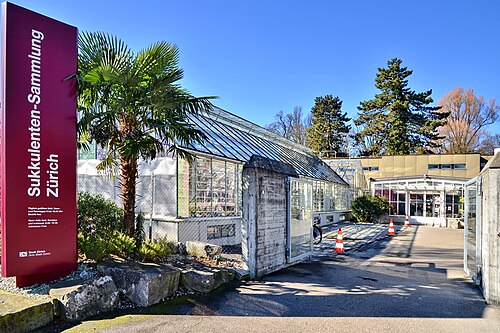
Porrentruy's botanical garden, founded in 1798 and now part of the JURASSICA Museum, gained new glasshouses in 1961 under Joseph Tièche, who ran the garden from 1952 to 1986. The complex, on the Route de Fontenais beside the cantonal high school, is visited one compartment after another: a tropical house, a house of carnivorous plants and ferns, an orchid and bromeliad house, a succulent house and a Mediterranean house. It shelters a large cactus collection that began with a gift made in 1980 and a Tillandsia collection donated in 2010.
Affiliate links — booking through Verrière helps fund our research, at no extra cost to you.
History
1 min
Porrentruy's botanical garden was founded in 1798. Antoine Lémane, a teacher at the École centrale, the school that became today's cantonal high school, attempted a first sowing in spring 1799 with some 240 kinds of seed sent by the Muséum national d'histoire naturelle in Paris (the Dictionnaire du Jura dates this trial to 1798). On 17 April 1799 the central administration of the department approved the building of a Dutch-style greenhouse at the southern end of the garden, the first record of glass on the site.
Nothing came of the scheme for some thirty years. On 30 October 1832 the college authorities proposed turning their garden into a botanical garden; Jules Thurmann, with the political backing of Xavier Stockmar, directed it from 1832 to 1854, and the beds sown in spring 1833 were laid out according to the Candolle system. In 1839 the garden was enlarged and its greenhouse repaired.
In the twentieth century Joseph Tièche, in charge from 1952 to 1986, reorganised the garden into four sections and in 1961 opened new glasshouses for tropical plants, carnivorous plants, orchids and cacti. The Jura garden replaced the old alpine garden in 1970, and the whole site was reorganised in 1972. Private gifts later enriched the glasshouse collections, notably Pierre Locuty's cacti in 1980 and a Tillandsia collection in 2010. The garden now belongs to the JURASSICA Museum, a natural-science institution.
Architecture and engineering
1 min
The glasshouses stand along the Route de Fontenais, next to the buildings of the cantonal high school between which the outdoor garden is laid out. Rather than a single large palm house, they form a chain of glazed compartments, each given over to one habitat and entered one after the other.
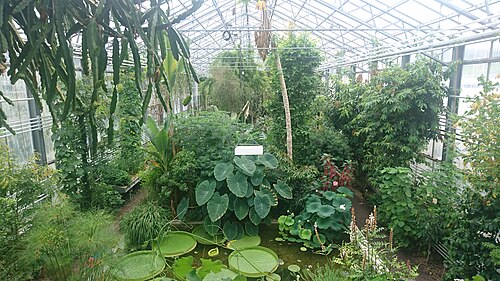
The route begins in an entrance hall where a display case of plant fossils and seeds traces the evolution of plants, echoing the museum's palaeontological work. Next comes the main section, the warm and humid tropical house, where a banana plant several metres tall grows. The house of carnivorous plants and ferns is split into two compartments, the second kept for aquatic plants, and the orchid house runs on into a space for bromeliads.
The succulent house, home to the cactus collection, was made possible by the support of a patron, Abbé Georges Jeanbourquin (1904-1996), himself a keen grower of orchids. Last comes the Mediterranean house, where citrus trees are accompanied by a soundtrack of waves, gulls and cicadas.
Plant collections
1 min
The tropical house concentrates on useful plants: bananas, vanilla, pepper and coffee grow alongside ginger and cacao, among tree ferns and cycads. In the next house, carnivorous plants show their range of insect traps, surrounded by ferns and begonias, while the aquatic compartment holds rice, papyrus and a small collection of Caladium.
The orchid house displays more than 400 specimens and leads on to the bromeliads, including a collection of over 450 Tillandsia species, out of roughly 800 known, received as a gift in 2010. The cacti and other succulents come largely from a donation made in 1980 by Pierre Locuty (1910-2000), a chemical engineer who retired to Fregiécourt and sought a simple way to grow cacti; the collection is put at 500 to 600 species. The Mediterranean house pairs lemon, orange and mandarin trees with caudiciform plants, which store water at the base of the stem or in their roots.
Visiting
1 min
The glasshouses belong to the JURASSICA Museum's botanical garden in Porrentruy, behind the cantonal high school. A visit extends easily into the outdoor garden, with more than 80 rose varieties, some 180 iris varieties and the Jura garden of over 800 species from the Jura range, and then into the park and galleries of the neighbouring natural-science museum.
Late spring is a rewarding time: the irises flower in late May and early June, when the museum reports more than a thousand cacti in bloom under glass. At the start of the route, the entrance hall's case of fossils and seeds links the glasshouses with the museum's palaeontological collections.
47.41° N, 7.08° E
Greenhouses nearby
More greenhouses — Switzerland
Do you have a good photo of this greenhouse? Suggest it for this page →
Sources (8)
- jurassica.ch/fr/Jardin-botanique/Serres/Serres.html
- jurassica.ch/fr/Jardin-botanique/Serres/Serre-des-plantes-succulentes/Serre-des-plantes-su
- jurassica.ch/fr/Jardin-botanique/Serres/Serre-des-orchidees-et-des-bromeliacees/Serre-des-
- jurassica.ch/fr/Jardin-botanique/Serres/Serres-tropicales/Serres-tropicales.html
- jurassica.ch/fr/Infos-pratiques/Actualites/Iris-et-cactus-en-fleurs-au-jardin-botanique-de
- fr.wikipedia.org/wiki/Jardin_botanique_de_Porrentruy
- diju.ch/f/notices/detail/6448-jardin-botanique-de-porrentruy
- openstreetmap.org/way/154497807