Sainte-Marie de La Tourette Convent
Éveux, Rhône
Sources checked October 2026
- Year
- 1953-1960
- Architect
- Le Corbusier
- Type
- Dominican convent
- Access
- Grounds freely open 8 am to 7 pm; interior by guided tour booked online; working convent (official website, October 2026)
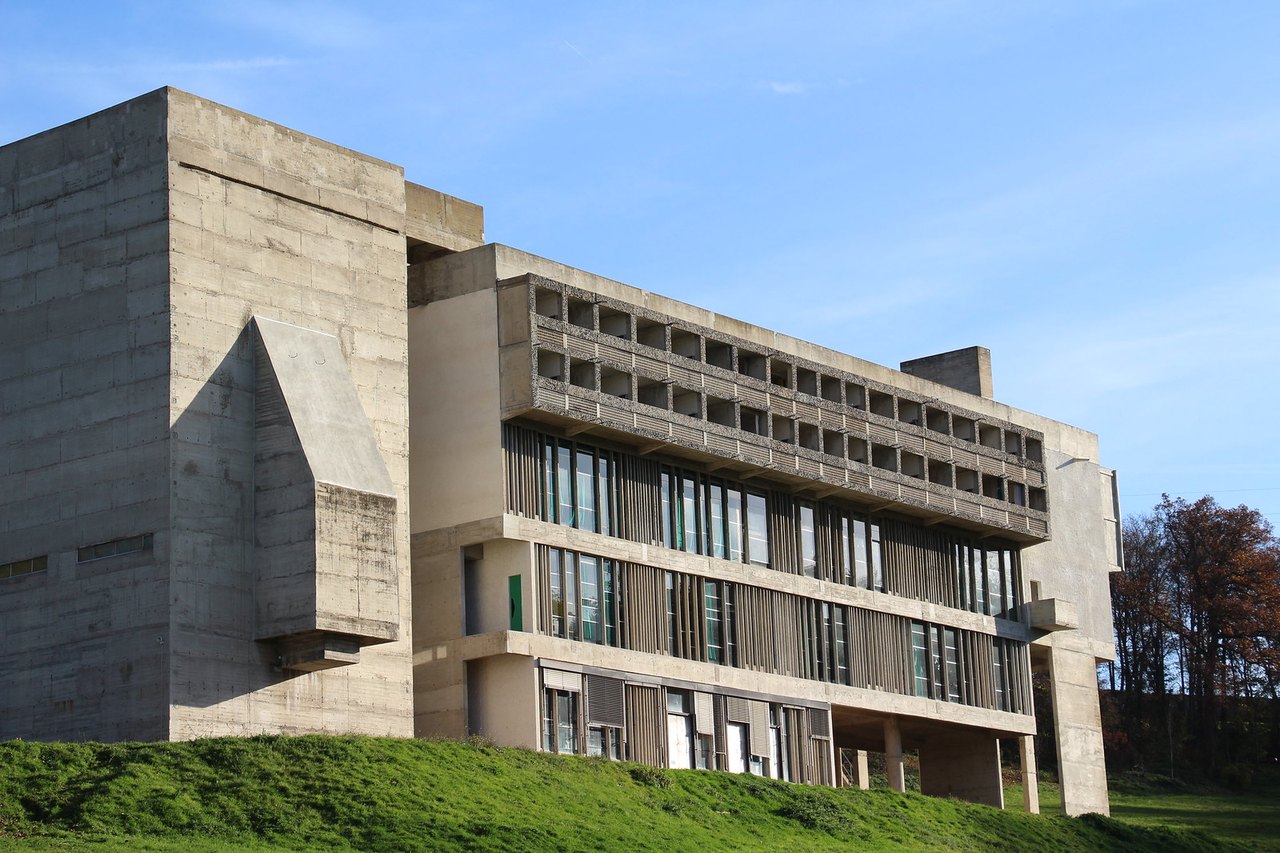
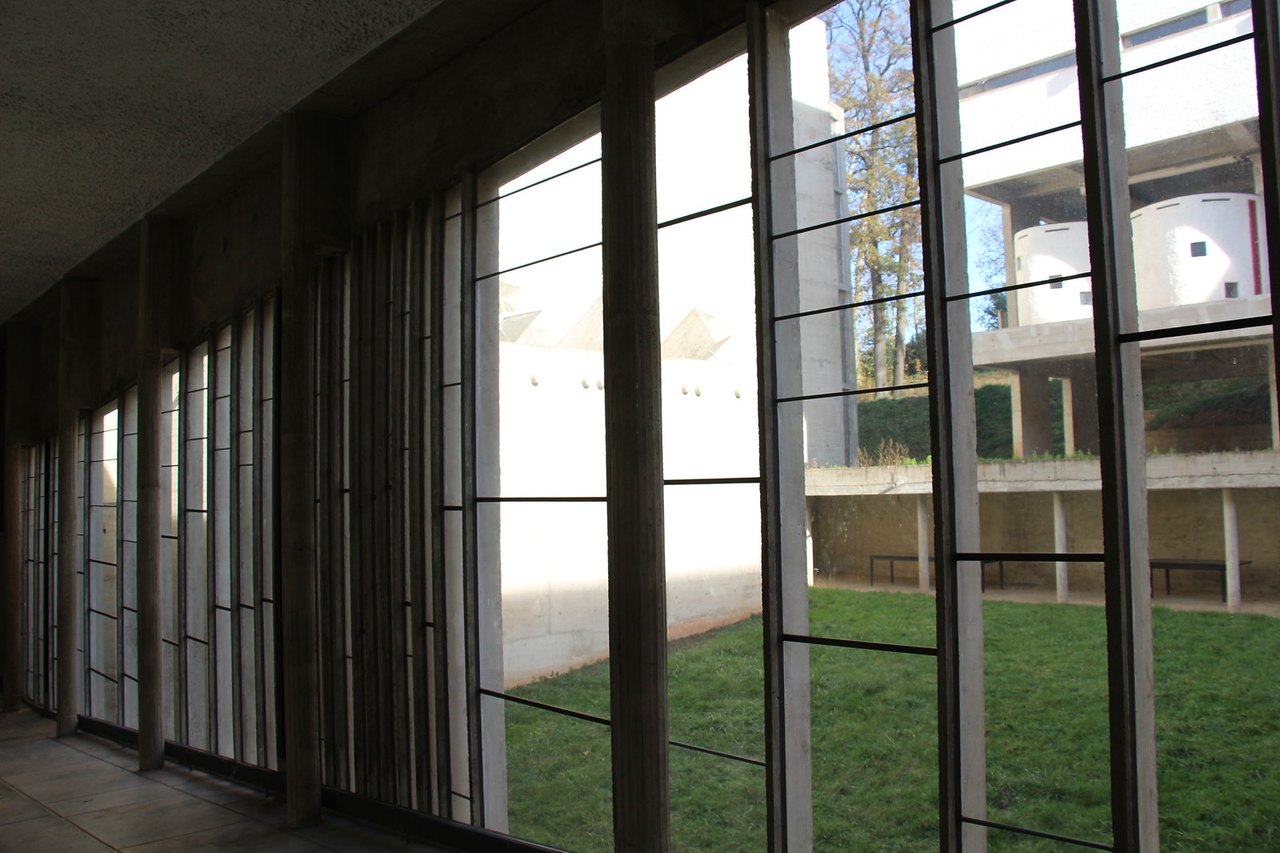
Built from 1953 to 1960 for the Dominicans near Lyon, this concrete convent forms a U closed on the north side by the church and stands on pilotis on steeply sloping ground. Le Corbusier controls the light with light cannons, coloured slits, light wells and glass panels, among them the undulating glass panels made with Iannis Xenakis. A Dominican community still lives here; the grounds are freely open, while the interior can only be visited with a guide, by reservation. It is one of the 17 works by Le Corbusier inscribed on the UNESCO World Heritage List in 2016.
Affiliate links — booking through Verrière helps fund our research, at no extra cost to you.
History
In the early 1950s the Dominican Order wanted a training centre in the Lyon region. The Dominican Province of Lyon picked Le Corbusier on 3 February 1953 to build its study convent on the La Tourette estate, which the friars had bought in 1943. The choice came at the instigation of Father Couturier, director of the review L'Art sacré, for whom Le Corbusier was the greatest living architect. Le Corbusier ran the project with his associate André Wogenscky, for about a hundred monks, students and teachers.
The friars moved in on 2 July 1959 and the convent was inaugurated on 19 October 1960, with Le Corbusier and Cardinal Gerlier attending. On 31 August 1965, on its way to the state funeral in Paris, Le Corbusier's body was watched over for a night by the friars in the church.
In the late 1960s the convent ceased to be a studium; in the early 1970s it opened to visits and stays. Listed as a historic monument in 1979, it has been listed in its entirety, with its outbuildings, since the order of 16 December 2011. A restoration from 2006 to 2013, under the supervision of Didier Répellin, chief architect of historic monuments, preceded the reopening of the church to the public in April 2013. Since 17 July 2016 it has been one of the seventeen works by Le Corbusier inscribed on the UNESCO World Heritage List.
Architecture
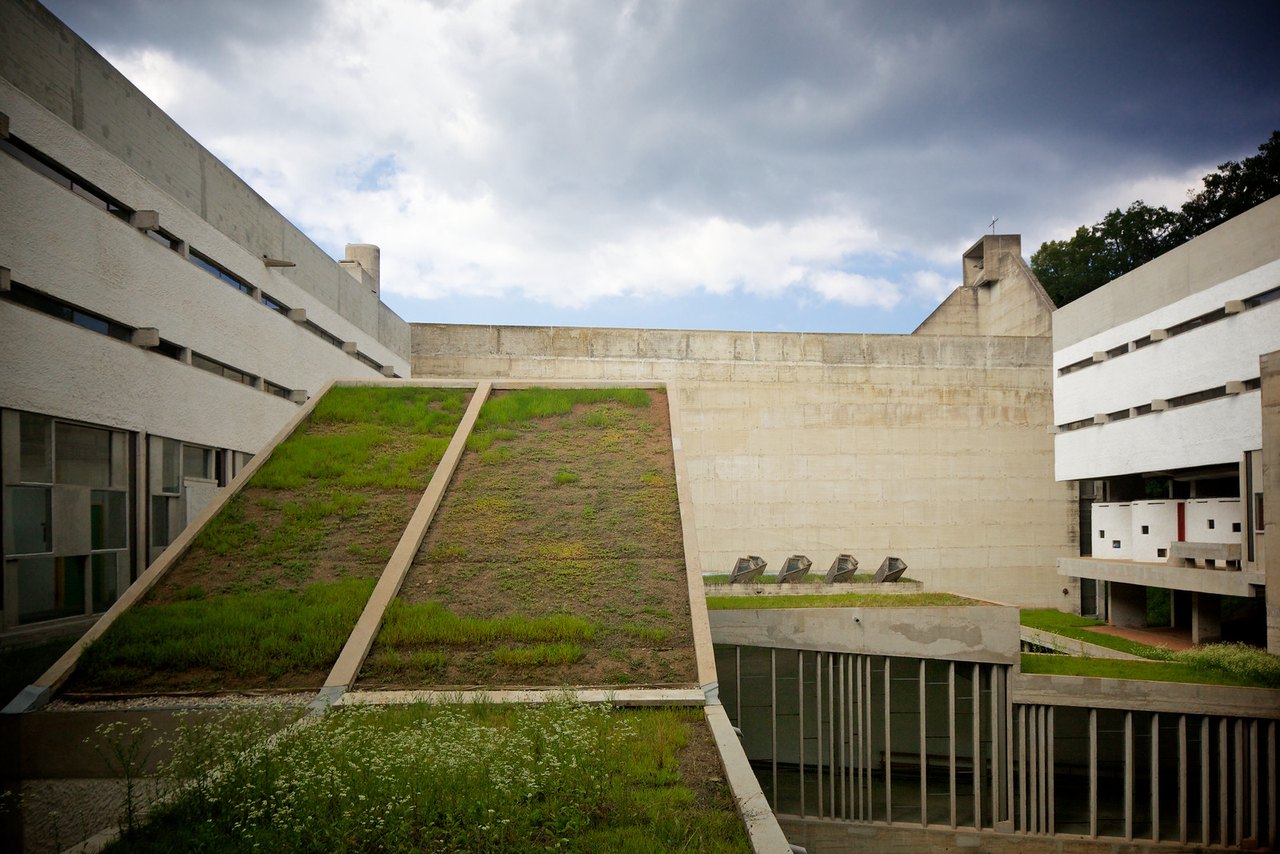
Inspired by Cistercian convents, the convent follows a square plan made of two separate concrete bodies: a U of three wings, closed on the north side by the church. The wings rest on a framework of concrete posts and beams and stand on pilotis, which respond to the steep slope of the site. With no cloister, impossible because of that slope, corridors laid out as a cross, the "conduits", join the volumes on the ground floor. The programme follows the three functions of monastic life: living, studying and praying. The texture of the materials belongs to a Brutalist aesthetic.
The two upper levels hold the cells, which face outwards. They are organised from the outside in following the natural decrease of light: a loggia for meditation, a well-lit workspace, then a place to rest with a bed, which a wardrobe divides from the washing area. Their dimensions come from the Modulor: 5.92 m long and 1.83 m high, while a friar's cell is 1.83 m wide and a father's is 2.26 m wide. Communal activities occupy the lower floors: the refectory and kitchen, the chapter room, the oratory, the library and the classrooms.
On the lower floors the facades are free, independent of the structure. Towards the courtyard, Le Corbusier uses Z- and H-shaped glass panels, prefabricated elements alternating opaque concrete and glazed parts; towards the outside, undulating panels (pans ondulatoires) made of concrete posts set at varying distances that form waves. These undulating panels were made in collaboration with the composer Iannis Xenakis, a collaborator of Le Corbusier; they are used here for the first time.
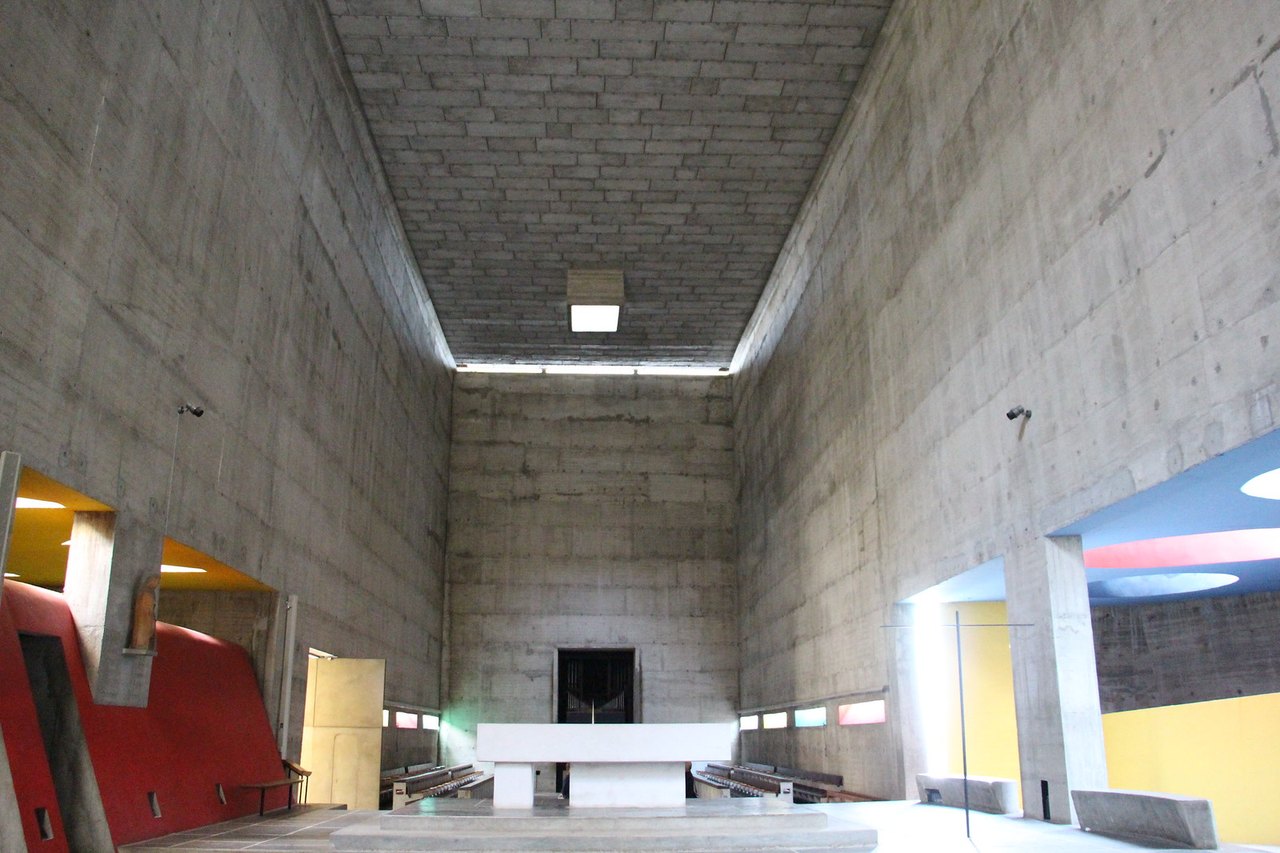
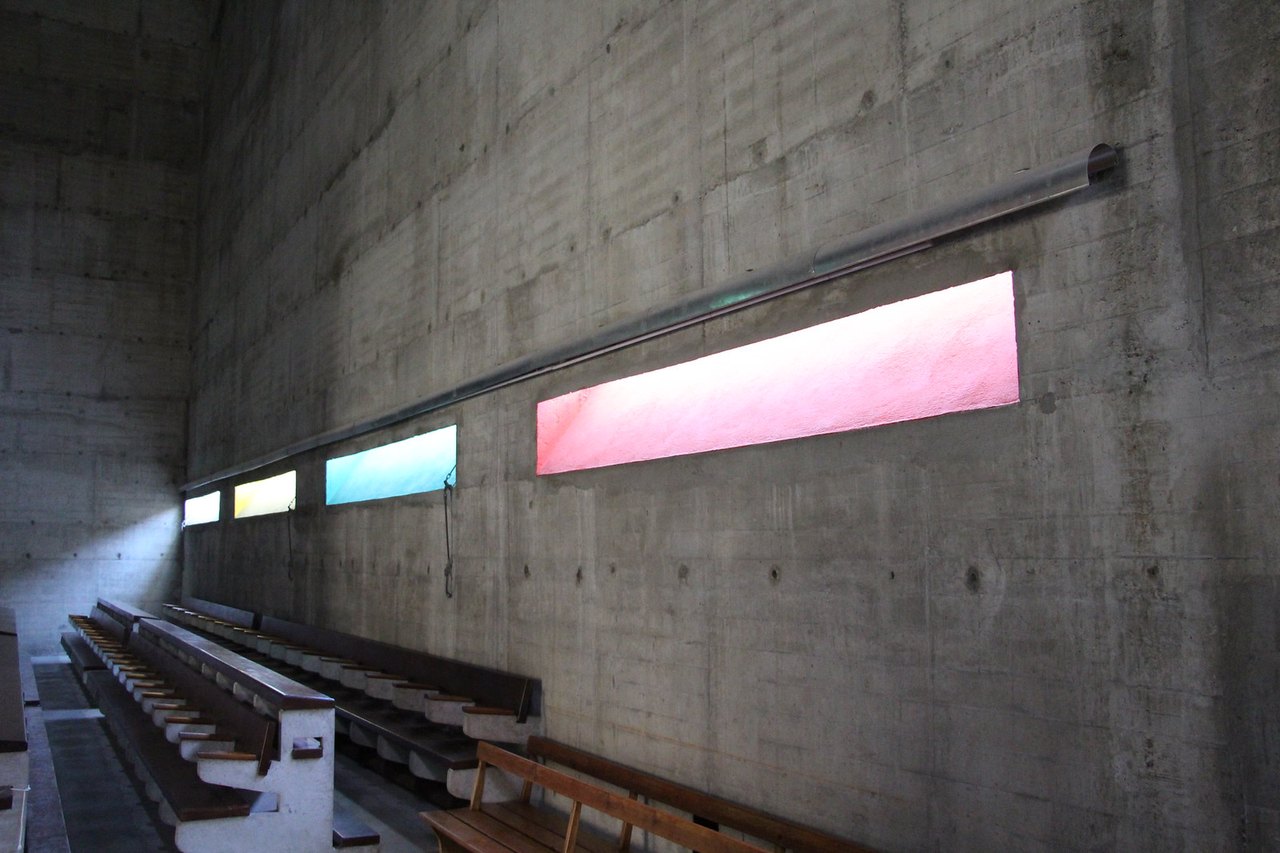
At La Tourette Le Corbusier deploys a palette of devices to control natural light: light cannons (canons à lumière), light machine-guns (mitraillettes), horizontal and vertical slits, light wells, shields, loggias, glass panels. The church is a parallelepiped of board-marked cast concrete, its formwork meticulously designed; a light well and horizontal and vertical slits with coloured surfaces light it and create varied effects of light inside. The adjoining crypt and sacristy receive oblique light, partly coloured, through light cannons and light machine-guns respectively. The roof terrace is conceived as a space for meditation, its high concrete parapet preventing the distraction of monks at prayer.
Le Corbusier said of it in 1961: "This convent of rough concrete is a work of love. It does not speak. It lives from the inside."
Use today
It is a lived-in convent: a Dominican community of about ten people lives here, its days paced by moments of work, exchange and common prayer. The services are open to the faithful.
The friars receive groups, professional or religious, and individuals for one or more days, in 50 individual rooms, cells of Dominican friars in Modulor format. Each year they organise the "Rencontres de La Tourette" and art exhibitions, and the convent offers professional seminars.
Visiting
The grounds are free: all the outdoor areas are open from 8 am to 7 pm, with no drones, and visitors are asked to respect the private areas and the calm of the place. The interior can only be visited with a guide, by booking. The tour lasts about 1 h 30, in French and/or English depending on the visitors. Tickets are paid, limited in number, named, and neither exchangeable nor refundable; booking is exclusively online. The roof terraces and the cells are not open to visitors.
From September to June, tours take place Tuesday to Saturday at 2.30 pm (with exceptions, some public holidays for example) and on Sundays at 2.30 pm (in French and/or English) and at 3 pm (in French, from April to the end of June and from September to the end of October). In July and August, three guided tours are offered every day.
To sleep at the convent, the guesthouse is open from Monday evening to Sunday morning and can be booked online up to the day before arrival; guided tours are not included in a stay and are booked separately. The services are open to the faithful: Mass at noon Monday to Saturday, vespers at 7 pm Monday to Saturday, Mass at 11 am on Sunday.
People with reduced mobility have access only to the floor of intellectual life (the friars' classrooms); access to the church requires being accompanied. The convent is 30 minutes by car from central Lyon, with 50 free parking places; by train, get off at L'Arbresle, about 30 minutes' walk away. In a satnav, enter "Éveux (69, Rhône)", not "La Tourette".
Photos
45.82° N, 4.62° E
Greenhouses nearby
Architecture nearby
By the same architect
Sources (15)
- couventdelatourette.fr/le-couvent/reserver-votre-visite.html
- couventdelatourette.fr/
- couventdelatourette.fr/le-couvent/son-histoire.html
- couventdelatourette.fr/le-couvent/unesco.html
- couventdelatourette.fr/le-couvent/sa-restauration.html
- couventdelatourette.fr/notre-communaute/offices-religieux.html
- couventdelatourette.fr/sejour-et-retraite/acces-et-plan-access-and-map.html
- couventdelatourette.fr/sejour-et-retraite/individuels-et-groupes.html
- fondationlecorbusier.fr/oeuvre-architecture/realisations-couvent-sainte-marie-de-la-touret
- sites-le-corbusier.org/oeuvres/couvent-sainte-marie-de-la-tourette-eveux/
- pop.culture.gouv.fr/notice/merimee/PA00117761
- wikidata.org/wiki/Q1902867
- openstreetmap.org/relation/1952778
- fondationlecorbusier.fr/en/work-architecture/achievements-sainte-marie-de-la-tourette-mona
- sites-le-corbusier.org/en/oeuvres/couvent-sainte-marie-de-la-tourette-eveux-2/
Affiliate links — booking through Verrière helps fund our research, at no extra cost to you.