Hyōgo Prefectural Children's House (兵庫県立こどもの館)
Himeji, Hyōgo Prefecture
Sources checked October 2026
- Year
- 1989
- Architect
- Tadao Ando
- Type
- Large prefectural children's activity centre (大型児童館)
- Access
- Open to the public, free admission, closed on Tuesdays, on the last day of each month and from 28 December to 4 January (official site, October 2026)
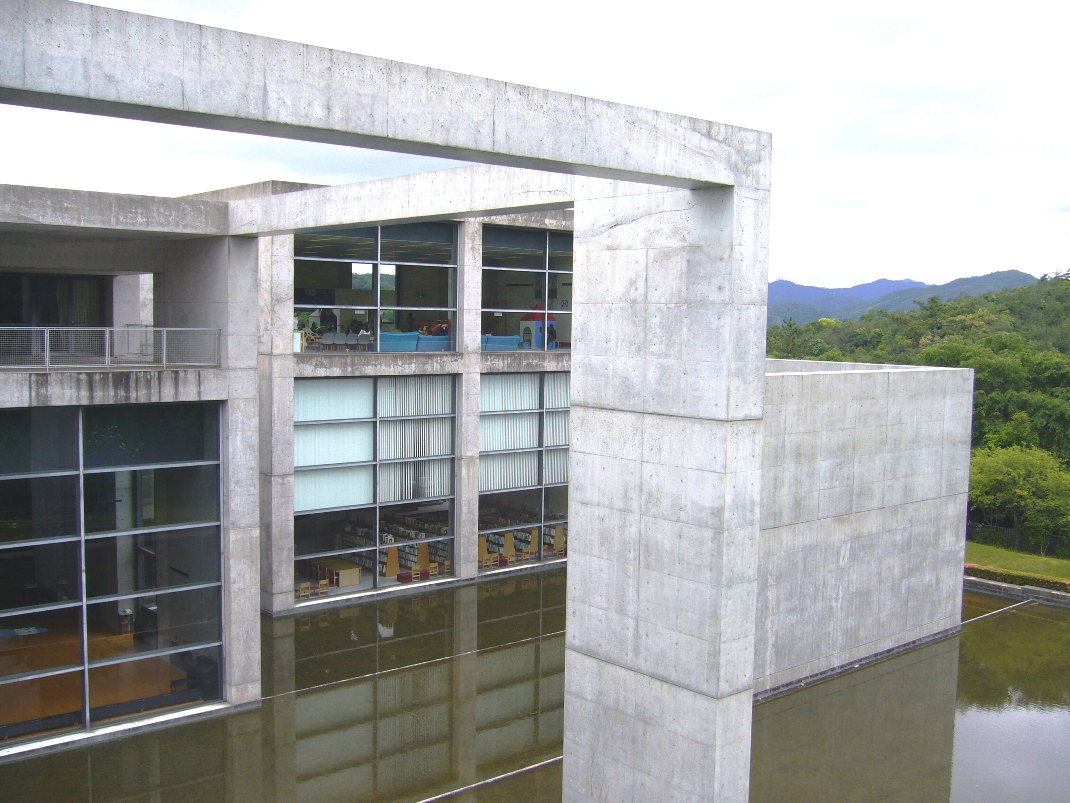
Opened in July 1989 in western Himeji, this large prefectural children's house is a Tadao Ando building surrounded by water: a large reservoir to the west, an artificial stream from the east to the south, ponds to the north and west. It won the Building Contractors Society prize (建築業協会賞) in 1991. Children play, read and make things there; admission is free.
Affiliate links — booking through Verrière helps fund our research, at no extra cost to you.
History
The Hyōgo Prefectural Children's House (兵庫県立こどもの館, Hyōgo-kenritsu Kodomo no Yakata) opened in July 1989 in the Sakurayama (桜山) park area, in western Himeji (姫路), about twenty minutes by car from the station. It was conceived as a place where children come with their families or in groups to present what they have learned or studied, to read and to make things, and where parents and people who work with children can train and exchange ideas; its founding statement speaks of training warm-hearted people to carry the twenty-first century. It also serves as the hub for the prefecture's children's activity centres.
The building is by Tadao Ando (安藤忠雄). It won the Building Contractors Society prize (建築業協会賞, known as the BCS prize) in 1991.
Architecture
A large reservoir lies to the west of the building. An artificial stream therefore runs from the east to the south of the main building, and artificial ponds are laid out to the north and west, so that the building seems to float on the water; the green of the neighbouring mountains and the water are borrowed from the landscape as a backdrop (借景, shakkei).
The main building (本館) has a steel-reinforced concrete (SRC) structure, with one basement level and three storeys above ground, for 7,006.69 m2 of floor area. The spaces run from the basement (B1) to the second floor (3F): play spaces in the basement; the library, the craft room, a circular theatre (円形劇場) and a waterside square (水辺の広場) on the ground floor; a viewing lobby (展望ロビー) on the first floor; an open-air theatre (屋外劇場) on the second. The house likens its spaces, inside and out, to a maze in which one goes looking for treasure.
Use today
It is a place of play and learning open to crawling babies as well as high-school students and adults. In the basement, the Waiwai hiroba (わいわいひろば) is a "challenge circuit" where children play freely with body and imagination, with a "dinosaur forest", wooden toys and a music corner; the Hikōki hiroba (ひこうきひろば), set inside an aeroplane, is for watching DVDs. On the ground floor, a children's library lends books, the craft room (工作室) offers free crafts with recycled materials or paid workshops, and the circular theatre hosts performances. On the first floor, the Asobi no hiroba (あそびのひろば) gathers old-fashioned toys, and meals are eaten at the Obentō hiroba (おべんとうひろば) or in the viewing lobby. On the second floor, a play room (親子遊戯室) is reserved for pre-school children and their parents.
On the site, 22 sculptures by Susumu Shingū (新宮晋) give form to the ideas of 22 children from around the world, chosen in a sculpture-idea competition held for the house's thirtieth anniversary; an outdoor rally invites visitors to find them. The house also reaches beyond its walls: it travels to family drop-in venues and small childcare facilities across the prefecture ("Ugoku Kodomo no Yakata-gō", 動く・こどもの館号) and runs training for people who support parents.
Visiting
The house is open from 9:30 to 16:30 and admission is free (some materials in the craft room are charged). It is closed every Tuesday, on the last day of each month, and from 28 December to 4 January. When a Tuesday falls on the last day of the month, the following day is also closed; when a Tuesday is a public holiday, the closure moves to the first following day that is not a holiday. Groups of ten or more book by telephone.
From Himeji station (north exit), a Shinki (神姫バス) bus for Ōichi (太市) stops at Kodomo-no-yakata-mae, about twenty minutes away; services are infrequent, so check the timetable. The 108-space car park is free. The house asks visitors not to enter the watercourse.
34.85° N, 134.62° E
Greenhouses nearby
Architecture nearby
Sources (10)
- kodomonoyakata.jp/about/
- kodomonoyakata.jp/guide/
- kodomonoyakata.jp/access/
- kodomonoyakata.jp/map/
- kodomonoyakata.jp/
- seishonen.or.jp/honbu/?page_id=6436
- city.himeji.lg.jp/atom/sakurayama/index.html
- ja.wikipedia.org/wiki/兵庫県立こどもの館
- openstreetmap.org/way/244157126
- wikidata.org/wiki/Special:EntityData/Q11392907.json
Affiliate links — booking through Verrière helps fund our research, at no extra cost to you.