Himeji City Museum of Literature (姫路文学館)
Himeji, Hyōgo
Sources checked October 2026
- Year
- 1991 (north building), 1996 (south building)
- Architect
- Tadao Ando
- Type
- Municipal literature museum, two concrete buildings and a Taishō-era villa
- Access
- Open to the public from 10:00 to 17:00, closed on Mondays unless a public holiday; south building free to enter (official site, October 2026)
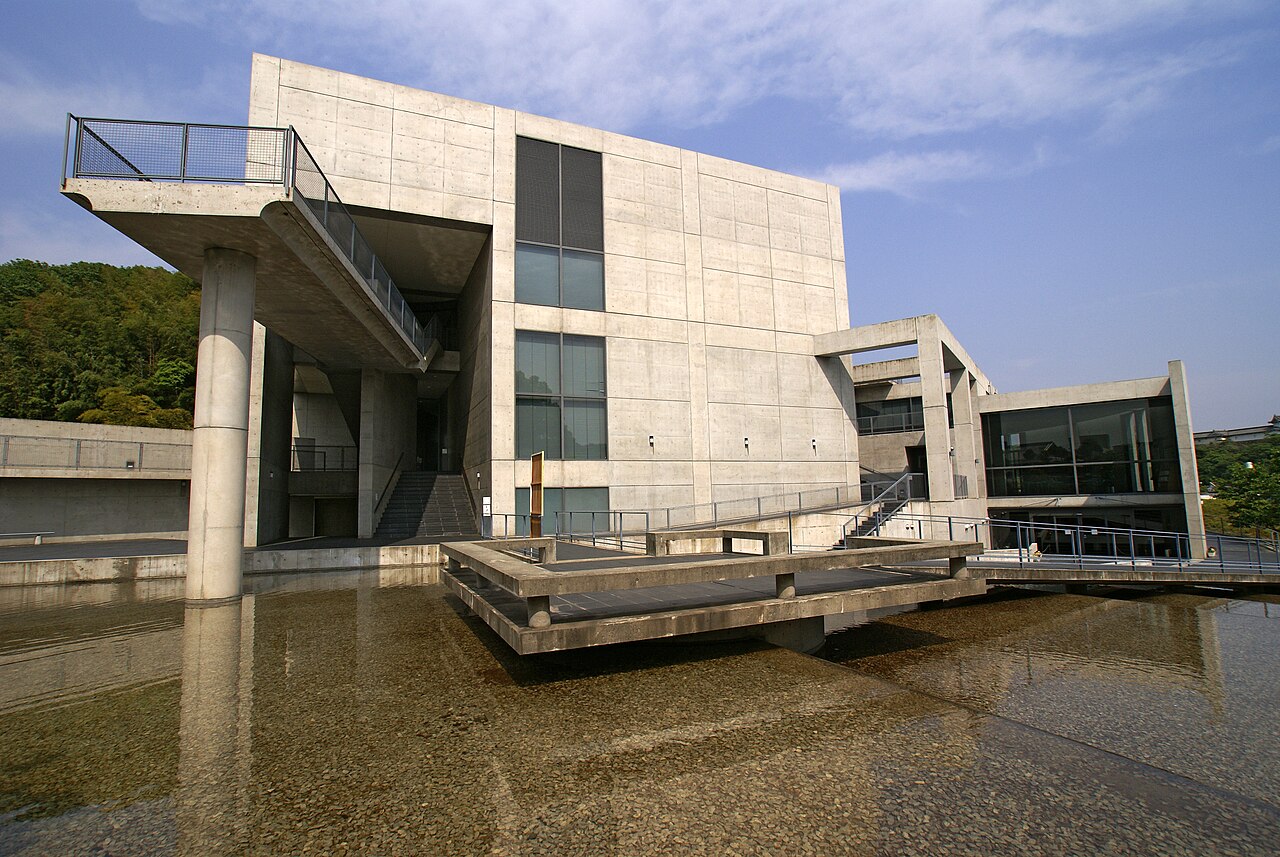
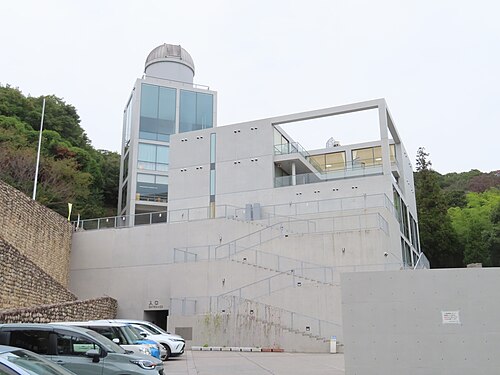
At the foot of Otokoyama Hill (男山), about 500 m north-west of Himeji Castle (姫路城), Tadao Ando designed two buildings for this municipal museum devoted to the writers and scholars of the Harima (播磨) region. The north building, opened in 1991, combines cubes and a cylinder; the south building, opened in 1996, is an assembly of square and rectangular faces in front of an artificial pond. The castle is in view through glass slits and from the roof terrace. A Taishō-era villa, partly preserved, completes the ensemble.
Affiliate links — booking through Verrière helps fund our research, at no extra cost to you.
History
The project began in August 1983 as the “Himeji Municipal Literature Archive” (姫路市立文学資料館). A construction committee and a committee for collecting and studying documents were set up in early 1984. In February 1988, to mark the hundredth anniversary of the birth of the philosopher Watsuji Tetsurō (和辻哲郎), a native of the city, the cultural prize that bears his name (和辻哲郎文化賞) was created.
The museum opened in April 1991 as part of the celebrations of the city's centenary (市制百周年). Its mission is to honour the writers and scholars connected with Harima (播磨), the region centred on Himeji, to collect and study their documents, and to serve as a base for every kind of literary activity. The south building opened in May 1996, together with the room devoted to Shiba Ryōtarō (司馬遼太郎). The museum is run by the city.
The Bōkeitei villa began as a secondary residence, built in the Taishō era for a Himeji businessman by the name of Hamamoto (濱本). It became municipal property in 1958 and served as a place of recreation and a wedding hall. When the museum was built, it was decided to keep one third of the property; that part was renamed Bōkeitei (望景亭) by Sen Sōshitsu (千宗室), fifteenth grand master of the Urasenke tea school (裏千家), and was entered in 2009 on the register of tangible cultural properties (登録有形文化財).
The museum reopened on 30 July 2016 after about a year of renovation of all the buildings and the installation of digital equipment; the castle gallery and the room of words, in the permanent exhibition of the north building, were created on that occasion.
Architecture
The site lies at the foot of Otokoyama Hill (男山), about 500 m north-west of Himeji Castle. The hill, which carries the Senhime Tenmangū shrine (千姫天満宮), forms a geographical pair with Himeyama (姫山), on which the castle stands, and the architecture draws on that relationship: harmony between the buildings, the history and the natural setting; correspondence between museum and castle; contrasting geometries for the two buildings; and an alignment of the two with the pond and the Bōkeitei villa.
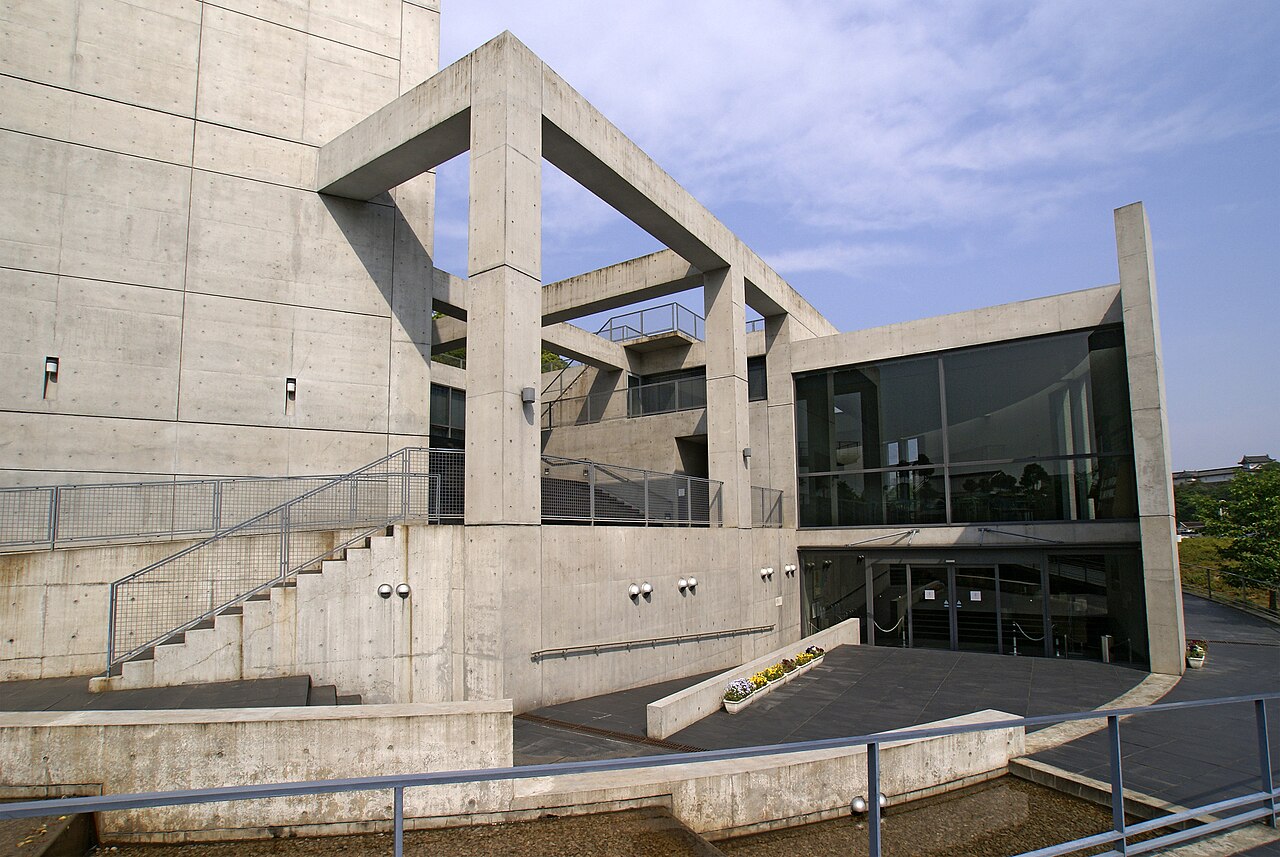
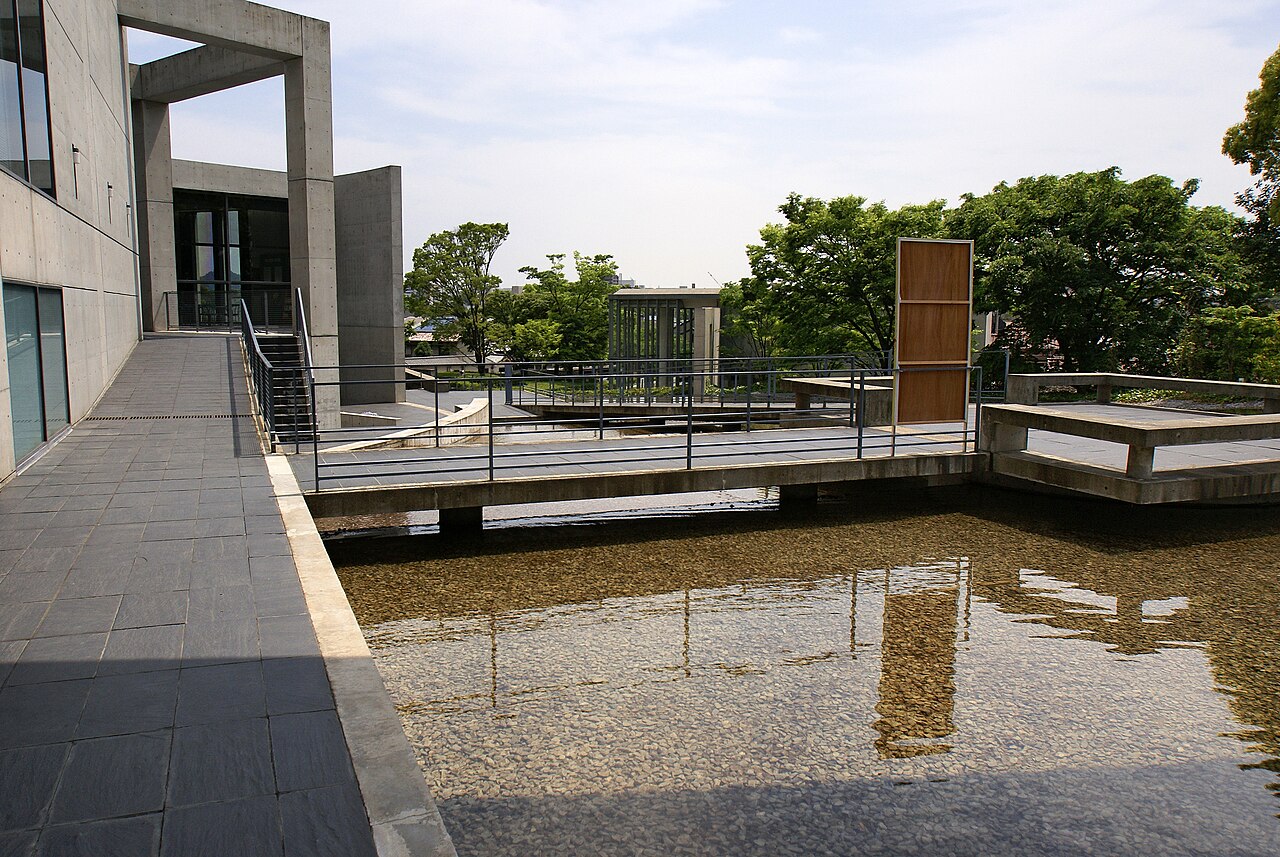
The north building, in steel-reinforced concrete, has three floors above ground and one below, for 3,815 m² of floor area. It is placed so that the castle can be seen from inside and from outside. Its plan is an open cylinder of 20 m radius enclosing one of two squares, each 22.5 m on a side and divided into nine parts, laid over each other at an angle of 30°. Inside, the space rises through three levels, the exhibition rooms follow one another in an ascending spiral, the structure of posts and beams stays open and stairs leave in several directions. Glass slits look out on the castle, a roof terrace gives a view of its towers and the town, and an observation deck stands out over the artificial pond.
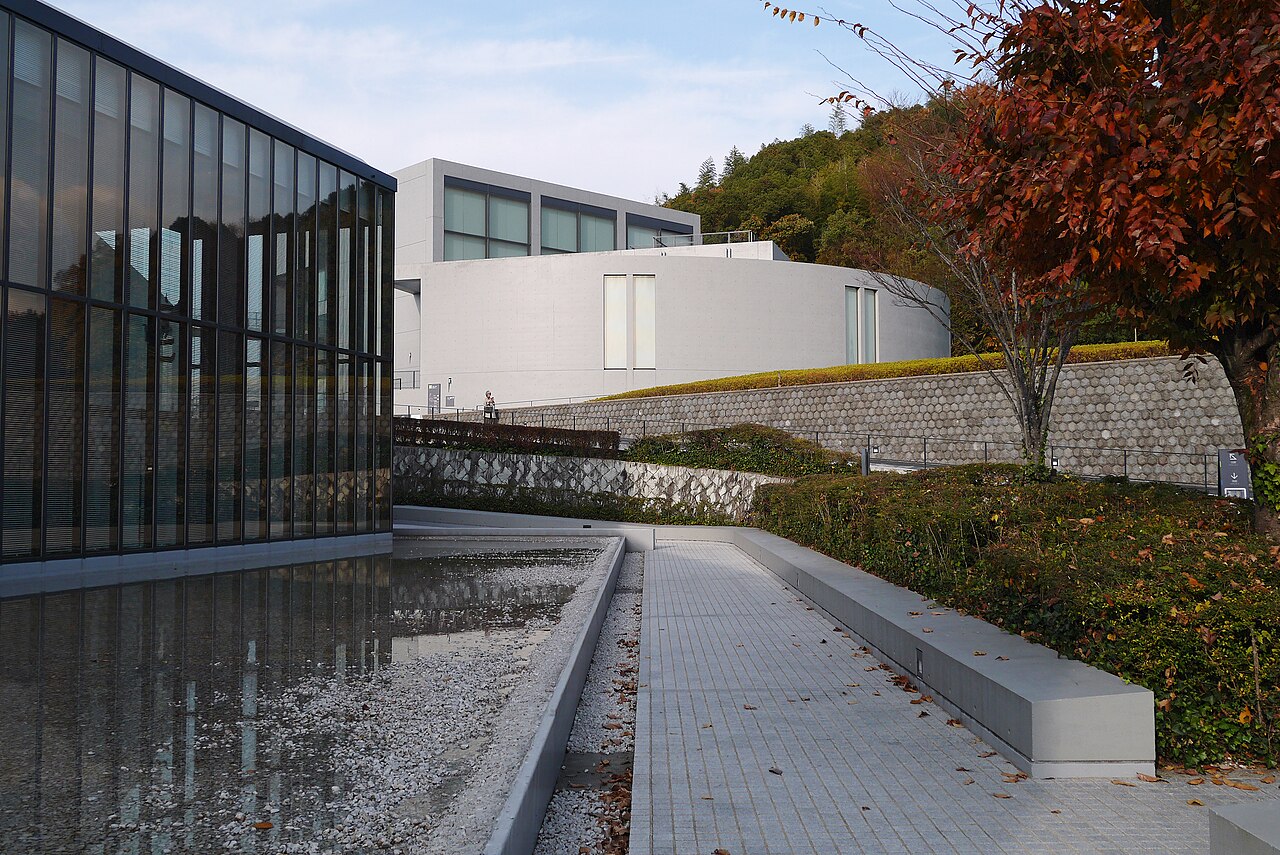
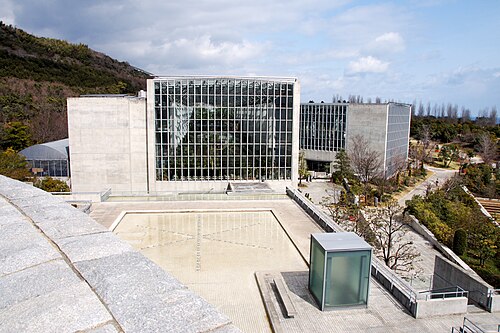
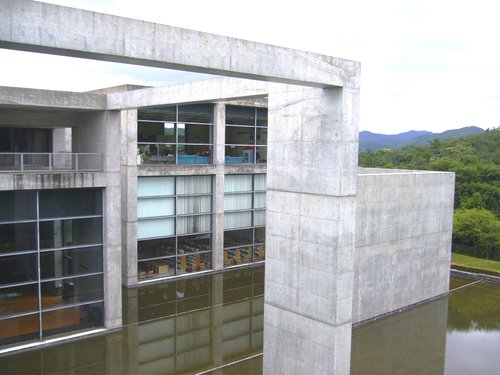
The south building, in reinforced concrete, has two floors above ground and one below, for 2,533 m². It stands in front of the pond, built of square and rectangular faces in an angular, minimalist design that contrasts with the north building. A corridor-like inner stairwell, skylights at every turn and glass walls that let in light and landscape set the rhythm of the visit.
On the courtyard side, a stone wall with a turtle-shell pattern follows a design from the former Hamamoto residence; a ramp lined with the sound of running water lets the main building appear gradually; water from the pond descends a flight of steps like a cascade; a waterside resting area looks onto the pond and the garden.
The Bōkeitei villa is a single-storey timber building with a tiled roof, of 444 m². It holds a room of 40 tatami mats and a tea room.
Use today
The museum is devoted to writers and scholars connected with Harima. On the ground floor of the north building, the gallery of historical tales of Himeji Castle (姫路城歴史ものがたり回廊) follows the history of the castle and of Himeyama Hill from Antiquity to the present in staged videos, documents and graphics, along a curved corridor holding 26 episodes. Next to it, the “Kotoba no mori” room (ことばの森展示室, “forest of words”) takes the words left by writers and scholars of the region as a way in and introduces the people who wrote them, using touch panels. The Watsuji Tetsurō corner (1889-1960, philosopher and ethicist from Himeji) presents his life, his work and the prize that bears his name. On the upper level are a temporary-exhibition room and a special-exhibition room; temporary exhibitions and lectures complete the route.
The south building, free to enter, houses the Shiba Ryōtarō room (1923-1996, novelist born in Osaka). His family came from Hirohata, now part of Himeji, up to his grandfather's generation. With manuscripts, illustrations, historical documents and graphics, the room shows what connects him to Harima, notably through “Harimanada monogatari” (『播磨灘物語』), and has a corner on the people of Banshū. The building also holds a café, a children's room (よいこのへや), a triangular gallery, a library, an information library and a reading room for researchers.
The collections of writers and scholars of the region, received whole and each catalogued under the person's name (文庫), are kept in closed stacks; readers who wish to see them contact the museum beforehand. The Bōkeitei villa can be hired for cultural events.
Visiting
The museum is open from 10:00 to 17:00, with last entry at 16:30; the south building (café, children's room and so on) opens at 9:00. It is closed every Monday (open if the Monday is a public holiday), the day after a public holiday (open if that day is a Saturday or a Sunday), and from 25 December to 5 January. The permanent exhibition in the north building is ticketed and free for under-18s (including those between their 18th birthday and the following 31 March); special exhibitions are also free for under-18s. The south building is free to enter. Groups of five or more can ask for a free guided tour of the permanent exhibition by volunteers.
Address: 84 Yamanoi-chō (山野井町), Himeji. From Himeji Station, buses leave from stands 9, 10, 17 and 18 of the Shinki bus terminal; allow about 6 minutes to the stop “市之橋文学館前” (in front of the museum), then a 4-minute walk north. Free parking for 50 cars is available. Ramps and lifts serve the buildings.
Photos
34.84° N, 134.69° E
Greenhouses nearby
Architecture nearby
Sources (17)
- himejibungakukan.jp/gaiyou/
- himejibungakukan.jp/riyou/
- himejibungakukan.jp/gaiyou/sisetu/
- himejibungakukan.jp/event_calendar/josetu_info/
- himejibungakukan.jp/event_calendar/shiba/
- himejibungakukan.jp/riyou/access/
- himejibungakukan.jp/riyou/barrier_free/
- himejibungakukan.jp/gaiyou/omonasiryo/
- himejibungakukan.jp/gaiyou/sisetu/boukeitei/
- himejibungakukan.jp/en/construction.html
- himejibungakukan.jp/en/img/attention_seat_en.pdf
- himeji.keizai.biz/headline/1511/
- online.bunka.go.jp/db/heritages/detail/198759
- ja.wikipedia.org/wiki/姫路文学館
- wikidata.org/wiki/Special:EntityData/Q11447552.json
- openstreetmap.org/way/493399839
- openstreetmap.org/way/493399778
Affiliate links — booking through Verrière helps fund our research, at no extra cost to you.