Floral Place Greenhouse, Denpark (安城産業文化公園デンパーク フローラルプレイス)
Anjō, Aichi Prefecture
Entry updated on October 5, 2026
- Year
- 1997
- Architect
- Unknown
- Style
- Steel-framed glazed atrium housing a recreated Danish-style street
- Dimensions
- 3,600 m² atrium; 3,875 m² floor area
- Status
- Open to the public
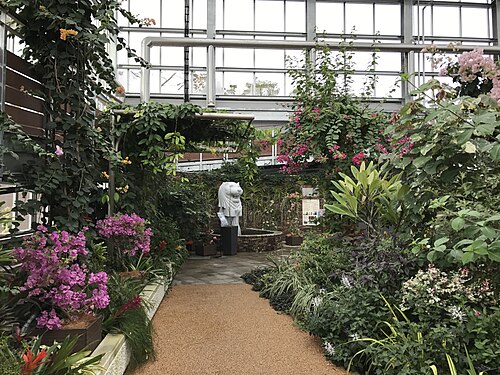
The centrepiece of Denpark, opened in 1997 in Anjō, a city once nicknamed 'the Denmark of Japan' for its diversified farming, Floral Place is a steel-framed building with 3,875 m² of floor space whose glazed atrium covers 3,600 m². Under the glass, a recreated Danish street, the Lykke tower and a statue of the Little Mermaid frame container-grown beds that change with each of the park's major seasonal flower shows. Closed in 2019 for seismic strengthening and new air conditioning, the greenhouse reopened on 6 April 2020.
Affiliate links — booking through Verrière helps fund our research, at no extra cost to you.
History
1 min
Even before the war Anjō was known as 'the Denmark of Japan': by developing diversified farming that combined rice, field crops, orchards and livestock, the city had become a model for farms across the country and was likened to Denmark, then a byword for advanced agriculture. The park that keeps this memory alive grew out of a 1989 request from the city council for an agricultural park. A master plan followed in 1992; in 1996 the foundation charged with promoting urban agriculture in Anjō was set up, and the project cost some 14 billion yen, about 6.5 billion of it for land. The name, chosen through a public competition, plays on the syllable 'Den': that of Denmark, but also of the Japanese words for countryside and tradition.
The park opened on 29 April 1997, Greenery Day, and the city's register of public buildings dates the large greenhouse, Floral Place, to the same year. The millionth visitor arrived as early as 23 November 1997 and the first year drew more than 1.2 million people, before attendance settled permanently below half that level. The park joined the Japan Association of Botanical Gardens in 1998, and the foundation became its designated manager in 2006.
The medium-term plan adopted in 2019 scheduled a closure of about ten months, from mid-May 2019 to mid-March 2020, for seismic strengthening, renewal of the air-conditioning and interior refurbishment. Floral Place reopened on 6 April 2020, but the whole park had to close again from 11 April to 19 May during the state of emergency. In June a café, the first restaurant run directly by the foundation, opened under the glass.
Architecture and engineering
1 min
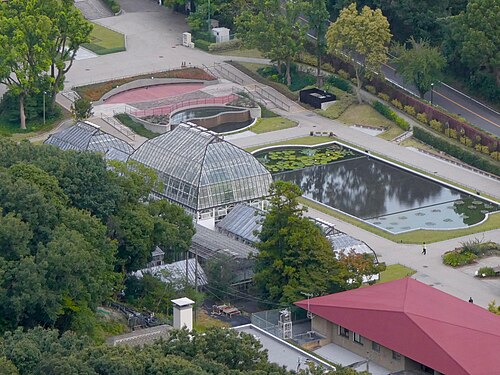
Anjō's register of public buildings describes Floral Place as a two-storey steel-framed structure with a floor area of 3,875.44 m², machine room included; the glazed atrium inside covers 3,600 m². On the official park map the greenhouse appears as a long glass volume ending in a rounded apse, at the eastern end of the site beside a multipurpose hall and the market building. None of the sources consulted names its architect or builder.
Under the glass roof, a recreated Danish street lines up houses with brightly coloured façades that hold a shop of Nordic goods, a craft workshop and cafés. At the centre rises the Lykke tower, the 'tower of happiness'; since 2020 a fountain on its ground floor has invited visitors to toss in Danish krone coins stamped with a heart. A statue of the Little Mermaid watches over a pool between the event square and Lykke square. At the far end of the greenhouse, the Garden Room, a small exhibition space, can also be viewed from an upper gallery.
The 2019–2020 works addressed earthquake resistance and thermal comfort. In 2020 the foundation went on to record summer temperatures inside and outside the greenhouse, together with energy costs, in order to redefine how the air-conditioning is run.
Plant collections
1 min
Floral Place does not rely on a permanent collection. According to the park map, all its plants are grown in containers, so the beds can be remade often and kept in top condition; Japanese Wikipedia, citing the Chūnichi Shimbun, counts five changes a year. These set the rhythm of the major flower shows: in 2020, a reopening show in spring, a tropical show from June to September, then Halloween, Christmas and, at the end of winter, a 'sweet' show. In 2026 the Halloween display took a pumpkin kingdom as its theme.
The Garden Room runs themed exhibitions alongside. Shows of schizanthus, herbs, hostas, aquatic plants, coleus and camellias were scheduled for 2020, the first two being cancelled during the pandemic, and an exhibition of ornamental foliage plants was held there in 2026. The park also points out rare plants in front of the Little Mermaid pool, such as indigo (藍草) and a double-flowered form of インドシクンシ. The park as a whole holds about 3,300 species and 300,000 plants, many of them propagated in a production greenhouse closed to the public.
Visiting
1 min
Floral Place stands at the eastern end of the park, near the market building. Covered and air-conditioned, it offers a sheltered stop in any weather, and the foundation counts on it to draw families in summer. The rest of the 13.1 hectares can be explored on a circuit of about 1.5 km or on a signposted 2.5 km walking route, while the small electric Märchen train loops round the site in about thirteen minutes. The Halloween show, from October to mid-November, and the Christmas show, running into January, transform the greenhouse in autumn and winter; guided flower tours are held there on some weekends, as on 17 and 18 October 2026. City buses link the park with JR Anjō Station.
34.93° N, 137.06° E
Greenhouses nearby
More greenhouses — Japan
Do you have a good photo of this greenhouse? Suggest it for this page →
Sources (8)
- denpark.jp/post-detail.php?id=14
- denpark.jp/image_gardenmap/map2022.pdf
- city.anjo.aichi.jp/shisei/gyoseishiryo/documents/hozenkeikaku.pdf
- denpark.jp/zaimu_r02.pdf
- dp43076263.lolipop.jp/%E7%AC%AC%EF%BC%95%E6%AC%A1%E4%B8%AD%E6%9C%9F%E8%A8%88%E7%94%BB%EF%B
- denpark.jp/6-tyuukikeikaku.pdf
- denpark.jp/flower.php
- ja.wikipedia.org/wiki/%E5%AE%89%E5%9F%8E%E7%94%A3%E6%A5%AD%E6%96%87%E5%8C%96%E5%85%AC%E5%9