Botanischer Garten Gießen Glasshouses (Palmenhaus, Ernst-Küster-Haus, Victoria-Haus)
Gießen, Hesse

Sources checked October 2026
- Year
- 2017–2022
- Architect
- HAAS Architekten (Berlin)
- Style
- Contemporary university glasshouses in precast concrete and glass; the Palmenhaus echoes the 1907 palm house
- Dimensions
- 749 m² usable, 992 m² gross (three buildings)
- Status
- Ernst-Küster-Haus and Victoria-Haus open 20 March to 20 October; garden closed in winter
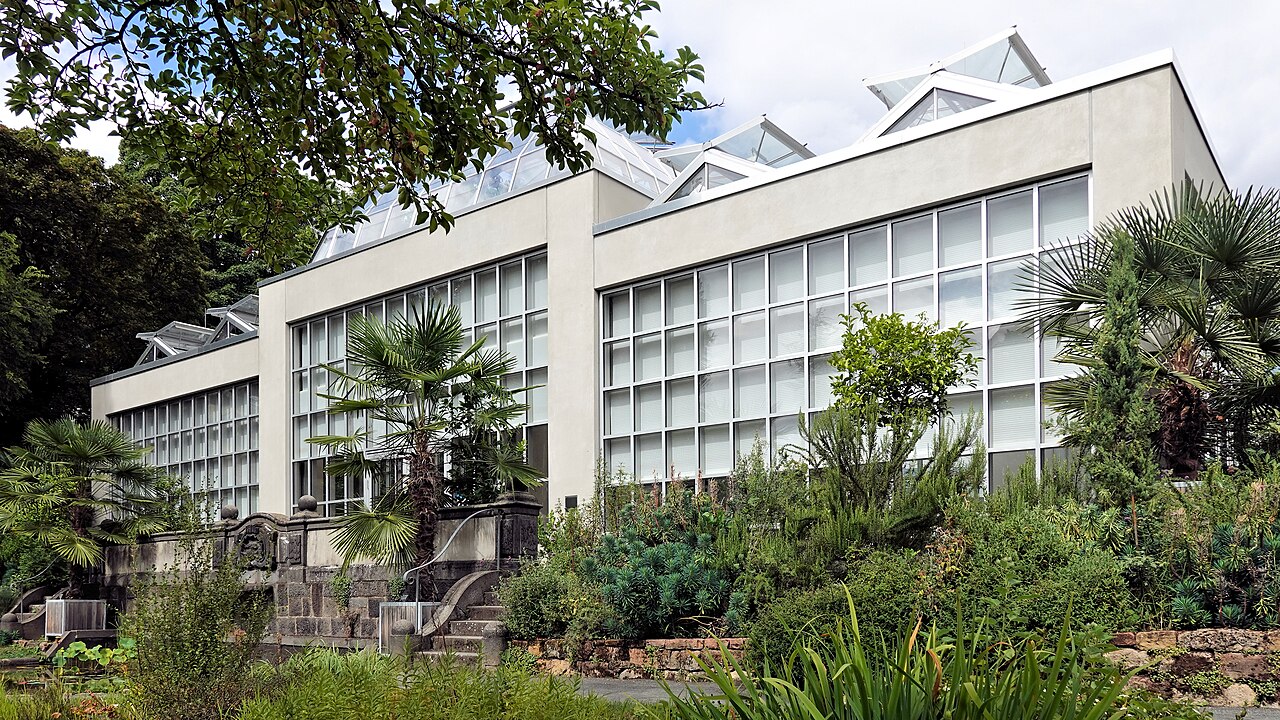
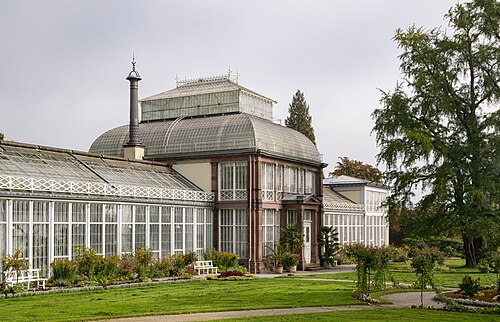
In the botanical garden of Justus Liebig University, which dates from 1609 and calls itself Germany's oldest university botanical garden, a group of three glasshouses designed by HAAS Architekten of Berlin replaced ageing installations between 2017 and 2020. The Palmenhaus, with its three parts and central dome, echoes the palm house of 1907 that fell to bombing and overwinters the garden's tubbed plants. The Ernst-Küster-Haus, a warm house of cacti, succulents and palms, and the circular Victoria-Haus, built around a pool for Victoria amazonica, have welcomed visitors since April 2022.
Affiliate links — booking through Verrière helps fund our research, at no extra cost to you.
History
Gießen's botanical garden dates from 1609, when Landgrave Louis of Hesse-Darmstadt gave the university, founded two years earlier, a small pleasure garden beside the castle tower to set up a hortus medicus. According to Wikipedia, a building for overwintering plants went up in 1699 and a first Glashaus in 1720, demolished in 1859. Under Adolph Hansen the garden gained several cold houses and a sizeable overwintering house, inaugurated in 1904. The garden and the magazine Baumeister also refer to a palm house of 1907, which Baumeister describes as Wilhelmine in style, with three naves divided by basalt columns and a central dome.
The Allied air raid of 6 December 1944 wrecked these installations. The botanist Ernst Küster reports that 200 to 300 incendiary bombs fell on the garden and that the panes of every glasshouse came crashing down; according to Baumeister, the palm house fell victim to the bombing. Postwar rebuilding, carried on until 1982 under Dietrich von Denffer and then Rüdiger Knapp, produced new glasshouses, though Hesse's state secretary for finance described it in 2019 as only piecemeal.
The current project began in August 2017 with the demolition of what stood there. A press release of 22 November 2019 reports the topping-out ceremony (Richtfest), with a budget then put at about 8 million euros, of which 4.8 million came from the Higher Education Pact 2020 and 3.2 million from the university. The university records a handover in December 2020, while the garden's own pages date the three houses to 2020 or 2021. The Ernst-Küster-Haus and Victoria-Haus opened to visitors on 11 April 2022, the Palmenhaus staying shut at first; the official inauguration took place on 16 September 2022. A wall and an outdoor pool from the old palm house were kept. The university's project sheet gives a total cost of 7,932,000 euros.
Architecture and engineering
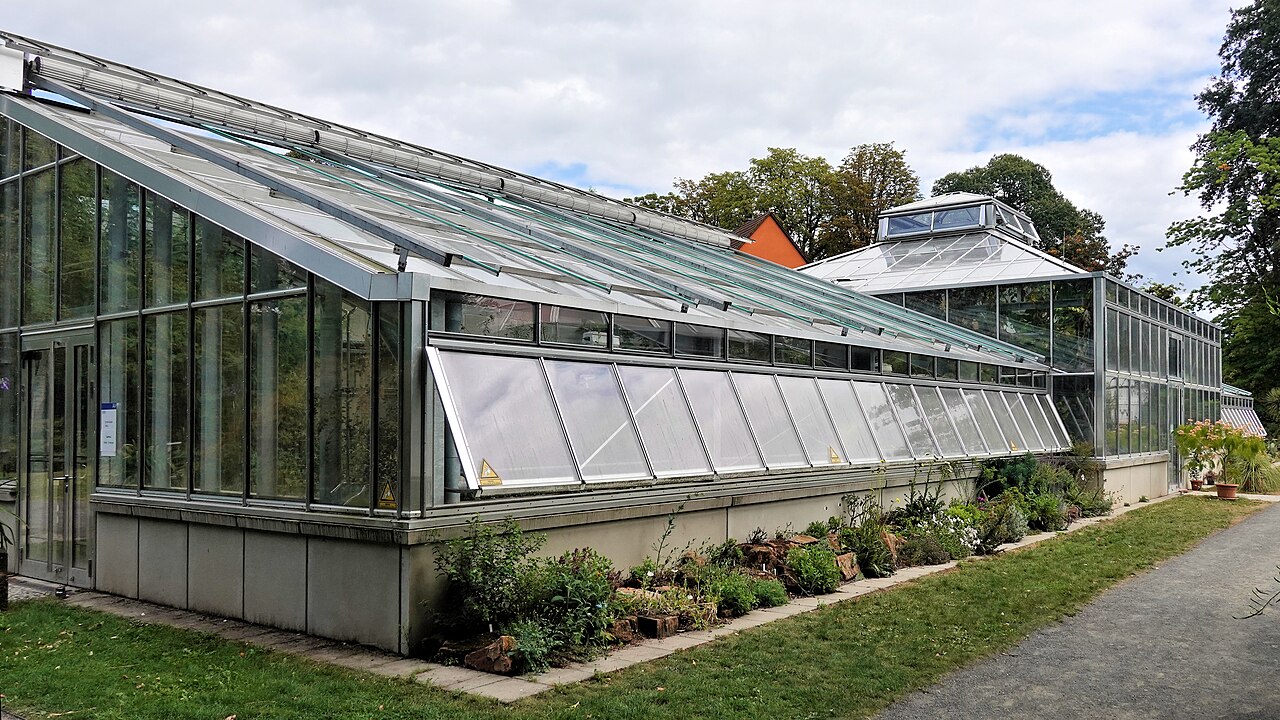
The scheme brings together three buildings: the Palmenhaus, the Victoria-Haus and a warm house, the Ernst-Küster-Haus, with staff facilities for the gardeners. The university's project sheet counts 749 m² of usable floor area for 992 m² gross; the 2022 press release speaks of 833 m² of total usable area.
The Palmenhaus takes up the features of the historic building: massive piers, a plan in three parts and a dome over the central body. According to Baumeister, the frame combines large precast concrete elements with glazed façades stretched between them; the side naves have glazed roofs, the central dome is glass, and the glazing is low-iron white glass chosen to let in as much light as possible. The manufacturer Wicona names its Variolux Thermo36 hi roof system and Wictec 50 HI façade system for this building, and the Variolux system for the envelope of the other houses. Cooling is adiabatic, by evaporation, and heat and light are computer-controlled. In summer the Palmenhaus can host concerts and events.
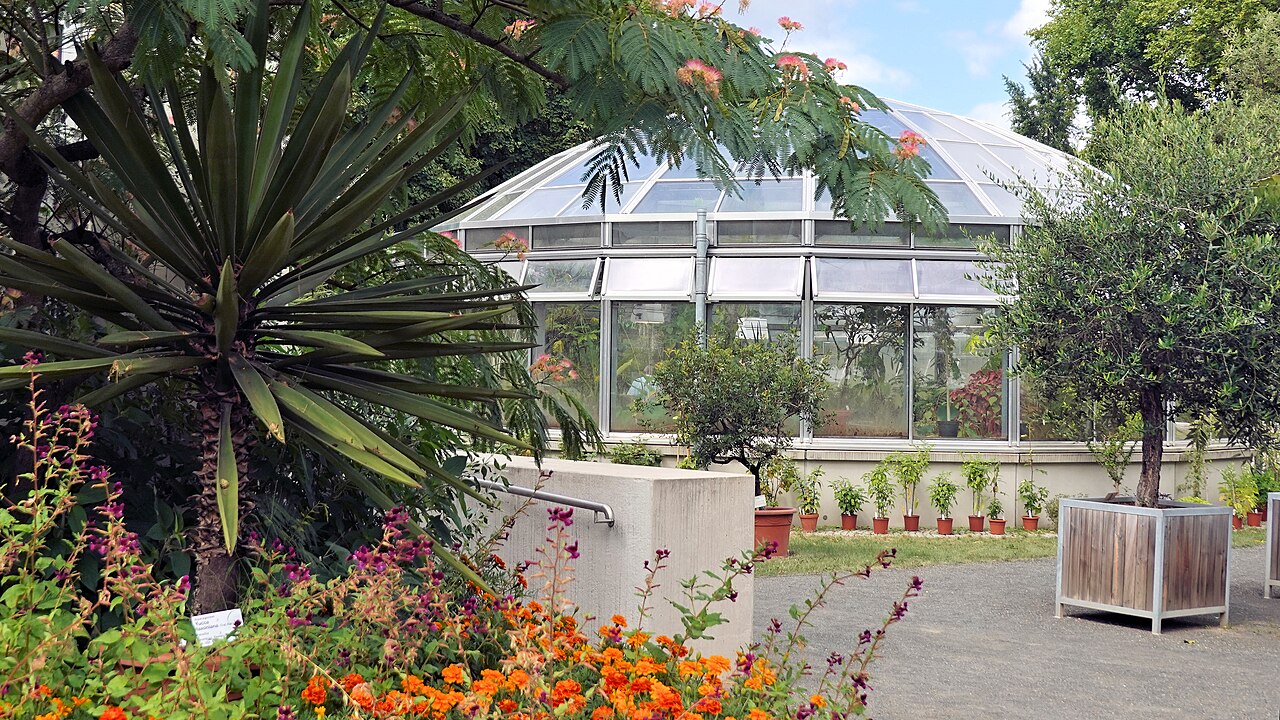
The Ernst-Küster-Haus, a warm house, stays at about 18 °C inside when it freezes down to -15 °C outside; it has no floor slab and its paths are laid out naturally. Its basic structure goes back to buildings of 1858 and 1936, and it contains three compartments kept at different temperatures. The Victoria-Haus is circular, dominated by a large central pool.
Plant collections
The Palmenhaus is above all a winter shelter: from October to May it holds the garden's large collection of tubbed plants that cannot take the cold. For the rest of the year it is used for exhibitions and for the 'Grüne Schule', the garden's green school, which offers activities for children and young people.
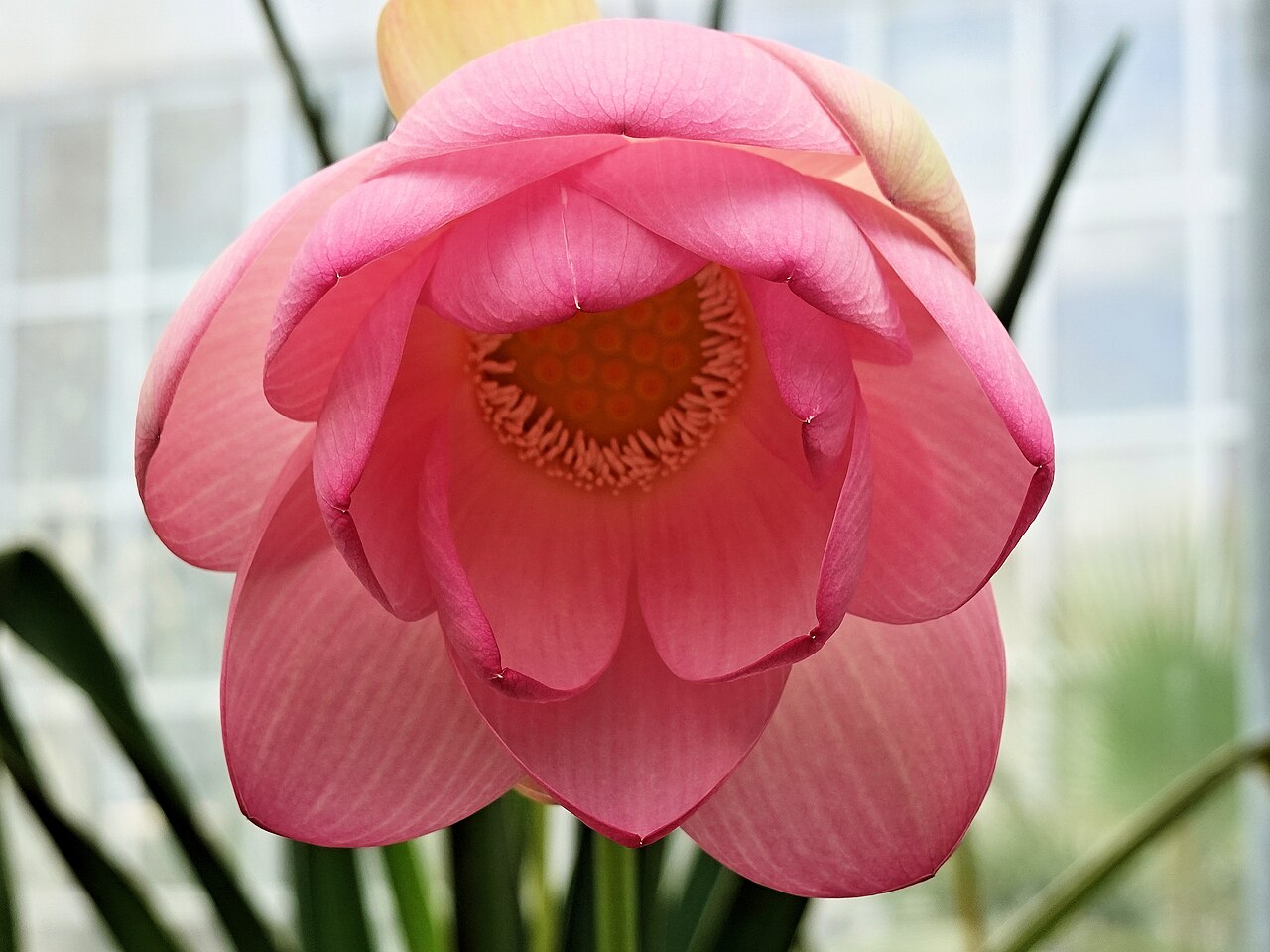
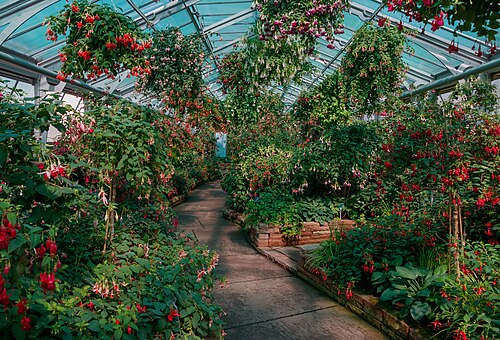
The Ernst-Küster-Haus shows plants of the tropics and subtropics in three differently heated compartments, notably cacti, succulents and palms. The Victoria-Haus holds Victoria amazonica, the giant tropical water lily that gives it its name, in the middle of its pool, together with many other tropical aquatic and useful plants; moving the lily into its own glasshouse freed up teaching space, the university says, and better matched the pool size and climate to the plant's needs.
A fourth glasshouse, the Adolph-Hansen-Haus (1980), holds propagation areas and teaching and research collections, together with a house of useful plants from a wide range of tropical and subtropical species; it can be entered only on guided tours. Across the whole garden the university counts about 7,500 species.
Visiting
The glasshouses stand in the botanical garden, in the middle of the city, on Senckenbergstraße. The official visiting hours for the glasshouses name only the Ernst-Küster-Haus and the Victoria-Haus; the Palmenhaus serves as a winter store for tubbed plants and as an exhibition space in summer. The garden is closed from late October to mid-March.
The group covers under 1,000 m² gross, so a visit naturally extends into the garden: the Darwin evolution trail, the scent and touch garden laid out for blind visitors, the rose garden shaped like a rose hip, and the ginkgo planted in 1816, the garden's oldest tree, opposite the old castle. Guided tours are offered.
50.59° N, 8.68° E
Greenhouses nearby
More greenhouses — Germany
Do you have a good photo of this greenhouse? Suggest it for this page →
Sources (8)
- uni-giessen.de/de/ueber-uns/botanischer-garten/rundgang
- uni-giessen.de/de/ueber-uns/botanischer-garten/offen
- uni-giessen.de/de/ueber-uns/botanischer-garten/geschichte
- uni-giessen.de/de/org/admin/dez/e/4/bauprojekte/neubau_gewaechshausanlage
- uni-giessen.de/de/ueber-uns/pressestelle/pm/pm137-22schmuckstuecke-des-botanischen-garten-
- uni-giessen.de/ueber-uns/pressestelle/pm/pmgewaechshaus
- glasstec.baumeister.de/client_articles/botanischer-garten-giessen-haas/
- wicona.com/de-de/professionell/magazin/alle-referenzen/botanischer-garten-giessen
Affiliate links — booking through Verrière helps fund our research, at no extra cost to you.