Tropical House, National Botanic Garden of Wales
Llanarthne, Carmarthenshire (Wales)
Entry updated on October 5, 2026
- Year
- 2004
- Architect
- John Belle
- Style
- Contemporary tropical glasshouse
- Status
- Open to the public
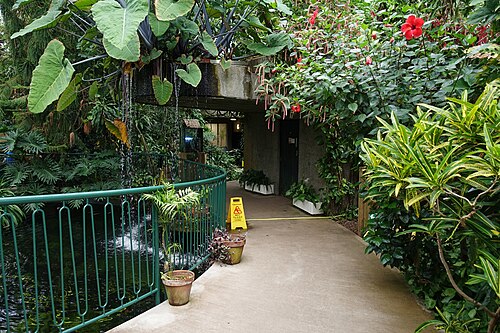
A late addition to the Double Walled Garden of the National Botanic Garden of Wales, this tropical glasshouse was designed by John Belle, an architect born in Pontcanna, Cardiff, who built his career in the United States. The garden dates it to 2004, while another source refers to an opening in 2007. It recreates the atmosphere of a tropical rainforest and shows orchids, passion flowers and ferns, together with plants that yield coffee, chocolate and chewing gum. In 2016 it was adapted to receive tropical butterflies.
Affiliate links — booking through Verrière helps fund our research, at no extra cost to you.
History
1 min
The Tropical House belongs to the Double Walled Garden of the National Botanic Garden of Wales, a walled garden rebuilt from ruins and replanted. The garden describes it as a late addition to this space, designed as a new attraction, and dates its construction to 2004. The Wikipedia article on the garden instead records the opening, in 2007, of a new tropical glasshouse intended to continue the classification displays with tropical monocots; the sources consulted do not reconcile the two dates.
The design was entrusted to John Belle, an architect born in Pontcanna, Cardiff, who spent most of his career in the United States. According to the garden, it was his first major project in Wales.
In June 2016 the garden announced that the glasshouse would become a haven for tropical butterflies, due to arrive the following July. The work focused on the indoor climate and on preventing the insects from escaping, while new nectar plants were brought in. The sources consulted give neither the construction cost nor the later history of the butterfly display beyond 2016.
Architecture and engineering
1 min
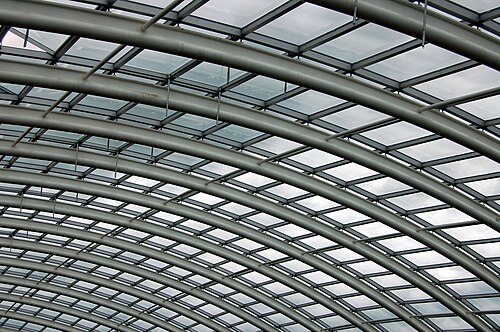
The sources consulted say little about the structure itself: its dimensions, materials and shape are not given. They stress its purpose instead, since the glasshouse was conceived to recreate a tropical rainforest, with the atmosphere and conditions that plants from such habitats need in order to thrive.
Its position in the Double Walled Garden sets it within a space laid out in quarters: one holds a modern take on a kitchen garden, the other three hold beds that show the classification and evolution of the flowering plant families.
The 2016 alterations give an idea of its equipment. The temperature was raised to 26 °C and the humidity increased; nets were fitted to stop butterflies flying up into the roof; plastic curtains were hung at the doors, and mirrors were to be installed so that visitors could check that no insect left the house with them.
Plant collections
1 min
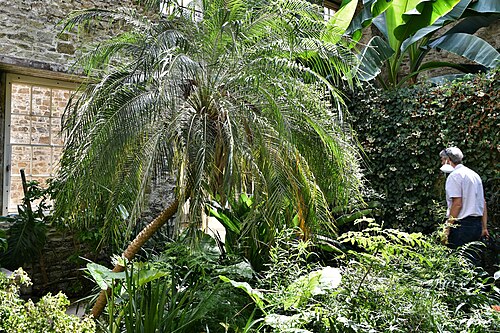
The glasshouse is devoted to plants from tropical rainforests. The garden points to orchids, passion flowers and ferns, wild relatives of familiar houseplants, and useful species that yield coffee, chocolate and chewing gum. According to Wikipedia, it also continues the garden's classification displays with tropical monocots.
In winter, Guzmania conifera, an epiphyte from the rainforests of Peru and Ecuador, is one of the highlights of the house. When tropical butterflies were introduced in 2016, the team added Pentas lanceolata, whose star-shaped flowers provide nectar for the insects.
Visiting
1 min
The glasshouse stands in the Double Walled Garden, some 230 metres west of the Great Glasshouse, the garden's other large glazed building, which is devoted to Mediterranean-climate floras. The two are easily combined, moving within a few minutes' walk from a dry climate to a humid tropical one.
The garden recommends it in winter as a place to warm up and find vivid floral colour, when Guzmania conifera is at its best. The rest of the Double Walled Garden, with its kitchen garden and classification beds, extends the walk.
51.84° N, 4.15° W
Greenhouses nearby
More greenhouses — United Kingdom
Do you have a good photo of this greenhouse? Suggest it for this page →