Glasshouses, Singleton Botanical Gardens
Swansea, Wales
Entry updated on October 5, 2026
- Architect
- Unknown
- Style
- Modern landscaped aluminium glasshouses with four climate zones
- Status
- Open to the public
At the heart of Singleton Park, an estate Swansea bought from the Vivian family in 1919, the city's botanic garden opened in 1926 as the Educational Gardens, with a collection of economic plants and British flora. Its aluminium glasshouses took the place of the original wooden Tropical and Show houses, which had become dangerous. They now bring together a tropical range kept above 12 °C, a temperate house built around a pond of koi and goldfish, an economic house of useful plants and an arid house devoted to cacti and succulents.
Affiliate links — booking through Verrière helps fund our research, at no extra cost to you.
History
1 min
Singleton Park occupies the former estate of the Vivian family, which Swansea's council bought in 1919 for use as a public park. The botanic garden began there as the Educational Gardens, opened on 25 May 1926 with a collection of economic plants and British flora and a clear teaching purpose. During the Second World War part of it was turned over to vegetables under the Dig for Victory campaign.
The first glasshouses, built of timber, included a Tropical house and a Show house. Having become dangerous, they had to be demolished and were replaced by aluminium structures; Wikipedia dates the replacement to 1987, whereas the Friends of the gardens place the construction of the new glasshouses in the early 1990s.
The garden has continued to grow since. In 2006 Tŷ Blodau, the 'Flower House', opened as a visitor and education centre funded by the Friends of the City of Swansea Botanical Complex, and a Wildflower and Wellbeing Garden followed in 2017. On 4 August 2019 descendants of the Vivian family unveiled a bilingual panel marking a hundred years of public ownership of the park. Together with the woodland garden at Clyne and the tropical glasshouse of Plantasia, the garden now forms Swansea's municipal botanical complex, which reports some 6,500 taxa in cultivation.
Architecture and engineering
1 min
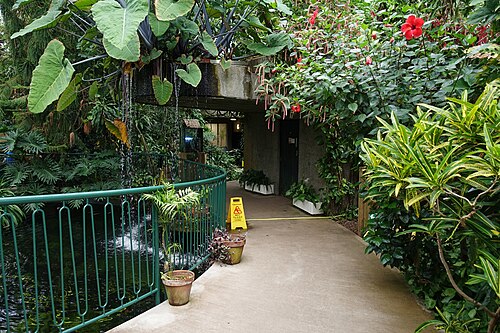
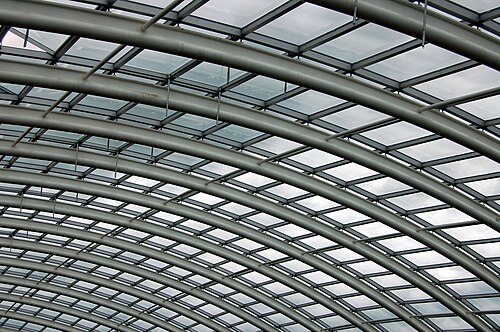
The present glasshouses stand on the site of the old timber Tropical and Show houses and are built of aluminium. Rather than a single great hall, the garden has several houses with distinct climates: the tropical range, where the temperature never falls below 12 °C; the temperate house, for plants from Mediterranean-type climates; the economic house, devoted to useful plants; and the arid house, which gathers cacti and succulents from several of the world's deserts.
The Friends describe them as landscaped glasshouses, where visitors meet plants from the world's jungles and rainforests, and then those of the deserts in the arid section. The temperate house is built around a pond where koi and goldfish move among aquatic plants.
Plant collections
1 min
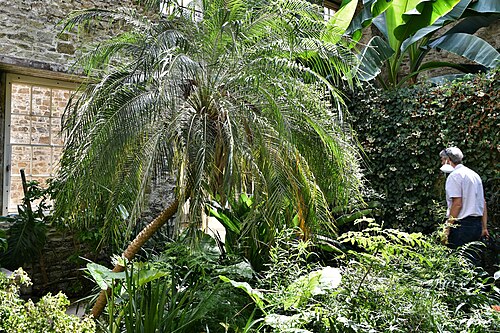
Each house presents a selection of plants highlighted by the Friends of the gardens. The arid house includes Aloe vera, Crassula ovata, Echinocactus grusonii, Mammillaria bombycina and Stapelia grandiflora. The temperate house holds Abelia floribunda, Brugmansia sanguinea var. flava, Clivia miniata, Hymenosporum flavum, Sparmannia africana and Ugni molinae. The economic house shows useful plants such as Cyperus papyrus, Musa acuminata 'Cavendishii Group', Psidium cattleyanum, Ceratonia siliqua and Coffea arabica. Finally, the tropical range shelters Asplenium nidus, Beaumontia grandiflora, Cattleya maxima, Nepenthes species, Neoregelia carolinae 'Tricolor' and Thunbergia mysorensis.
Across the botanical complex as a whole, the special collections cover rhododendrons, orchids, species pelargoniums, hybrid fuchsias and foliage begonias.
Visiting
1 min
The botanic garden covers about five acres of formal gardens within Singleton Park, a 250-acre park in Sketty. The entrance lies about 200 metres inside the park, through the Lodge gateway on Gower Road. Around the glasshouses, the herbaceous borders flower from March to October and peak in August, when tours and events are concentrated, and up to 200 species are in bloom even in winter. The park also has the Swiss Cottage, designed by P. F. Robinson in 1826, and a boating lake, while Plantasia and Clyne Gardens complete a tour of the botanical complex.
51.61° N, 3.98° W
Greenhouses nearby
More greenhouses — United Kingdom
Do you have a good photo of this greenhouse? Suggest it for this page →