Plantasia (Plantasia Tropical Zoo)
Swansea, Wales
Entry updated on October 3, 2026
- Year
- 1990
- Architect
- Percy Thomas Partnership (engineers: Ove Arup & Partners)
- Style
- Truncated pyramid in tubular steel and glass
- Dimensions
- ≈1,600 m²
- Status
- Open to the public (a tropical zoo since 2021)
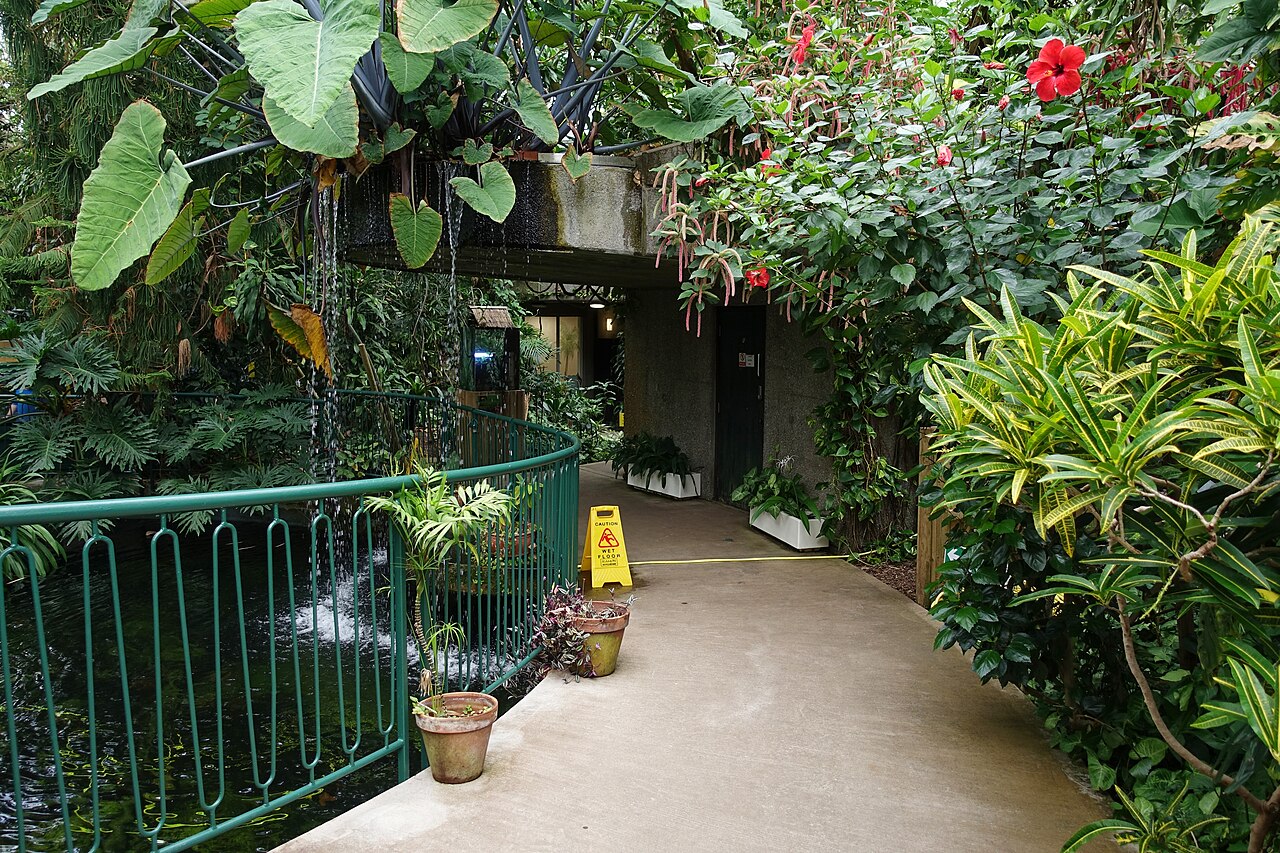
Opened in 1990 in the Parc Tawe retail park, this glasshouse shaped like a truncated pyramid grew out of an idea from Swansea's city council: pairing a public tropical hothouse with a shopping development. Designed by the Percy Thomas Partnership with engineers Ove Arup & Partners, it covers about 1,600 m² under a tubular steel frame ringed by a moat that collects rainwater from the roof. Refurbished in 2018-2019 and renamed Plantasia Tropical Zoo in 2021, it combines a rainforest, an arid zone and more than forty animal species.
Affiliate links — booking through Verrière helps fund our research, at no extra cost to you.
History
1 min
Plantasia began as an idea of Swansea's city council, which wanted to attach a public tropical hothouse to the new Parc Tawe retail park, developed with Citygrove. The concept, described at the time as the first of its kind, led in 1990 to a glass pyramid designed by the Percy Thomas Partnership, with Ove Arup & Partners as structural engineers, Rowecord Engineering for the steelwork and Wimpey Construction as main contractor. It cost £2.5 million, and in the same year the building received a commendation in the Structural Steel Design Awards.
First billed as Swansea's own rainforest, the hothouse was run by the council until the mid-2010s and then handed to the operator Parkwood Leisure. In 2018-2019 the council invested £1.1 million in a refurbishment that reorganised the route around the layers of the rainforest and added a café, a shop, a waterfall lookout, a rainforest hut and a living bridge. The site took the name Plantasia Tropical Zoo in 2021.
The glasshouse has also served as a location for two episodes of Doctor Who, in 2007 and 2009. It welcomed 115,000 visitors in 2023 and keeps changing: a section devoted to venoms and poisons opened in 2026.
Architecture and engineering
1 min
The building takes the form of a truncated pyramid, a shape chosen for its inherent stability. Its tubular steel frame combines rectangular and circular hollow sections, built-up columns and lattice girders, with tripods set along the walls providing stability. The frame carries a glass roof over a floor area of about 1,600 m².
A moat around the pyramid collects the rainwater running off the roof. Inside, the original design stacked three environments: an arid zone for cacti at the lowest level, a humid fern house at the highest, and in the centre a tropical area planted with palms around a pond fed by a cascade.
The 2018-2019 refurbishment kept the envelope but rethought the route inside to evoke the successive layers of the rainforest, adding a lookout over the waterfall and a living bridge. The 1990 building thus remains an example of a contemporary public glasshouse conceived as a piece of steel engineering in its own right.
Plant collections
1 min
Plantasia now brings together two main climates: a humid rainforest and an arid zone. According to Wikipedia it holds more than 600 plant species, around 5,000 plants in all; the regional press puts the figure at more than 700 tropical plants.
Since its conversion into a tropical zoo, animals have taken a large place: more than 60 animals of over 40 species, among them meerkats, crested geckos, tarantulas, red-bellied piranhas, koi carp, green-winged macaws, Burmese pythons, Asian leopard cats, spectacled caimans and Kleinmann's (Egyptian) tortoises. The zoo takes part in the European Endangered Species Programme for this tortoise. The venoms and poisons section opened in 2026 features oriental fire-bellied toads, checkered garter snakes and mangrove snakes.
Visiting
1 min
Plantasia stands in the Parc Tawe retail park in Swansea, which makes it easy to fit into a day in the city. Allow one to two hours for the rainforest, the arid zone and the animal areas. The programme includes regular activities, among them a crocodile feeding session billed as the only one in Wales, and an hour-long escape game set inside the glasshouse. Temporary installations, such as the life-sized replicas of prehistoric animals shown from July 2024, keep the visit changing. On cold or wet days, the humid warmth of the pyramid makes a striking contrast with the weather outside.
51.62° N, 3.94° W
Greenhouses nearby
More greenhouses — United Kingdom
Do you have a good photo of this greenhouse? Suggest it for this page →