Tropenhaus and glasshouses of the St. Gallen Botanical Garden
St. Gallen, Canton of St. Gallen
Entry updated on October 5, 2026
- Year
- 1998
- Style
- Contemporary glasshouses; 1914 orangery with a glued-laminated (Hetzer) timber frame
- Status
- Open to the public
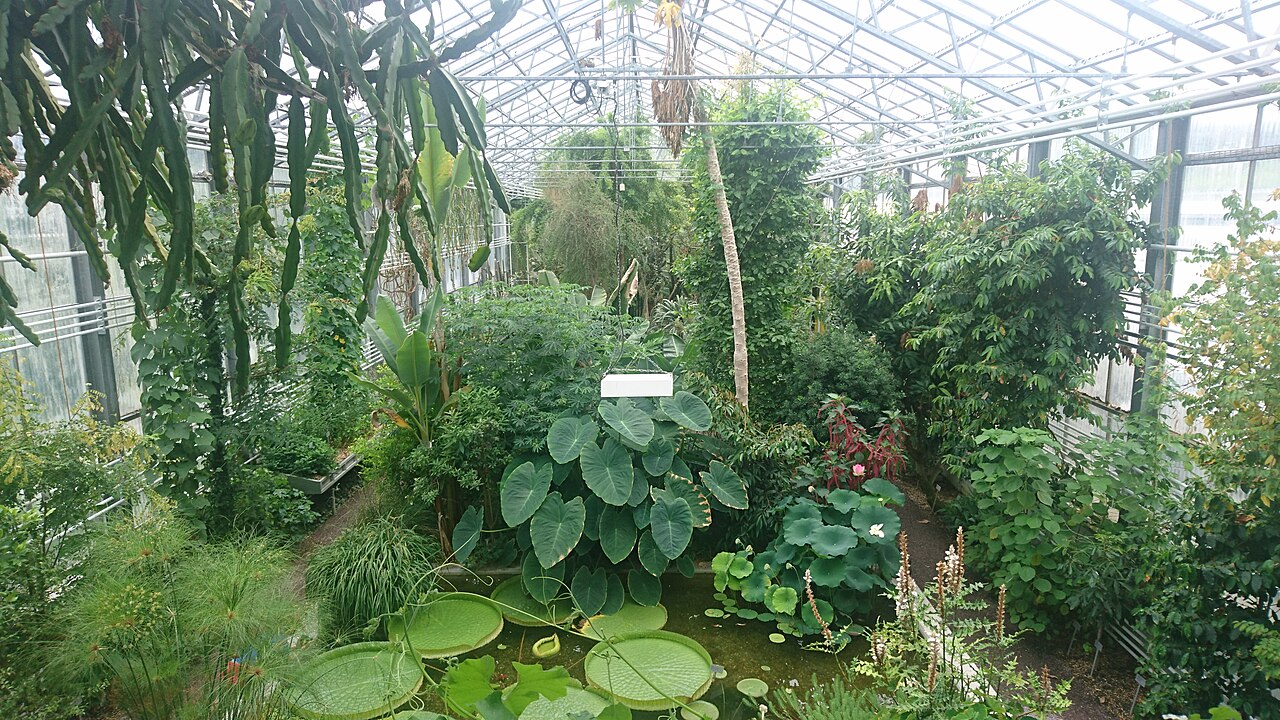
Owned by the City of St. Gallen and laid out from 1945 in the Neudorf district, the botanical garden shows some 8,000 labelled species, outdoors and under glass. Its Tropenhaus, built in 1998 around two pools and a viewing stand, brings together tropical rainforest, succulents and useful plants such as coffee, cinnamon and vanilla, with Victoria water lilies on show in summer. Nearby stand an alpine house (1993), an orchid house (2007), houses for carnivorous plants and lithops, and a 1914 orangery framed in glued-laminated timber.
Affiliate links — booking through Verrière helps fund our research, at no extra cost to you.
History
1 min
St. Gallen has had three botanical gardens in succession. The first was created in 1878 in the Stadtpark by Professor Bernhard Wartmann, the museum's first director, and covered about 6,000 m². In 1918 its site was needed to build the Historical Museum, and the garden moved to a plot near today's teacher-training college, which in turn had to make way for building projects in 1934.
The present garden began at Stephanshorn, in the Neudorf district, where ground was broken on 16 June 1945. Laying it out took around ten years, with help from school pupils; much of the work is credited to Kurt Aulich, a biology teacher at the cantonal school, and to the landscape architect Paul Zülli, head of the city's gardens department. A friends' association followed in 1946. The orangery is older than the garden itself: it was put up in 1914, together with the adjoining buildings, for the municipal nursery.
From 1990 a long programme of renewal transformed the European and American sections, the meadows, the pergolas and the fern garden; it was completed in 2011. The glasshouses were renewed over the same period: the alpine house was finished in 1993, a new Tropenhaus was built in 1998, and an orchid house was added to it in 2007. The city's natural history museum moved next door to the garden and reopened there on 12 November 2016. The garden belongs to the City of St. Gallen and is a member of the Hortus Botanicus Helveticus network.
Architecture and engineering
1 min
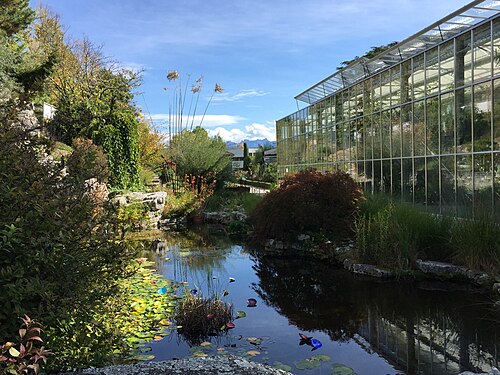
The city counts six buildings among the garden's glasshouses: the Tropenhaus, the orchid house, the alpine house, a house for carnivorous plants, a lithops house and the orangery. The largest, the 1998 Tropenhaus, is arranged around two pools and a viewing stand. Several habitats follow one another inside, from the tropical rainforest, an environment that needs 24 to 30 °C and high humidity all year round, to a section of subtropical succulents. The orchid house has extended it since 2007.
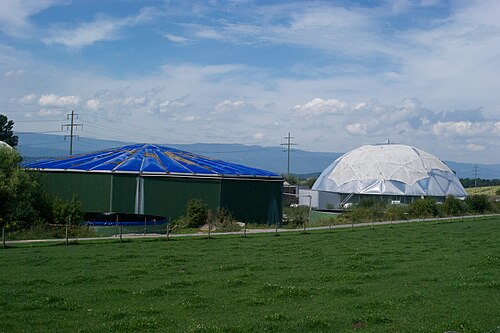
The alpine house, completed in 1993, stands out for its unusual architecture. It is unheated, sheltering plants that winter cold, heavy rainfall or unsuitable soils would prevent from growing in the open.
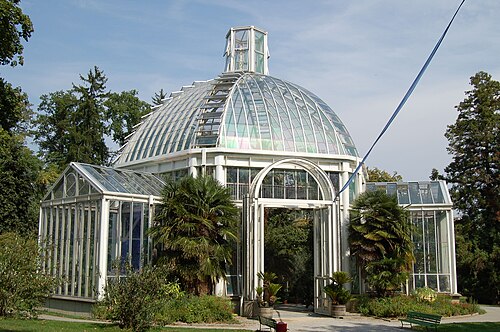
The 1914 orangery is the oldest building. Its spacious interior reveals a load-bearing frame of glued-laminated timber beams built on the Hetzer system, crowned by a lantern that lets in more daylight. From mid-October to late May it serves as winter quarters, at around 5 °C, for the garden's container plants. The sources consulted name neither the architect nor the dimensions of the glasshouses.
Plant collections
1 min
Just inside the Tropenhaus, the Victoria pool displays the giant water lilies and lotus flowers in summer, the lotus carrying associations of rebirth and purity in East Asia; in winter, papyrus, rice and thalia take their place. The useful-plants section presents species that people consume every day, often without knowing what they look like: coffee, pepper, paprika, ginger, cinnamon, vanilla, sugar cane, citrus, banana, pineapple, peanut, cotton and jute. The rainforest section shows epiphytes, lianas, aerial roots and oversized leaves, while the succulents illustrate adaptation to scarce rain and wide swings in temperature.
The other houses are devoted to orchids, carnivorous plants and lithops, the so-called living stones. The alpine house holds mountain plants together with many species from the Mediterranean and from comparable climates in the Americas and Asia, shown in rotation. Across the whole garden, some 8,000 species are labelled.
Visiting
1 min
The garden lies at Stephanshornstrasse 4 in the Neudorf district, right beside the natural history museum, so the two visits combine easily. An hour is enough for the glasshouses; allow longer for the twenty or so outdoor sections. Summer is the season of the Victoria lilies and lotus, while the orangery, emptied of its container plants, then hosts exhibitions that are mostly devoted to natural history. Public guided tours of the grounds and glasshouses take place on the first Sunday of every month. Walkers can extend the outing along the Planetenweg, an 8 km trail laid out in 1979 that starts at the model sun near the Tropenhaus and leads to Mörschwil and Obersteinach.
47.44° N, 9.41° E
Greenhouses nearby
More greenhouses — Switzerland
Do you have a good photo of this greenhouse? Suggest it for this page →
Sources (5)
- stadt.sg.ch/home/freizeit-tourismus/gaerten-parks/botanischer-garten/geschichte.html
- stadt.sg.ch/home/freizeit-tourismus/gaerten-parks/botanischer-garten/abteilungen/tropenhau
- stadt.sg.ch/home/freizeit-tourismus/gaerten-parks/botanischer-garten/abteilungen/orangerie
- stadt.sg.ch/home/freizeit-tourismus/gaerten-parks/botanischer-garten/abteilungen/alpinenha
- de.wikipedia.org/wiki/Botanischer_Garten_St._Gallen