Botanical Building, Balboa Park (lath house)
San Diego, California
Entry updated on September 30, 2026
- Year
- 1914-1915
- Architect
- Bertram Goodhue (Exposition architect) and Carleton M. Winslow Sr.; concept by Alfred D. Robinson
- Style
- Redwood lath house on a steel frame
- Dimensions
- About 250 x 75 x 60 ft (≈76 x 23 x 18 m)
- Status
- Open to the public; restored and reopened December 2024
Built for the Panama-California Exposition, this open-slatted pavilion of curved redwood lath on a steel frame opened on 1 January 1915. Designed by Carleton Winslow under the direction of Bertram Goodhue, from an idea by Alfred Robinson, it measures roughly 250 feet in length and 60 feet in height and faces a lily pond. After decades of wear and repairs in 1957-1959, 1973, 1994 and 2002, it closed for a restoration costing around 26 million dollars and reopened on 6 December 2024. It houses more than 2,100 tropical and subtropical plants.
Affiliate links — booking through Verrière helps fund our research, at no extra cost to you.
History
1 min
The idea of a large lath house to shelter tropical plants is credited to Alfred D. Robinson, founder of the San Diego Floral Society, who proposed it in 1911 for the Panama-California Exposition. Bertram Goodhue, the Exposition's chief architect, supervised the project; Carleton M. Winslow drew up the final design and the engineer Thomas P. Hunter solved its structural problems. Excavation began in August 1913, the steel arrived in November and the building was finished in July 1914, opening to the public on 1 January 1915. It is one of four Balboa Park buildings intended to outlast the Exposition.
The twentieth century was less kind. During both world wars the neighbouring pond served as a swimming pool for the US Navy, and the glass annex that extended the building northwards was lost. Mildew, termites, rust and invasive bamboo and figs prompted repairs in 1949, then in 1957-1959 (when the front arcades and mullioned windows were removed), 1973, 1994 and 2002. The last campaign was controversial because of the dark brown colour chosen for the lath.
After an 8.2-million-dollar state grant in 2019, the building closed around 2021-2022 for a restoration costing about 26 million dollars and reopened on 6 December 2024, during December Nights. Sources differ on the exact figure, from 26 to about 30 million dollars depending on whether surrounding landscape work is counted.
Architecture and engineering
1 min
The structure combines a steel frame with curved redwood lath set with open gaps so that light filters through, in the manner of a horticultural shade house. Sources give dimensions of about 250 feet in length, 75 feet in width and 60 feet in height (roughly 76, 23 and 18 metres). The building is organised around a central rotunda crowned by a copper cupola and preceded by an arcade, facing the ornamental pools including the Lily Pond. Originally a steel-and-glass greenhouse projected northwards from the central section; it was demolished after the Second World War.
The latest restoration reinstated the arcade with historically accurate windows, the east and west facades, the ornamental woodwork and a copper cupola weighing about 2,000 pounds, while repairing the steel frame. Interior misters, modern lighting, water features and accessible paths were added. A Moreton Bay fig more than a century old was preserved at the north-east corner. The building stands within the Balboa Park National Historic Landmark District.
Plant collections
1 min
Sources mention more than 2,100 plants (or species, depending on the text): cycads, ferns, orchids, palms and other tropical and subtropical plants, supplemented by seasonal flower displays. According to the San Diego Museum Council the building covers about 13,000 square feet, with replanted beds of around 5,200 square feet. The planting list for the restoration was drawn up by the horticulturist Nan Sterman.
In 1915 the interior held palms, bamboos, bananas, orchids and ferns, while the glass annex sheltered anthuriums, crotons, dracaenas and giant Victoria water lilies. Local plant societies, designers and artists now stage temporary exhibits inside. In front of the building, the Central Gardens revitalisation led by Forever Balboa Park plans nine themed gardens with a Mediterranean inspiration.
Visiting
1 min
The Botanical Building stands on El Prado, facing the lily pond, in the museum district of Balboa Park. A visit of 30 to 45 minutes covers the interior and a circuit of the pond, though the setting rewards a longer stroll. The restoration widened the paths and improved accessibility.
The December 2024 reopening coincided with December Nights, the park's annual holiday festival. Several park museums, the Old Globe theatre and the El Prado promenade lie close by and make it easy to extend the day.
32.73° N, 117.15° W
Greenhouses nearby
More greenhouses — United States
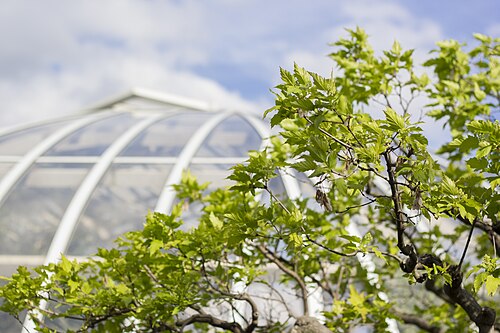
Do you have a good photo of this greenhouse? Suggest it for this page →
Sources (8)
- sandiegohistory.org/archives/amero/botanical/
- sandiego.gov/digital-archives-photos/balboa-park-botanical-building-and-lily-pond
- timesofsandiego.com/life/2024/12/06/historical-botanical-building-in-balboa-park-reopens-a
- sdarchitecture.org/project/botanical-building-restoration/
- sandiegomuseumcouncil.org/museums/balboa-park-botanical-building-gardens/
- balboaparkbotanical.org
- pacifichorticulture.org/articles/grand-renovation-for-balboa-park/
- en.wikipedia.org/wiki/Botanical_Building