Silk Center (シルクセンター国際貿易観光会館)
Yamashita-cho, Naka-ku, Yokohama
Sources checked November 2026
- Year
- 1959
- Architect
- Junzō Sakakura
- Type
- Trade and tourism complex (silk museum, offices, shops)
- Access
- Silk museum open to the public, closed on Mondays (museum website, November 2026)
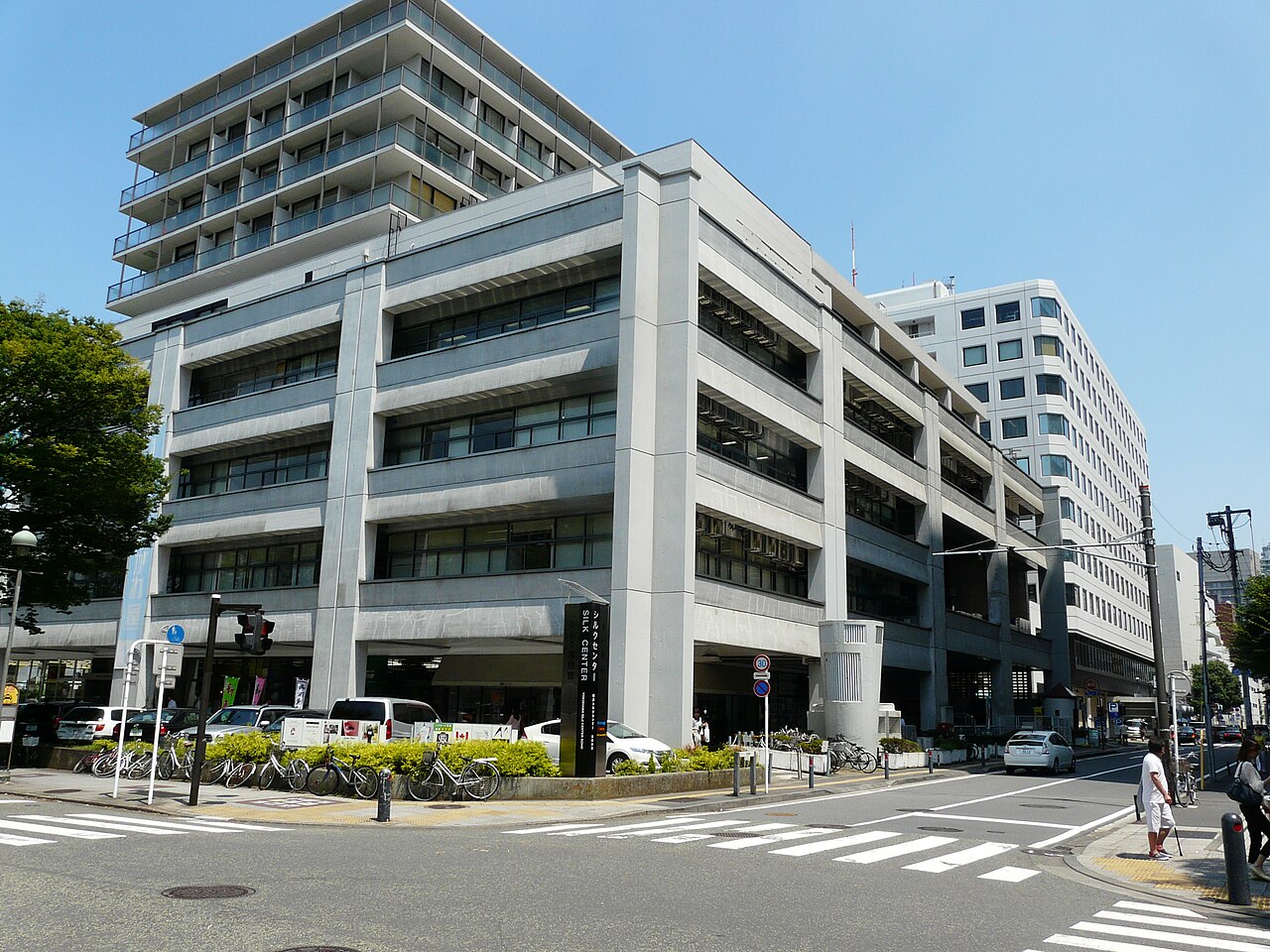
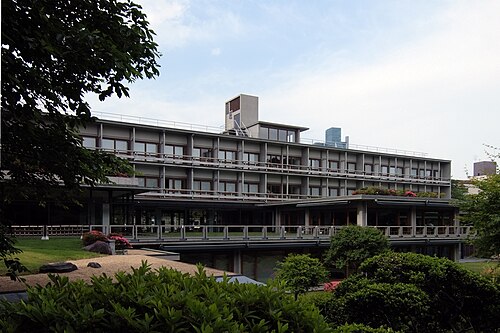
Built to mark a hundred years since Yokohama opened as a port, the Silk Center is the work of Junzō Sakakura's office, which won an invitation-only competition. On the roof of a long-span base the design sets a garden, above which the glazing and the horizontal lines of the former hotel's slabs and eaves were drawn to appear to float. The silk museum, open since 1959, is still housed there.
Affiliate links — booking through Verrière helps fund our research, at no extra cost to you.
History
The Silk Center grew out of the celebrations marking a hundred years since Yokohama opened as a port. In 1955 the governor of Kanagawa Prefecture proposed a centre to promote the international raw-silk trade, and a foundation was set up in 1956. The prefecture and the city ran the project together, the prefecture paying for the works and the city owning the land: chosen in 1957 at Yamashita-cho 1, it was where the British trading house Jardine Matheson stood in the first days of the open port.
An invited competition among six offices chose the proposal of Junzō Sakakura's office. Construction began in 1957 on Sakakura's design, and Kajima Corporation built the building. The centre was completed in 1959; in 1960 it received the Building Contractors Society (BCS) Prize, then in its first year.
The hotel on the upper floors closed in 1982, for lack of profit and because of fire-protection problems.
Architecture
The building has eight storeys above ground and two basements. It is made of two parts set apart by function, structure and design: a long-span base intended for the silk museum, offices and shops, and above it the floors of a tourist hotel.
The exterior was also meant to serve as a landmark for ships entering the port. The design sets a garden on the roof of the sturdy base, and it is above this garden that the hotel's light glazing and the horizontal lines of its slabs and eaves were drawn to appear to float. In the base, the two lowest levels provide open spaces, with half-levels and voids rising through several storeys. For the hotel, internal load-bearing walls were chosen for the rooms' sound insulation, privacy and views.
The foundations are of the floating type. To counter the uneven, arc-shaped settlement that the central part of the tower threatened to cause in the clay layer, a second basement was dug under the core, which reduces the pressure on the foundation raft. To keep costs down, only the perimeter of the base and the core are in steel-framed reinforced concrete, the rest in reinforced concrete. The base has since received seismic reinforcement.
Use today
The silk museum opened in March 1959, inside the centre, for the centenary of the port.
On the first of its two levels, visitors watch live silkworms and try reeling thread from cocoons and weaving. The second presents the history of Yokohama as a raw-silk export port, reconstructed costumes and silk objects, mostly Japanese clothing.
The floors of the former hotel, turned in 1998 into a support centre for young businesses, now house small-business offices under the name Yokohama Silk Center SOHO. The foundation also rents offices, shops and meeting rooms in the building.
Visiting
The silk museum is open from 9:30 to 17:00 (last entry 16:30). It closes on Mondays (the next day when Monday is a public holiday) and from 28 December to 4 January; temporary closures are possible.
The museum is in the Silk Center, at Yamashita-cho 1, a three-minute walk from Nihon-odori station (Minatomirai Line).
35.45° N, 139.65° E
Greenhouses nearby
Architecture nearby
By the same architect
Sources (10)
- bunka.go.jp/kindai/kenzoubutsu/research/kanagawa/008/index.html
- sakakura.co.jp/works/office/1684/
- silkcenter-kbkk.jp/
- silkcenter-kbkk.jp/museum/
- silkcenter-kbkk.jp/museum/museum-visit/
- silkcenter-kbkk.jp/museum/museum-about/
- silkcenter-kbkk.jp/museum/museum-guide/
- silkcenter-kbkk.jp/tenant/
- kajima.co.jp/english/
- japan47go.travel/en/detail/4b4fc783-a64b-4772-80b6-c226a361b147
Affiliate links — booking through Verrière helps fund our research, at no extra cost to you.