JungleWorld
Bronx Zoo, New York
No freely licensed photo of this greenhouse yet. Do you have one? Suggest it for this page →
Sources checked September 2026
- Year
- 1985
- Style
- Asian tropical pavilion with no visible barriers
- Dimensions
- about 4,000 m² (1 acre), 17 m high, 210 m trail
- Status
- Open to the public
Opened in June 1985 at a total cost of $9.5 million, including $4.1 million donated by patron Enid A. Haupt, a board member of the New York Zoological Society, JungleWorld recreates several Southeast Asian ecosystems across about 4,000 m² and 17 meters of height: volcanic scrub forest, mangrove, swamp, and rainforest. The building was designed to eliminate visible barriers as much as possible: the 210-meter wooden trail running through it has only short railings, with animals separated from visitors by ravines, streams, or simulated cliffs. Nearly 800 species have been exhibited there over the years, including otters, gibbons, and clouded leopards, in galleries that remind visitors that 150 acres of rainforest disappear every minute around the world. This immersive approach, innovative for its time, strongly influenced the later design of major tropical zoo greenhouses in North America, such as Omaha's Lied Jungle and Cleveland's The RainForest, both opened seven years later. JungleWorld remains today one of the Bronx Zoo's iconic buildings, the largest urban zoo in the United States.
Affiliate links — booking through Verrière helps fund our research, at no extra cost to you.
History
The Bronx Zoo, opened in 1899 and run by the New York Zoological Society (now the Wildlife Conservation Society), began planning a large indoor Asian rainforest in 1977 for the southeastern part of the park, the Wild Asia area. The project was completed in June 1985 at a total cost of $9.5 million, of which $4.1 million came from Enid A. Haupt, a member of the society's board of trustees.
The building was intended as more than a display of animals. It was designed to drive home a statistic widely quoted at the time: the loss of some 150 acres (about 61 hectares) of rainforest every minute worldwide.
Since opening, JungleWorld has also served as a breeding centre for several threatened species. More than a hundred silvered langurs have been born there since 1985, making this group one of the largest breeding groups of the species in North America. In 2022 a Matschie's tree-kangaroo joey became the first of its species born at the zoo since 2008, and a second joey from the same mother made its public debut in July 2024.
Architecture and engineering
JungleWorld is the largest building at the Bronx Zoo, covering about one acre (4,000 m²) beneath a 55-foot (17 m) roof. A wooden boardwalk roughly 210 metres long winds through it.
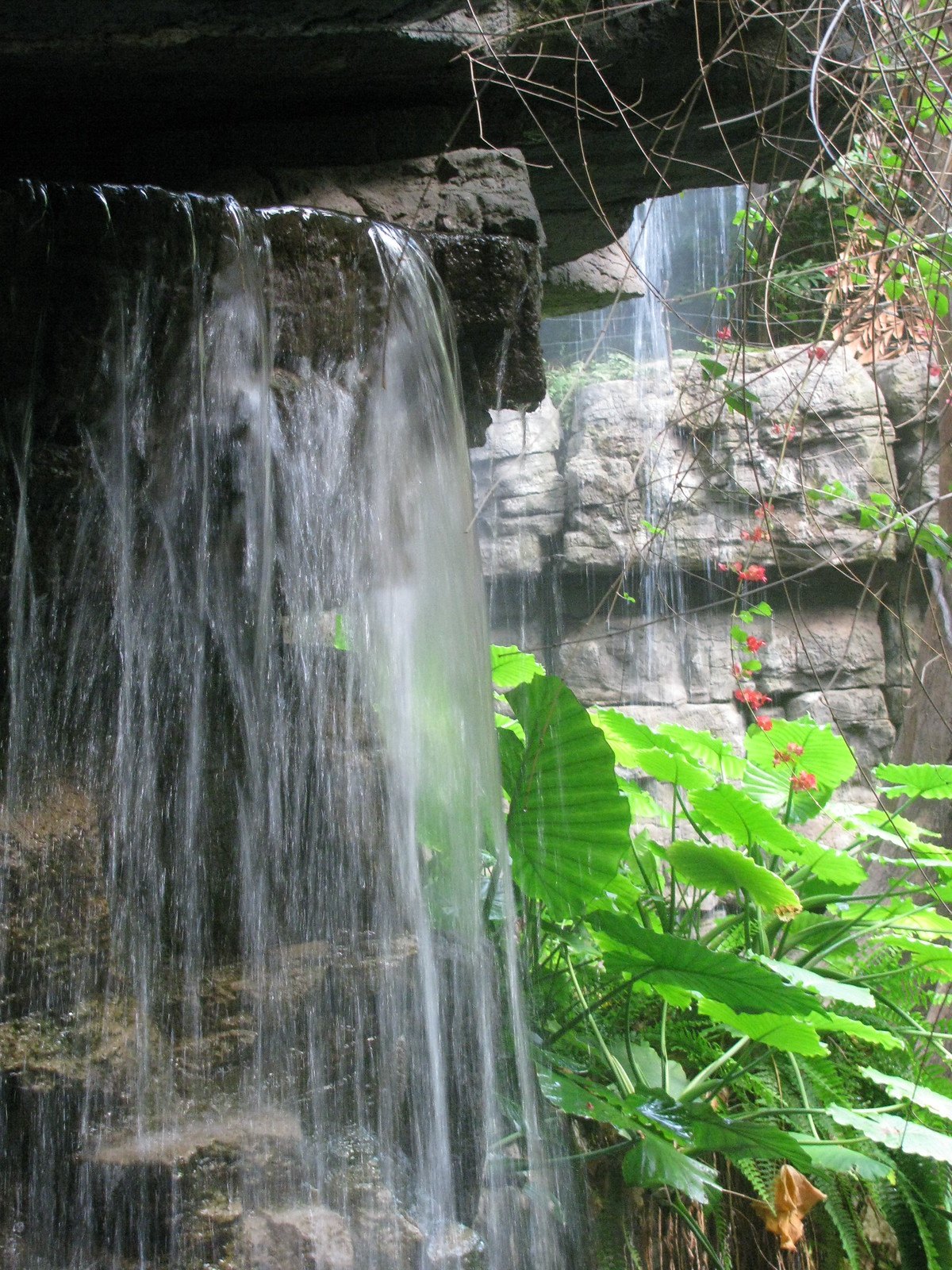
The guiding principle is the absence of visible barriers. There are no bars, the path has only low railings, and most animals are separated from visitors and from each other by ravines, streams or cliffs. The route passes through a sequence of recreated Asian habitats: a volcanic scrub forest, a mangrove, a swamp, and a lowland evergreen rainforest with giant trees that merges into a mountain rainforest. Five museum-style galleries link these habitats and explain how they work.
Lighting is kept deliberately low, like a forest understorey, and high perches are provided for birds and bats. A pond fed by a waterfall offers a place to sit and watch.
Plant collections
Most of the animals come from South and Southeast Asia. Mammals include northern white-cheeked gibbons, whose calls carry through the hall, Asian small-clawed otters, Malayan tapirs, silvered langurs and Javan lutungs, clouded leopards, treeshrews, greater mouse deer and Rodrigues fruit bats. The Matschie's tree-kangaroo from New Guinea is the geographical outlier.
The gharial, shown in connection with a conservation partnership with the Madras Crocodile Bank Trust, shares the space with Fly River turtles and gouramis. Birds include storks, lorikeets, Javan pond herons, Nicobar pigeons and great argus pheasants. Smaller forest-floor creatures, among them scorpions, stag beetles and fire-bellied toads, are displayed behind glass.
Visiting
JungleWorld stands in the Wild Asia section of the Bronx Zoo, which covers 265 acres (107 hectares) of Bronx Park. It is open year-round, and its tropical warmth makes it a welcome stop during a New York winter. Entry is included in the zoo's general admission, while limited-admission tickets require a surcharge.
The dim lighting takes a few minutes to adjust to, and strollers must be parked outside. The seating by the waterfall pool is a good place to pause and watch, or to wait for the gibbons to call.
40.85° N, 73.88° W
Greenhouses nearby
More greenhouses — United States
Do you have a good photo of this greenhouse? Suggest it for this page →
Affiliate links — booking through Verrière helps fund our research, at no extra cost to you.