Enid A. Haupt Conservatory
Bronx, New York

Sources checked September 2026
- Year
- 1899–1902
- Architect
- William R. Cobb (Lord & Burnham)
- Style
- Italian Renaissance, glass and steel
- Dimensions
- 156 meters long, with a 27-meter dome
- Status
- Open to the public
Inspired by both the Palm House at Kew and Joseph Paxton's Crystal Palace, this horseshoe-shaped conservatory narrowly escaped demolition in the 1970s before a $10 million gift from philanthropist Enid Haupt saved it. Eleven pavilions arc around a central dome 27 meters high. Designated a New York City landmark in 1976, it remains the largest Victorian glasshouse still in operation in North America.
Affiliate links — booking through Verrière helps fund our research, at no extra cost to you.
Practical info
- Tickets
- All-Garden Pass, which includes the Haupt Conservatory: adult $35 weekday, $39 weekend; senior or student $31 / $35; child $15 / $17; free under 2 and for members (prices listed in October 2026). Buy online or at the ticket windows.
- Opening hours
- The Garden is open 10am–6pm Tuesday to Sunday, and select Monday holidays. Exhibitions or events (Members-Only Previews, evening events) may close some areas earlier. The Haupt Conservatory is visited with the All-Garden Pass (daytime access).
- Getting there
- 2900 Southern Blvd., Bronx (NY 10458). Metro-North Harlem line, Botanical Garden station, 20 minutes from Grand Central; subway B, D or 4 then Bx25/Bx26 bus; buses Bx9, Bx12, Bx17, Bx19, Bx22. On-site parking: $25 per vehicle.
Frequently asked questions
Is the Haupt Conservatory included in the ticket?
Yes with the All-Garden Pass (exhibitions, Conservatory, Tram Tour, outdoor collections). The Grounds Access Pass, for NYC residents only, excludes the Conservatory, Special Exhibitions and the Tram Tour.
Is there a free time to visit?
On Wednesdays, outdoor Grounds admission is free all day for NYC residents and from 10 to 11am for other visitors. The Haupt Conservatory is included in the All-Garden Pass.
How do I get there by public transport?
Metro-North Harlem line to Botanical Garden station, across from the Mosholu Entrance, 20 minutes from Grand Central. Or subway B, D or 4 to Bedford Park Blvd, then the Bx25 or Bx26 bus.
Can I park on site?
Yes: $25 per vehicle; members park free with a Member Pass, or pay $10 without one. A Garden garage is at 401 Bedford Park Blvd., at the same visitor rate.
History
The New York Botanical Garden was founded in 1891 by the botanist Nathaniel Lord Britton and his wife, Elizabeth Gertrude Britton, who wanted the city to have an institution modelled on the Royal Botanic Gardens at Kew. The great glasshouse was among its first projects. Designed by Lord & Burnham, the leading greenhouse firm of the day, with William R. Cobb as architect, it was begun on January 3, 1899, by the builder John R. Sheehan and completed in 1902 for $177,000. Its designers drew on both the Palm House at Kew and Joseph Paxton’s Crystal Palace.
The building was repaired in 1935 and 1950, but by the 1970s it had deteriorated so badly that it faced either substantial rebuilding or demolition. The philanthropist Enid Annenberg Haupt settled the matter with $5 million for renovation and a further $5 million endowment for upkeep. The work, led by the architect Edward Larrabee Barnes, was finished in 1978, when the glasshouse, until then known simply as the Conservatory, was renamed in her honour.
Between 1993 and 1997 a second, $25 million renovation by Beyer Blinder Belle computerised the control of temperature, humidity and ventilation and completely redesigned the displays. The conservatory is a designated New York City landmark (in 1973 or 1976) and lies within the garden, which was declared a National Historic Landmark in 1967.
Architecture and engineering
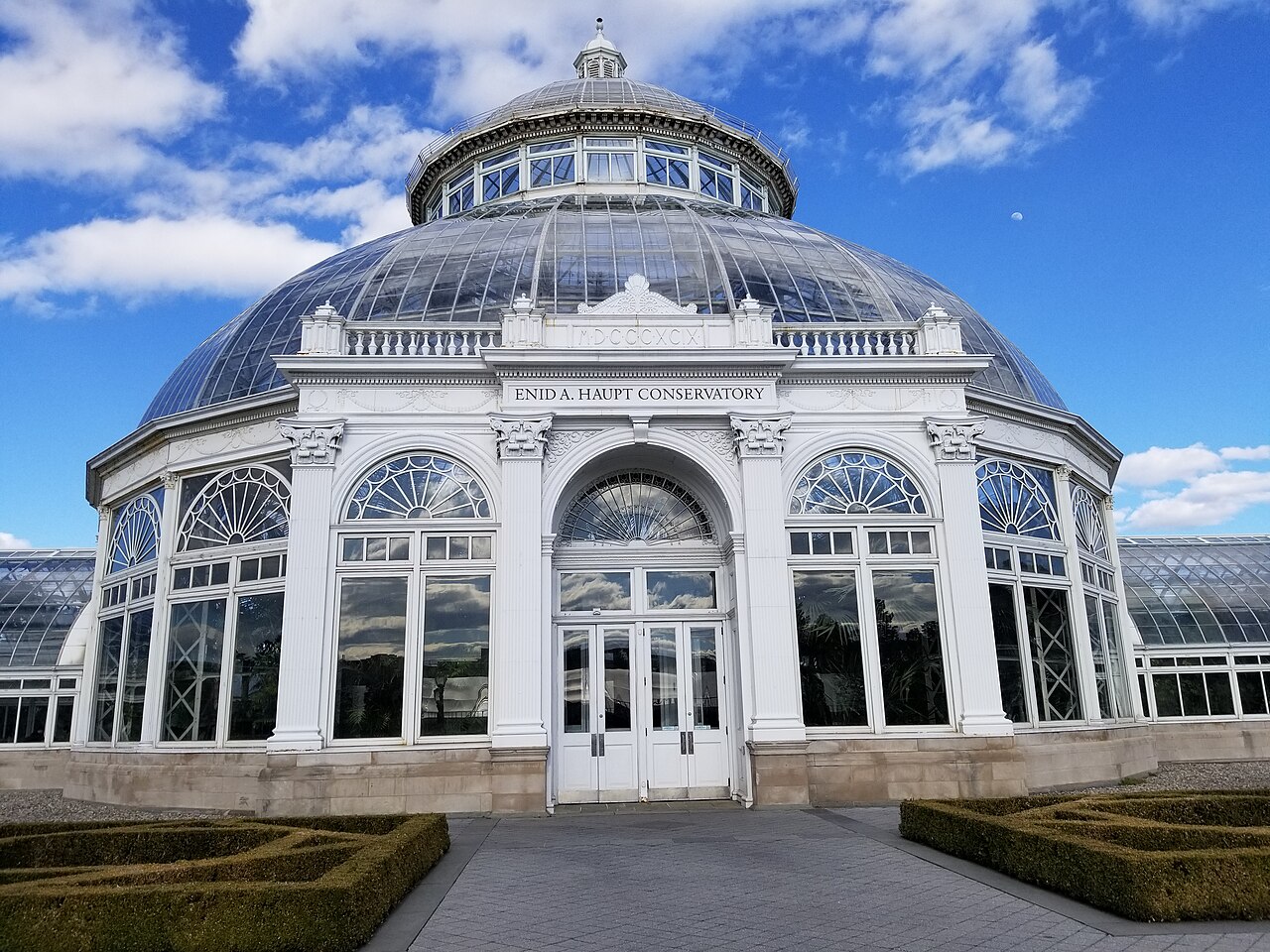
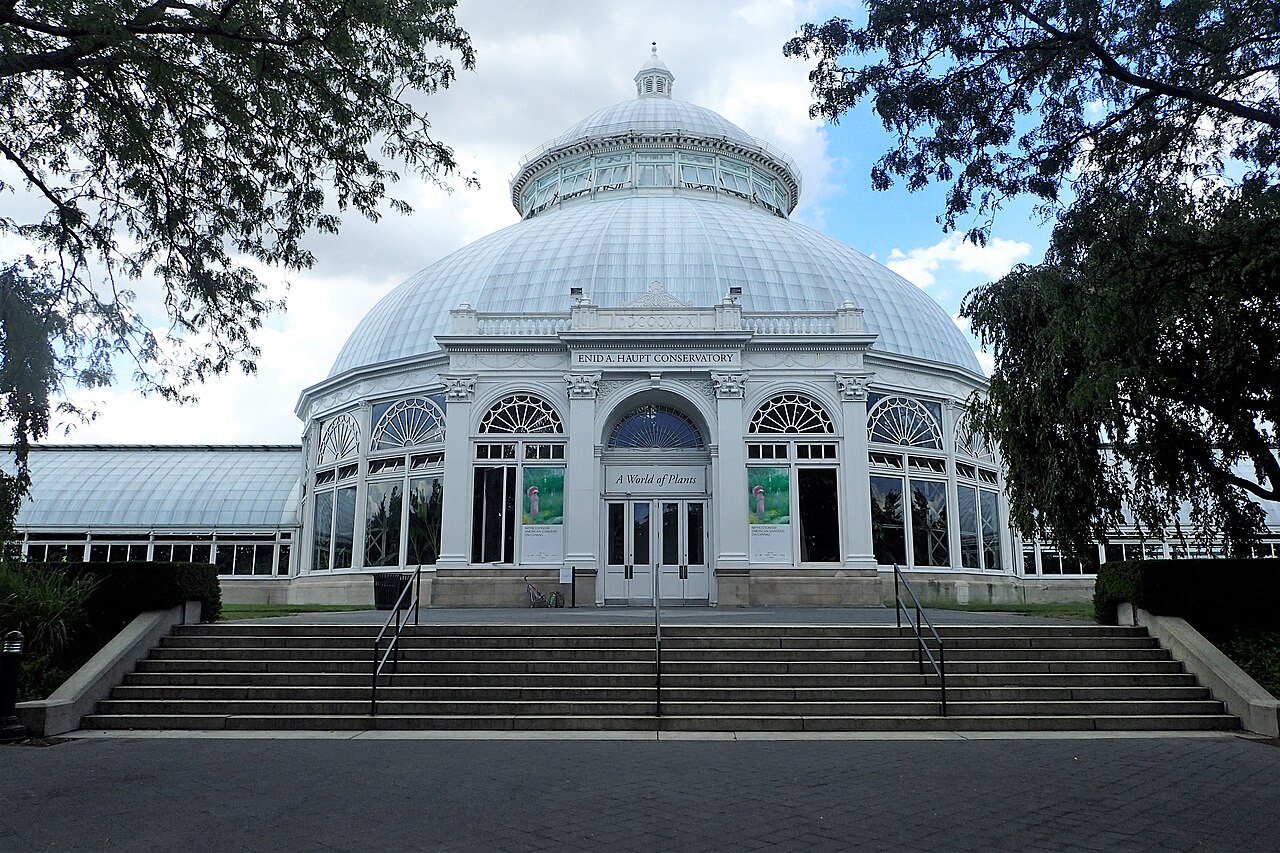
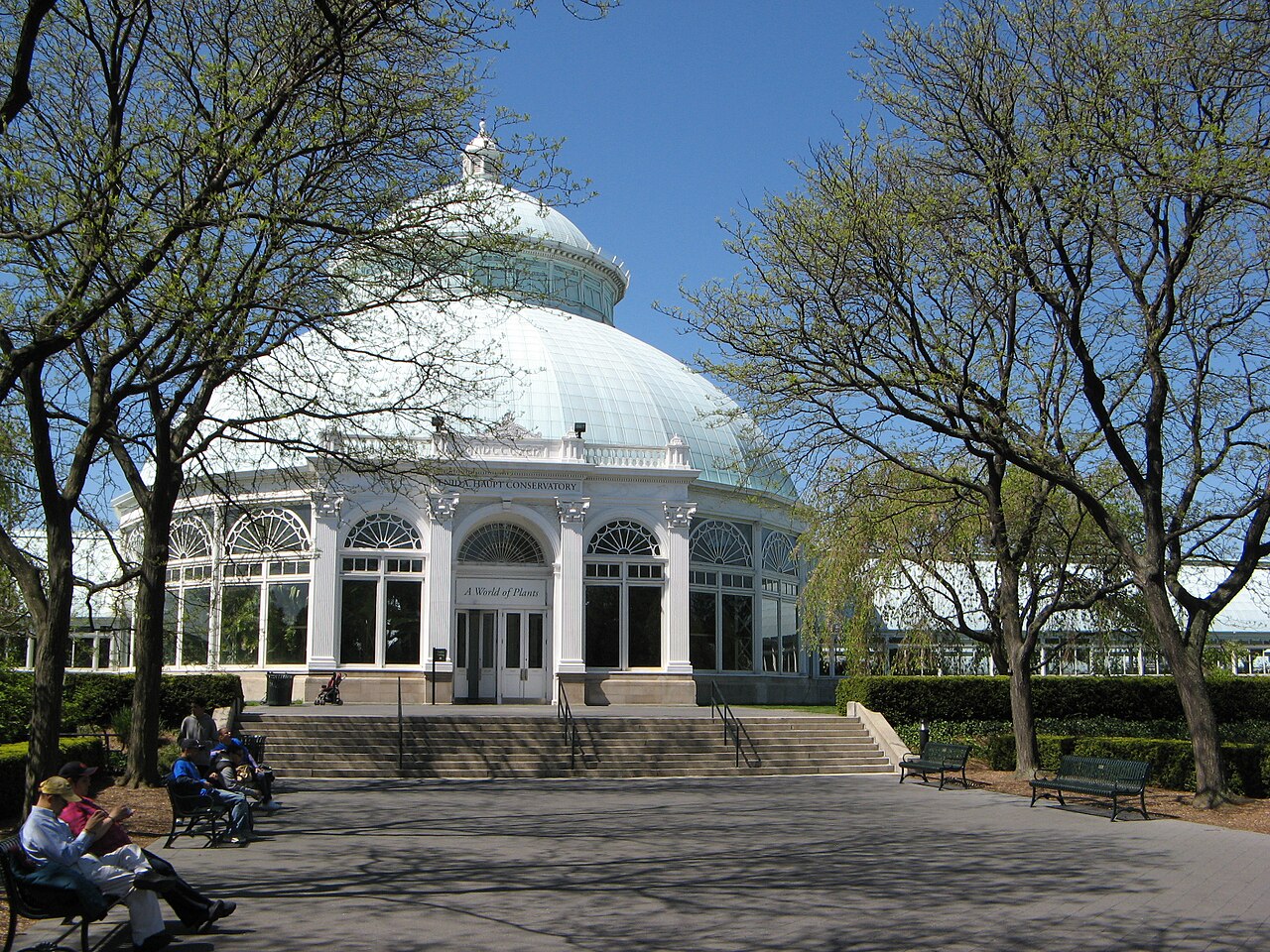
The conservatory forms a symmetrical C, 512 feet (156 m) long, made up of eleven glass pavilions arranged on either side of the central Palm House. The Palm House rises to a dome 90 feet (27 m) high, while the flanking pavilions, largely open inside as greenhouses usually are, follow one another in sequence. The idiom is Italian Renaissance, translated into iron and glass.
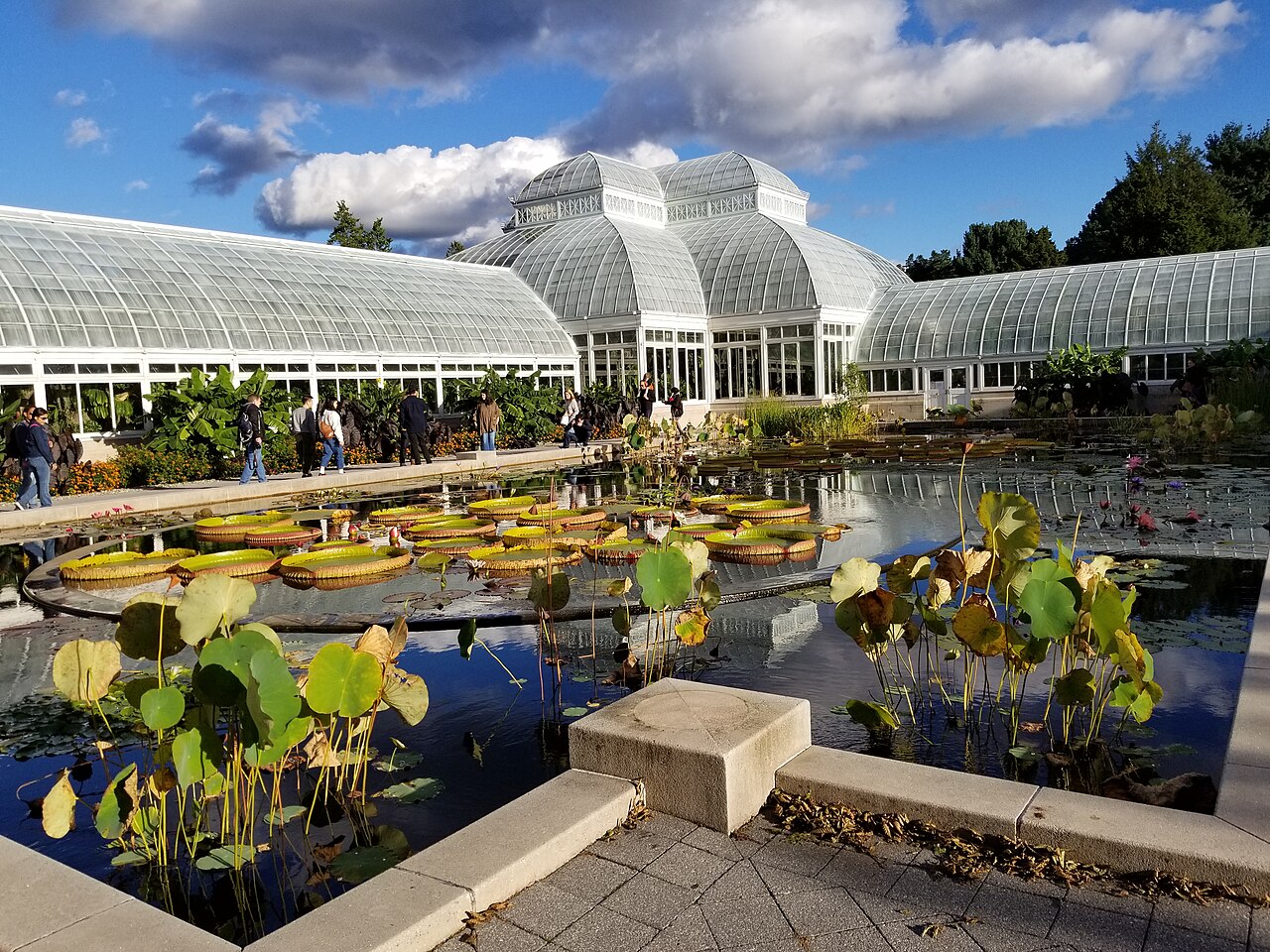
The structure combines steel, cast iron, wood and glass. Panes are about 16 inches across in most pavilions and 20 inches in the Palm House. The base and trim use a carefully chosen palette of materials: bluestone, buff Bedford stone, North River brick and Tennessee marble. The renovation completed in 1997 installed computerised systems to regulate the climate of each pavilion, which is what allows environments as different as a humid rainforest and a desert to share one roof. In summer, two outdoor pools beside the building display lotuses and water lilies.
Plant collections
Since 1997 the displays have treated a walk through the pavilions as a journey over mountains: from the wet western slopes, up through the rainforest and down into the desert. Each pavilion accordingly holds a group of plants representing a particular environment, with palms under the great dome, rainforest vegetation, and cacti and other desert plants. The palm and cactus collections include rare species.
The conservatory is also the stage for the garden’s major seasonal shows. The Orchid Show, first held in 2002, brings thousands of orchids into the galleries each spring; the Holiday Train Show, running since 1992, sends model trains past replicas of New York landmarks made from natural materials; and since 2007 Kiku has celebrated, each autumn, the Japanese art of training chrysanthemums.
Visiting
The conservatory stands within the New York Botanical Garden in the Bronx and makes a natural starting point for a day in its 250 acres of grounds. The calendar shapes the visit: the Orchid Show in spring, the lotus and water-lily pools in summer, Kiku in autumn and the Holiday Train Show, a family favourite, at the end of the year. The full circuit of the pavilions, from the palm dome to the deserts, runs as a loop. A visit is well extended into the outdoor gardens, notably the Peggy Rockefeller Rose Garden, first laid out by Beatrix Farrand, and the Thain Family Forest, an old-growth woodland split by the Bronx River.
40.86° N, 73.88° W
Greenhouses nearby
More greenhouses — United States
Do you have a good photo of this greenhouse? Suggest it for this page →
Affiliate links — booking through Verrière helps fund our research, at no extra cost to you.