The Vinery (pinery-vinery), Fulham Palace walled garden
Fulham, London (London Borough of Hammersmith and Fulham)

Sources checked October 2026
- Year
- 1810s-1820s (Bishop Howley); rebuilt in 2010
- Style
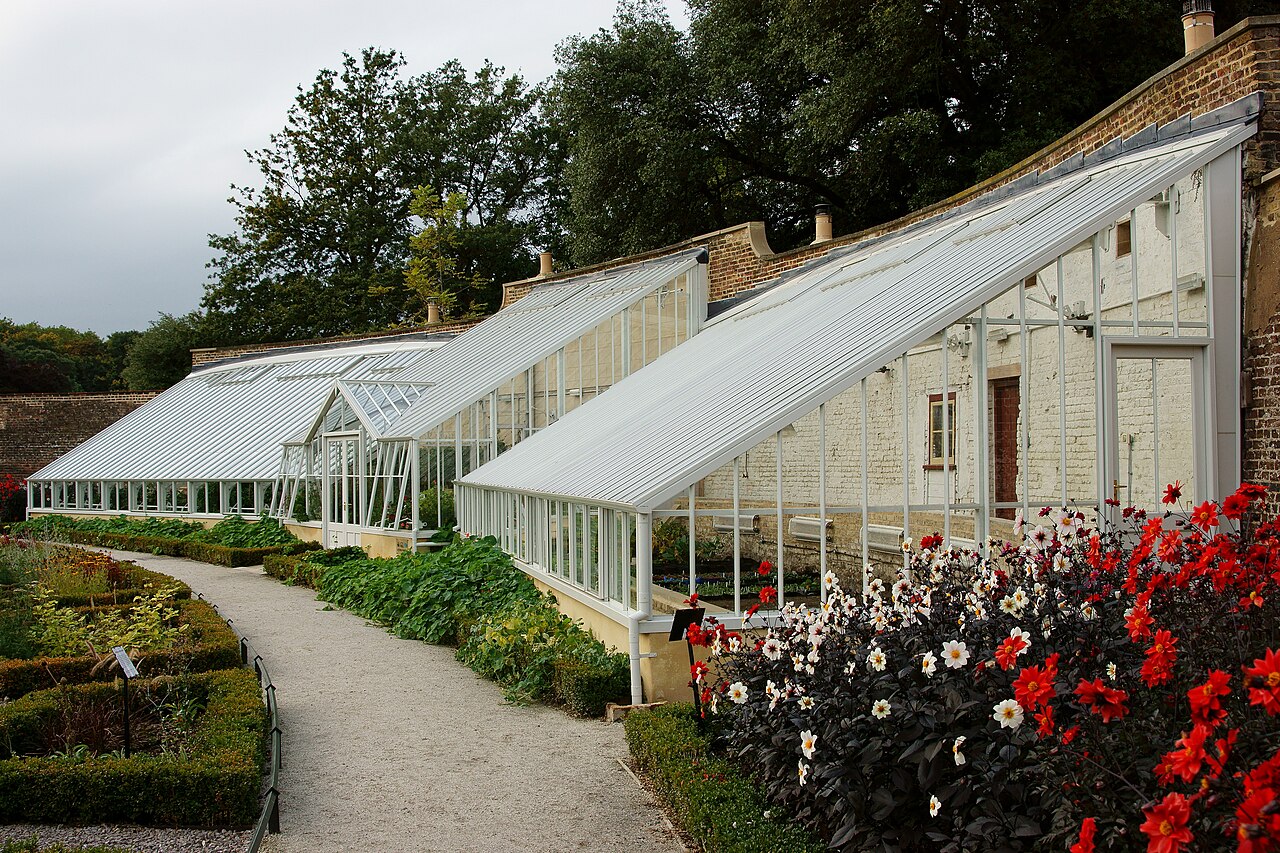
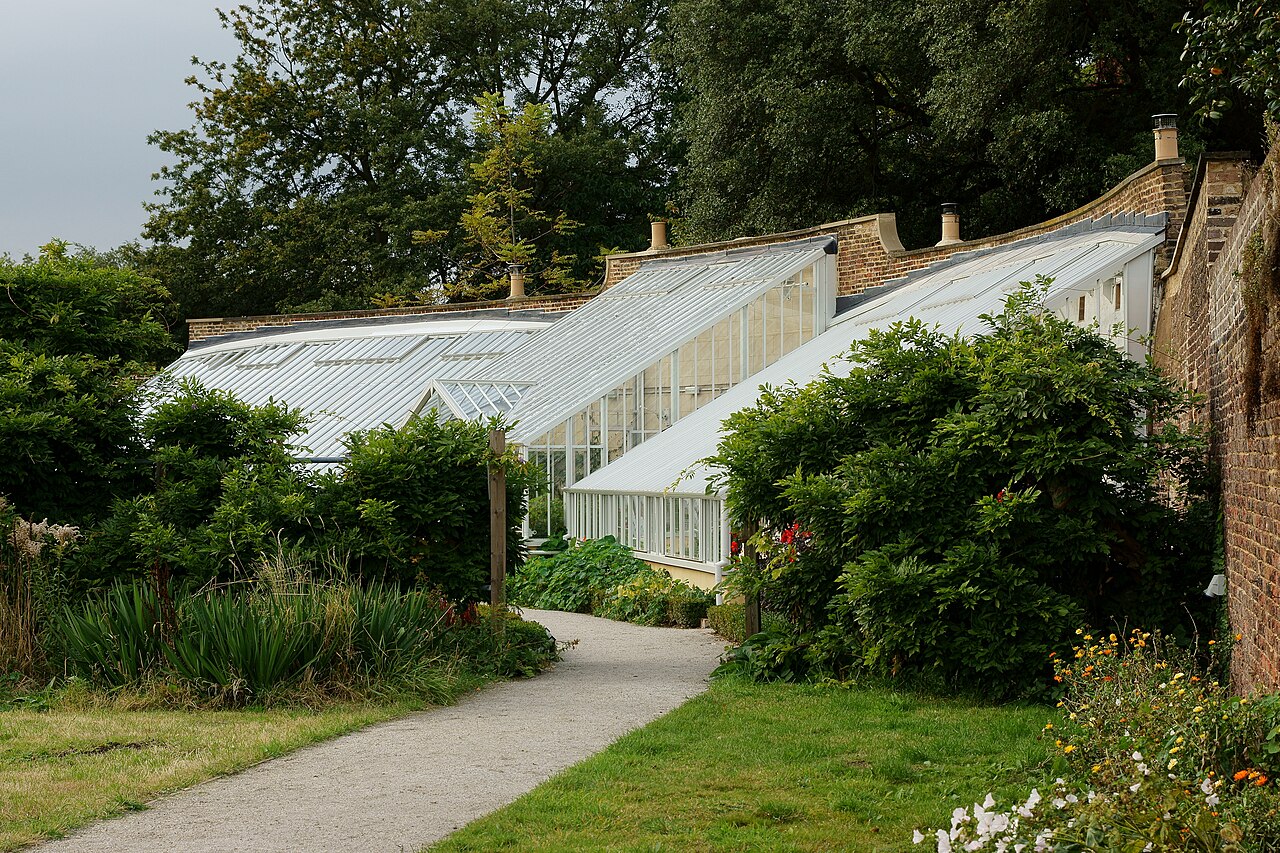
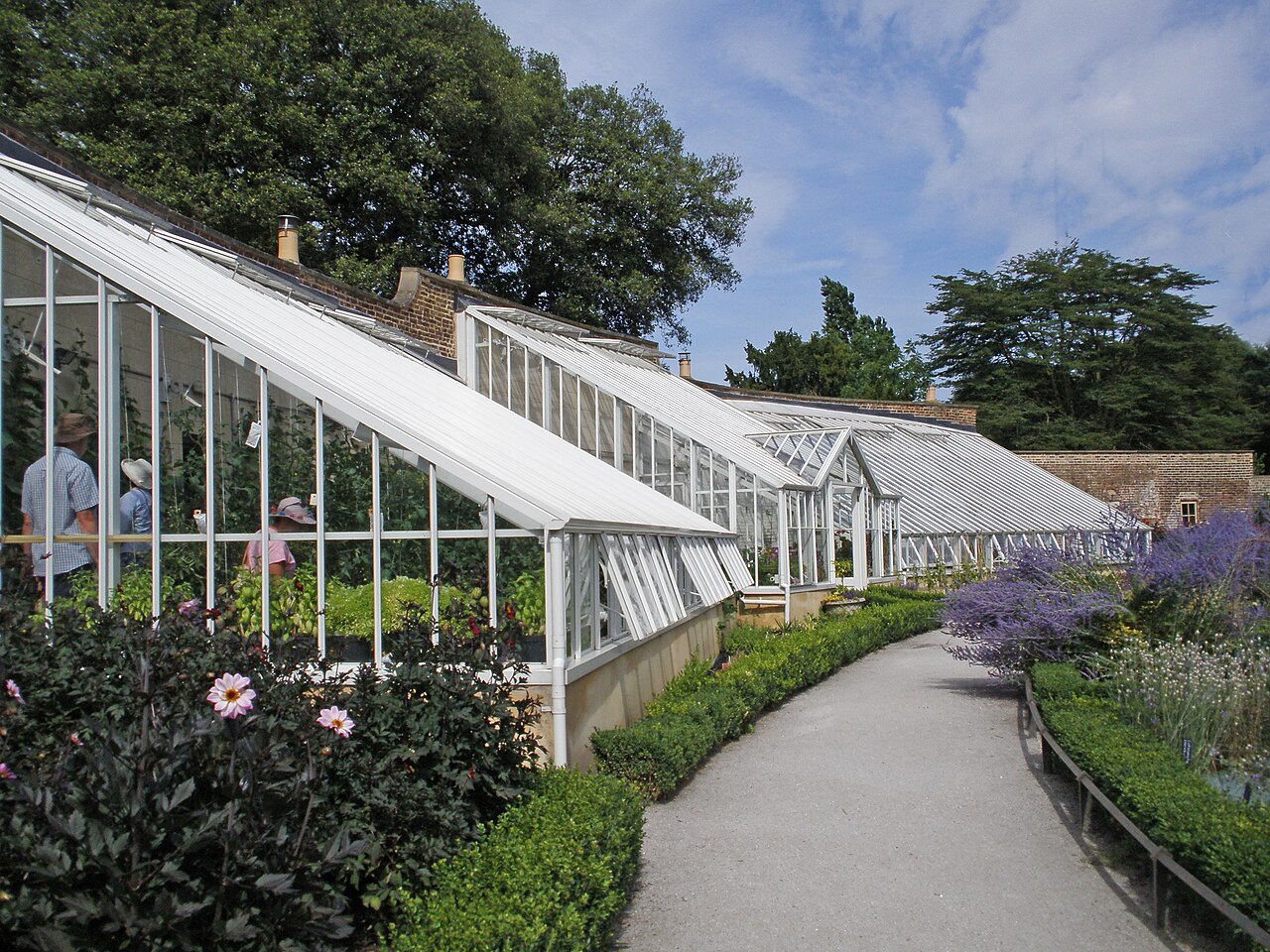
- Lean-to hothouse (pinery-vinery) against a brick wall, with glazed walls and roofs in white-painted bars
- Status
- Open to the public with the walled garden (free entry); west wing a plant nursery then a tomato house in summer, east wing turned into a workshop space in 2024
Set against the wall of the walled garden at Fulham Palace, the former residence of the bishops of London, this heated house for pineapples and grapes (a pinery-vinery) was built under Bishop William Howley, who held the see from 1813 to 1828. Collapsed by the turn of the twenty-first century, it was rebuilt in 2010 with National Lottery Heritage Fund support, and the Trust presents its underfloor heating as a legacy of the Georgian period. Its west wing is a plant nursery and, in summer, a tomato and cucumber house; the east wing, converted in 2024, hosts workshops. The walled garden can be visited free of charge.
Affiliate links — booking through Verrière helps fund our research, at no extra cost to you.
History
Fulham Palace was the residence of the bishops of London until 1973, and several of them were keen gardeners: the Trust cites the heated "stoves" of Bishop Henry Compton, from 1675 to 1713, parts of whose walls archaeologists believe they have found. The present walled garden came later. The Trust attributes it to Bishop Terrick and his architect Stiff Leadbetter in the eighteenth century; Historic England's register dates its walls to the eighteenth century but presumes it was created by the remodelling carried out under Bishop William Howley (1813-1828).
Howley is also the man of the pinery-vinery, a hothouse designed for pineapples as well as grapes: the palace timeline credits him with the first one in the walled garden, and planning papers quoted in the local press date a range of greenhouses and back sheds built in the garden to 1821. After the last bishop left in 1973 the glasshouses decayed: the register description, written in 2000, mentions only remains of timber-framed glasshouses, with derelict back sheds and boiler room, and the Trust writes that by the turn of the century the vinery had collapsed completely. Its rebuilding was among the projects of a landscape architects' report on the site's management, relayed by the London Gardens Trust around 2006.
Rebuilt in 2010 with National Lottery Heritage Fund support, in the second restoration phase of the palace, the vinery came shortly before the reopening of the walled garden in 2012. According to the same planning papers, three greenhouses were reinstated, while two others, which clues date to the nineteenth century, had gone by 1916. In 2024 a new greenhouse was added to the east and the vinery's east wing became a workshop space.
Architecture and engineering
Historic England's register describes, in 2000, nineteenth-century timber-framed glasshouses built against the curved north-east wall of the walled garden, with back sheds set against the outer wall and a boiler room; the surviving remains, listed Grade II, were then derelict. A press report on the 2023 planning application, however, places the group of greenhouses in the north-west corner of the garden. The present building is a 2010 reconstruction that keeps the principle of underfloor heating, which the Trust says was first installed in the Georgian period.
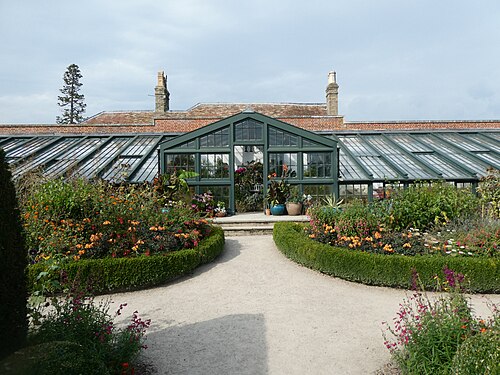
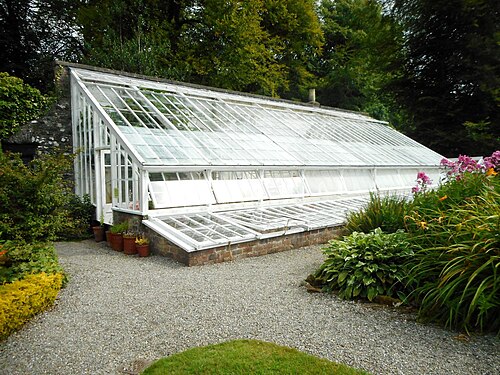
Photographs on Wikimedia Commons show a long run of lean-to houses against the brick wall, with glazed walls and roofs set in white-painted bars above low cream-coloured plinths; a taller gabled central section breaks the line of the roofs. The Trust's article on tomatoes mentions a ceiling to which the growing strings are tied, and windows and doors opened for ventilation.
The 2023 planning scheme proposed external blinds to keep one of the greenhouses cooler in summer, and a level-access door so that it could host workshops. Peregrine Bryant Architecture, which designed the new greenhouse in the walled garden (2023-2025), reports that changes to the protected site were kept very limited and that the works were supervised by the palace's community archaeologist.
Plant collections
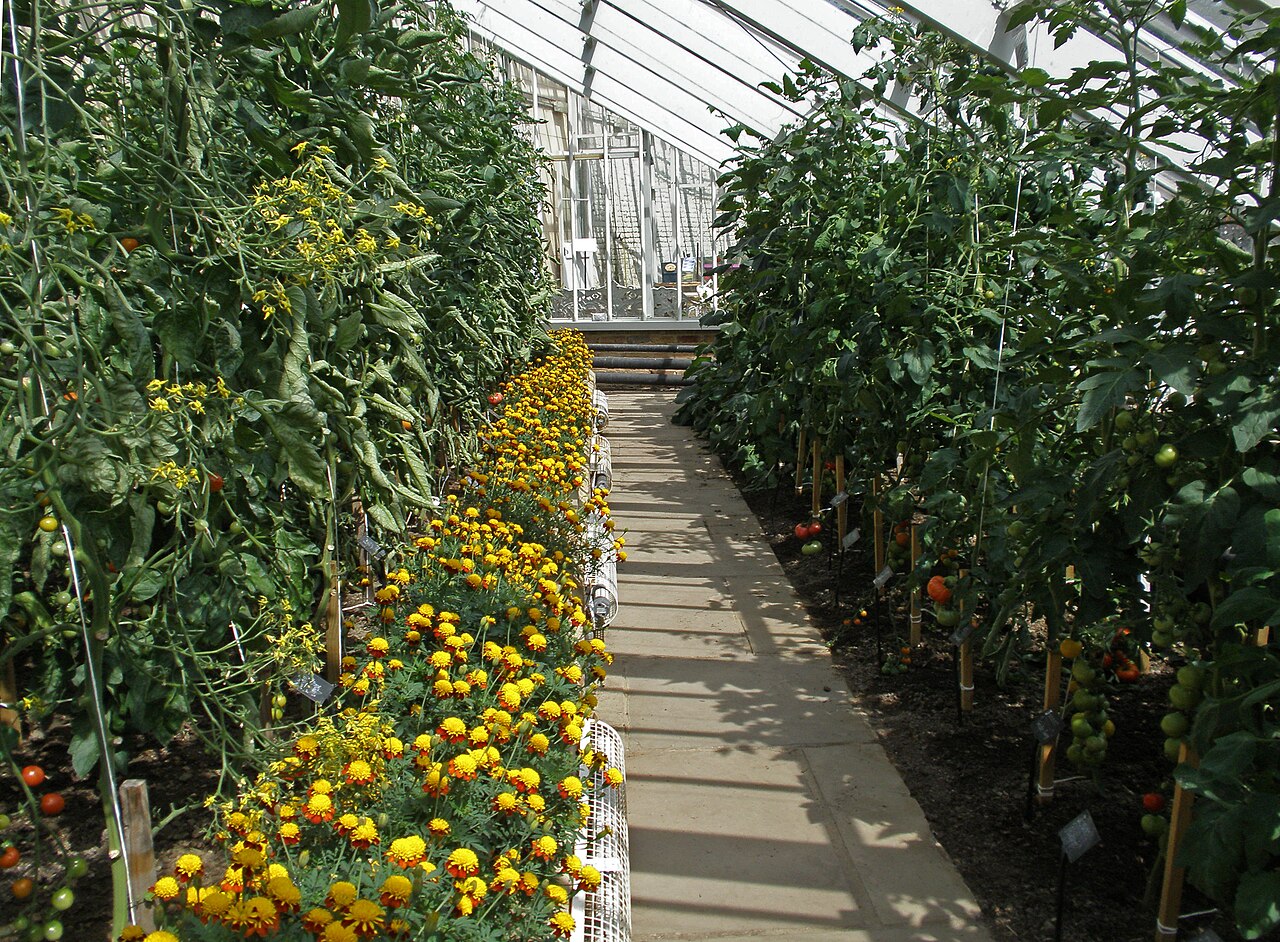
The vinery works today as a nursery and kitchen-garden glasshouse more than as a vine house; the name recalls the bishops' grapes and pineapples. The west wing serves as a plant nursery; once it is warm enough, around April or May, most stock moves outdoors and it becomes a house for tomatoes and cucumbers. In 2020 an article by one of the garden's apprentices listed the tomatoes 'Sungold', 'Rosella', 'Gardeners Delight', 'Alicante' and 'Supersauce' and the cucumbers 'Telegraph Improved', 'Delistar' and 'Marketmore', trained up strings tied to the ceiling.
Aphids are fought by biological means: parasitic wasps, Encarsia formosa, are released on cards, so the crops stay free of pesticides. The harvest, like the honey and cut flowers, is sold at the walled garden's market barrow, and cucumbers, rhubarb and soft fruit are made into pickles and chutney. Outside, a Chinese wisteria almost two hundred years old overlooks the vinery; the Trust notes that it reached England in 1816, and that a support of sixty-four double hoops was fitted in 2022 to hold it.
Visiting
The vinery stands along one side of the walled garden, beside the knot garden, facing the palace across the large lawn. The walled garden is visited together with the palace grounds, without a ticket, during opening hours, and the Trust states that the main public area of the vinery is step free. The walled garden also holds an apple orchard, beehives and a knot garden.
High summer, when tomatoes and cucumbers climb their strings, is the most telling moment; the wisteria that overlooks the vinery adds interest in its season. The palace lies about a hundred metres from Putney Bridge, with Bishop's Park as its neighbour and All Saints church next door.
51.47° N, 0.21° W
Greenhouses nearby
More greenhouses — United Kingdom
Do you have a good photo of this greenhouse? Suggest it for this page →
Sources (10)
- fulhampalace.org/seasons-in-time-the-palace-garden-from-then-to-now/
- fulhampalace.org/news/tomatoes-and-cucumbers-the-vinerys-finery/
- fulhampalace.org/house-garden/timeline/
- fulhampalace.org/house-garden/the-garden/the-walled-garden/
- fulhampalace.org/visit/access/
- historicengland.org.uk/listing/the-list/list-entry/1000133
- mylondon.news/news/west-london-news/fulham-palace-gardens-new-greenhouse-28311854
- peregrine-bryant.co.uk/latest/portfolio/fulham-palace-greenhouse/
- fulhampalace.org/news/resilience/
- londongardenstrust.org/features/fulham2006.htm
Affiliate links — booking through Verrière helps fund our research, at no extra cost to you.