Fox Talbot's Botanic Garden glasshouse, Lacock Abbey
Lacock, near Chippenham (Wiltshire), England

Sources checked October 2026
- Year
- 2003–2008 (reconstruction of a late 19th-century glasshouse; botanic garden created from 1827)
- Style
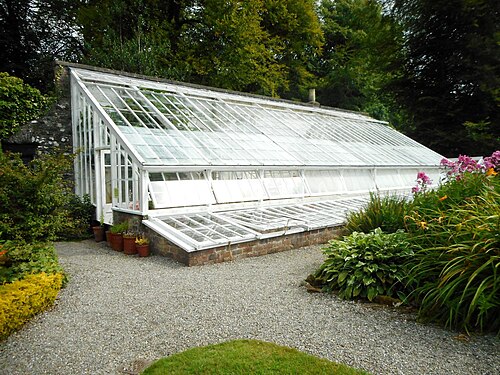
- Lean-to glasshouse against the north wall: white-painted timber frame on a red brick plinth, rebuilt
- Status
- Open to the public with the abbey grounds (National Trust)
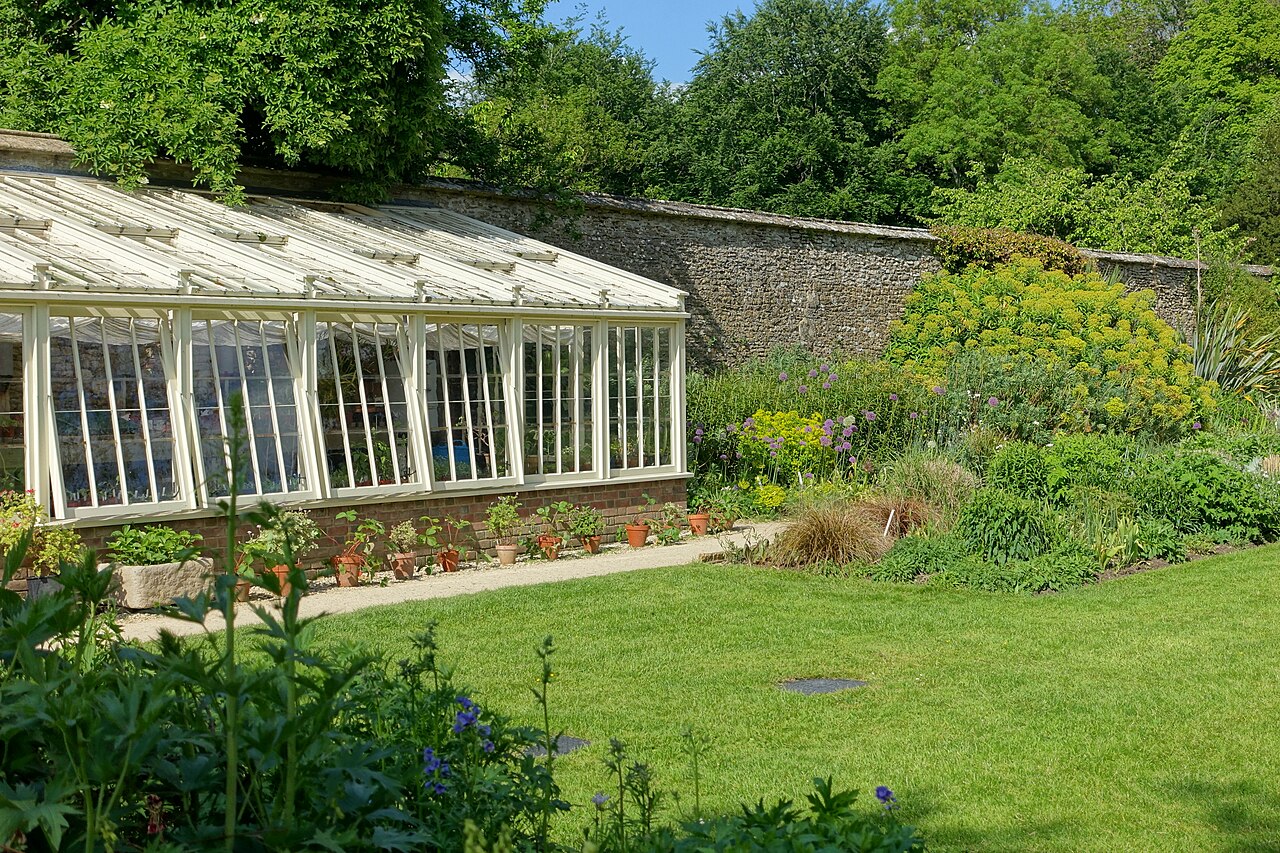
Lacock Abbey, home of photography pioneer William Henry Fox Talbot, has a walled garden behind its entrance: the former stable yard, which Talbot turned into a botanic garden from 1827, with glasshouses built against the north wall. Neglected after his death in 1877, they disappeared. The National Trust reopened the garden in 2000, then rebuilt a white timber glasshouse on a brick plinth in the north-west corner between 2003 and 2008, from the only known photograph of a late 19th-century glasshouse. The garden is part of the abbey grounds, open to visitors.
Affiliate links — booking through Verrière helps fund our research, at no extra cost to you.
History
Founded in 1232 as a convent, Lacock Abbey passed after the Dissolution of the Monasteries to the Sharington family and then to the Talbots. William Henry Fox Talbot (1800-1877) inherited it at five months old but lived there only from 1827; it was there that he made, in 1835, the earliest surviving photographic negative. A recognised botanist, he created a botanic garden soon after arriving, according to the 2012 Lacock Conservation Management Plan, in the former stable yard, which the 1764 estate plan still calls the stable yard and the 1840 tithe map a garden. He had glasshouses built against the north wall and then, in 1849 according to the 1998 study by Lewis and Fretwell, a free-standing conservatory. His letters mention a stove house, a zinc house and an orangery.
After his death his son Charles, who seems to have lacked his enthusiasm for plants, let the glasshouses fall into disrepair; according to the 1998 study cited in the management plan, they were removed around the 1940s. The enclosure was then used as allotments; in 2000 the Historic England register still recorded, along the north wall, the brick footings of two of Talbot's greenhouses. The National Trust, owner since the 1944 gift, took the garden in hand in the late 1990s and reopened it in 2000. The present glasshouse is a reconstruction, begun in 2003, built mainly in 2004-2005 and completed in 2008 in the north-west corner. It is based on the only known photograph of a late 19th-century glasshouse, built apparently after Talbot's death. The management plan notes that in 2011 the central glasshouse shown on the 1886 plan, and a southern path, were still missing.
Architecture and engineering
The botanic garden is an enclosure bounded by a tall limestone wall with ornamental capping, dated to at least the first half of the 18th century and perhaps partly in place by 1714, judging from that year's estate map. It lies west of the abbey, behind the entrance barn that houses the Fox Talbot Museum. The management plan describes a lawn, a gravel path circuit and borders in the northern half; the glasshouse stands in the north-west corner and a shelter with a slate roof on timber struts in the north-east corner.
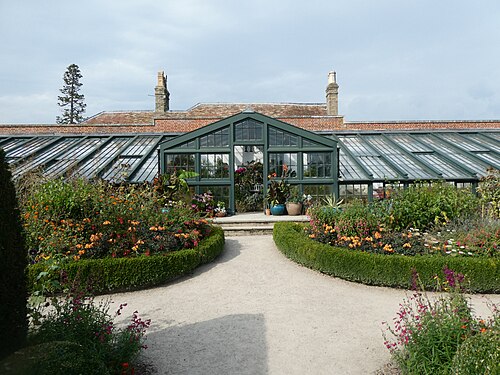
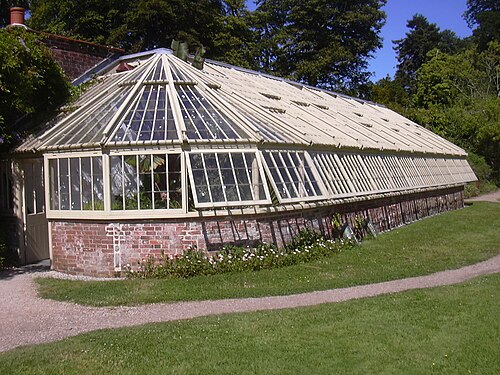
The glasshouse is a reconstruction built against the north wall: a white-painted timber frame on a red brick plinth, which the gazetteer annexed to the management plan says may have been part of a hot-flue heating system. Photographs on Wikimedia Commons show a single-pitch glazed roof fitted with vents, a front of small-paned sashes and a glazed door. Against the south wall of the neighbouring allotments survives a stone shed that may have been the boiler house of a glasshouse in the botanic garden.
Plant collections
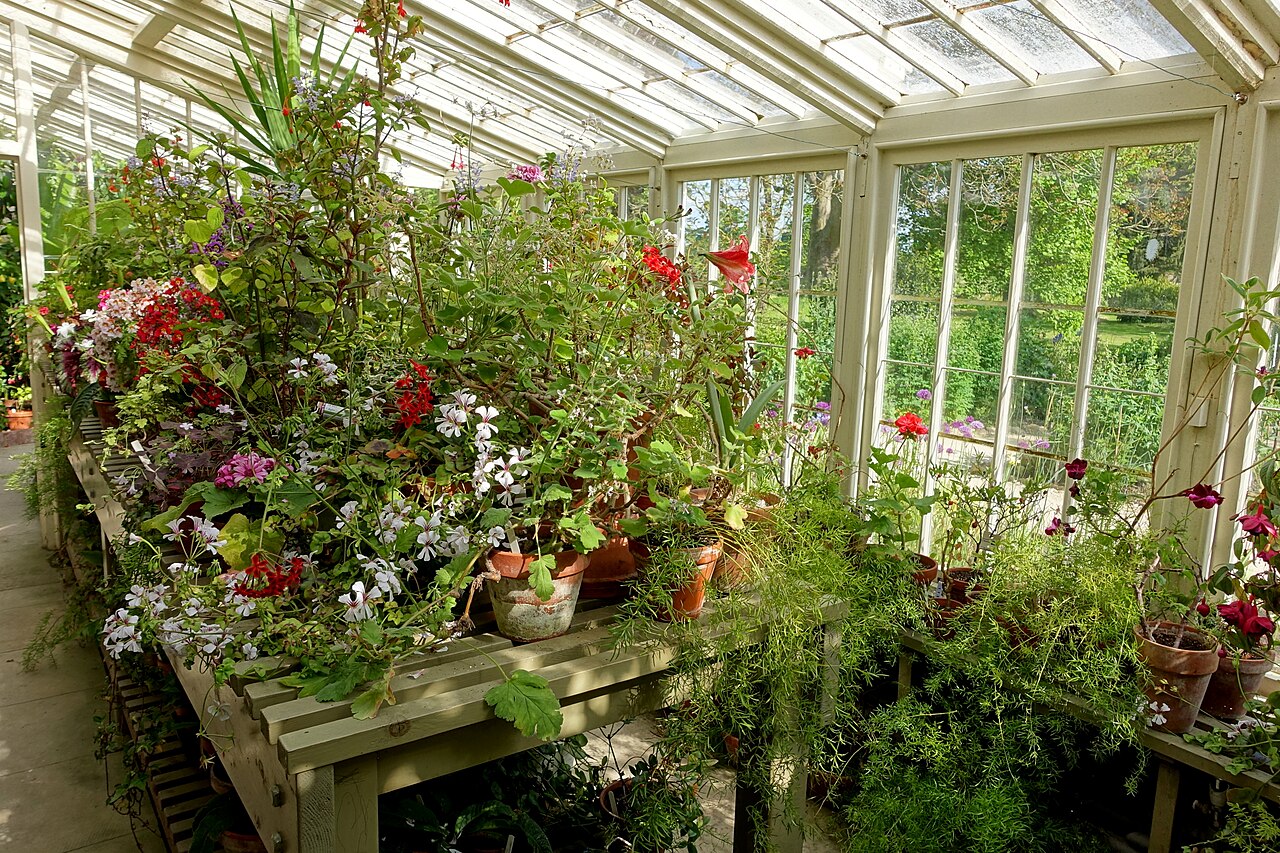
Talbot was a Fellow of the Linnean Society by the age of 29 and was above all interested in taxonomy; he corresponded with William Jackson Hooker, who directed Kew from 1841 to 1865. He gathered specimens and seeds from many regions, often through correspondents: his letters mention the Alps, Texas, the Euphrates, Sicily and the Ionian Islands. Under glass he grew many plants in pots, which the glasshouses served to shelter and propagate; he also liked trees, climbers and bulbs. The management plan considers it highly likely that he grew the plants for his earliest "photogenic drawings" (around 1836) himself.
Today photographs of the glasshouse show potted plants on slatted timber benches. In the enclosure, the Historic England register credits Talbot with planting a black walnut, a swamp cypress (Taxodium), a holm oak and tulip trees. The National Trust notes that the swamp cypress turns a red-brown colour in autumn before dropping its leaves. Well-kept herbaceous borders complete the garden.
Visiting
The botanic garden lies behind the entrance to the abbey grounds, north of the barn that houses the Fox Talbot Museum; the glasshouse stands in the north-west corner of the wall. The National Trust invites visitors to step inside the botanic garden with its historic glasshouse. In autumn the swamp cypress turns red; in spring the neighbouring woodland garden offers snowdrops, aconites and, according to the Trust, one of the best displays of Crocus vernus in the country. Photographs of the borders in flower date from late May to July. Worth combining: the Fox Talbot Museum, the cloister and the window of the 1835 negative, the rose garden, the orchard and the village of Lacock.
51.42° N, 2.12° W
Greenhouses nearby
More greenhouses — United Kingdom
Do you have a good photo of this greenhouse? Suggest it for this page →
Sources (8)
- nationaltrust.org.uk/visit/wiltshire/lacock/things-to-see-and-do-in-the-garden-at-lacock-a
- nationaltrust.org.uk/visit/wiltshire/lacock/history-of-lacock-abbey
- historicengland.org.uk/listing/the-list/list-entry/1001236?section=official-list-entry
- historicengland.org.uk/listing/heritage-gateway/results/record/c30a9cd9-4500-41f0-acda-ed2
- raa.se/app/uploads/2015/11/Lacock-CMP.pdf
- raa.se/app/uploads/2015/11/Lacock-Gazetteer.pdf
- commons.wikimedia.org/wiki/Category:Botanic_Garden,_Lacock_Abbey
- ourworldforyou.com/visiting-lacock-abbey-in-wiltshire/
Affiliate links — booking through Verrière helps fund our research, at no extra cost to you.