Liberty Greenhouses of Villa Visconti Borromeo Arese Litta (Serre Liberty)
Lainate (Metropolitan City of Milan), Lombardy
Entry updated on October 5, 2026
- Year
- 1892-1898
- Architect
- Riccardi Pietro firm of Rivoli (1892-1898 enlargement)
- Style
- Liberty (Italian Art Nouveau) iron-and-glass greenhouses
- Status
- Open to the public on monthly guided visits
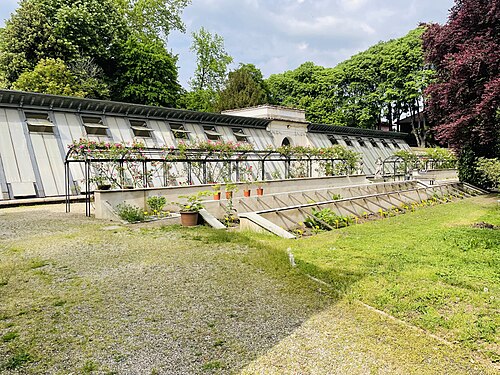
In the park of Villa Visconti Borromeo Arese Litta at Lainate, north-west of Milan, two iron-and-glass greenhouses in the Liberty style carry on a tradition of heated glasshouses recorded on the estate since the 18th century. Enlarged between 1892 and 1898 by the Riccardi Pietro firm of Rivoli, while the Weill Weiss barons owned the villa, they were used for orchid growing by the Toselli family, owners from 1932. Restored from 2015 with backing from the Fondazione Cariplo, they have been open to visitors since 2016 and hold more than 2,800 orchids looked after with the Lombard orchid growers' association, ALAO.
Affiliate links — booking through Verrière helps fund our research, at no extra cost to you.
History
1 min
The villa at Lainate was conceived around 1585 by Count Pirro I Visconti Borromeo, who had a nymphaeum built between 1585 and 1589 to designs by the architect Martino Bassi. In the 18th century the estate passed to the Litta family, and early in the 19th century Luigi Canonica reworked part of the park in the English manner. According to Il Giornale dell'Arte, a complex system of hot and cold greenhouses already existed in the first half of the 18th century. The villa's website and Il Giorno add that on either side of the exedra holding a terracotta group of the Rape of Proserpina, two cold houses sheltered the citrus trees in winter before two heated houses were given over to exotic plants. In 1840 the botanist Linneo Tagliabue recorded pineapples, bananas, coffee, tamarinds, palms, orchids, hibiscus and gardenias there.
After the state confiscated the villa in 1870, Baron Ignazio Weill Weiss bought it in 1872, and the greenhouses were altered and enlarged between 1892 and 1898 by the Riccardi Pietro firm of Rivoli. Sources disagree on the date of the Liberty houses: 1837 according to Il Giornale dell'Arte, the late 19th century according to Il Giorno, the early 20th century according to Italian Wikipedia. The property passed to Erminio Riboni in 1916 and in 1932 to the Toselli family, already orchid growers in Belgium, who carried on the business at Lainate until the end of the 1960s. The town bought the villa in 1970 or 1971, depending on the source. From 2015 both greenhouses underwent a careful restoration co-funded by the Fondazione Cariplo, and they reopened to the public in 2016.
Architecture and engineering
1 min
The Liberty greenhouses, also known as the 'hot houses', stand next to the park's Teatro Naturale; they are two iron-and-glass buildings that step down to the level of the parterre. According to a visitor guide, one wall of each structure is entirely glazed, and mechanisms fixed to the iron frames were used to regulate ventilation. A large boiler kept up a continuous spray of steam, so that exotic species could be sheltered and grown there; according to the same guide, part of the space is still used to raise plants that are then set out in the park.
The 1892-1898 enlargement, carried out by the Riccardi Pietro firm of Rivoli near Turin, drew on models then common in England and the Netherlands, as Il Giornale dell'Arte notes. The park also keeps two masonry orangeries, separate from these glazed houses. The programme begun in 2015, described as a philological recovery, covered both structures; the villa's website links it to a recovery plan that received one million euros from the Fondazione Cariplo. None of the sources consulted gives the dimensions or floor area of the greenhouses.
Plant collections
1 min
The greenhouses hold a historic collection of more than 2,800 rare orchids that once belonged to one of the founders, now deceased, of the Associazione Lombarda Amatori Orchidee (ALAO). The town of Lainate and the association, which has been active for more than forty years, look after it together. The core of the collection is made up of Cattleya, Bulbophyllum, Paphiopedilum and Phragmipedium, alongside Aerangis, Angraecum, Coelogyne, Dendrobium, Epidendrum, Maxillaria, Oncidium, Odontoglossum and Stanhopea, among others.
Highlights include plants of Mexipedium xerophyticum and the hybrid Cattlianthe Porcia Cannizzaro, which is now almost impossible to find in the trade. Many of the plants are award winners and more than thirty years old, and some species are extinct in the wild or severely threatened. A display of cacti and succulents from the Americas, from California, Mexico and Central America, rounds off the collection with Mammillaria, Ferocactus, Gymnocalycium, Agave and Echinocereus.
Visiting
1 min
The greenhouses are shown by ALAO volunteers, who run free guided visits without booking on the third Sunday of each month; extra openings accompany some local events, such as the San Rocco fair in September or the Historic Park Day.
A visit pairs naturally with the park and villa: the late 16th-century nymphaeum and its water games, a hornbeam gallery about 800 metres long, Italian parterres and a romantic grove, with 56 species of historic trees, among them a ginkgo planted around 1850.
45.57° N, 9.03° E
Greenhouses nearby
More greenhouses — Italy
Do you have a good photo of this greenhouse? Suggest it for this page →
Sources (7)
- villalittalainate.it/page.php?id=21&title=Parco+Storico
- ilgiornaledellarte.com/Articolo/Le-Serre-Liberty-di-Villa-Litta-custodiscono-una-collezion
- ilgiorno.it/milano/cosa-fare/il-patrimonio-botanico-oltre-2800-c96bf189
- it.wikipedia.org/wiki/Villa_Visconti_Borromeo_Arese_Litta
- alao.it/apertura-serra-06-settembre-2026-ore-1430/
- lorenzotaccioli.it/villa-litta-lainate-guida-completa-visita/
- en.wikipedia.org/wiki/Villa_Litta,_Lainate