Greenhouses of the Orto Botanico of the University of Genoa (Hanbury)
Genoa, Liguria
Entry updated on October 1, 2026
- Year
- 1859 (large greenhouse); rebuilt in 1965
- Architect
- Unknown
- Style
- Masonry greenhouses arranged on three levels, rebuilt with automatic climate control
- Dimensions
- Six greenhouses, about 1,000 m² on three levels
- Status
- Open to the public
Founded in 1803 by Domenico Viviani, the University of Genoa's botanical garden covers about a hectare behind the university palace. In 1859, under Giuseppe De Notaris, work began on a large masonry greenhouse of about a thousand square metres, rebuilt in 1965 with automatic control of ventilation, temperature, watering and humidity. The complex now has six greenhouses showing tree ferns, figs, aquatic plants, euphorbias, bromeliads, orchids and cycads.
Affiliate links — booking through Verrière helps fund our research, at no extra cost to you.
History
1 min
The University of Genoa founded its botanical garden in 1803 under Domenico Viviani, on a small 2,000 m² plot taken from the former Jesuit college of St Jerome in the Balbi district. In 1835 the university acquired a further 4,000 m² from the Pietraminuta estate, creating two terraces; the garden reached its present extent of about one hectare in 1865.
Under Giuseppe De Notaris, director from 1839 to 1872, construction began in 1859 on the large masonry greenhouse of about a thousand square metres, intended to house many exotic plants both in the ground and in pots. Ottone Penzig, working with Sir Thomas Hanbury, later had the new Botanical Institute built (1890-1892), inaugurated in 1892 during the first International Botanical Congress held in Italy.
Second World War bombing destroyed the Institute, leaving only its perimeter walls. In hard winters the staff heated the greenhouses by burning dried herbarium material and pieces of wood from the museum. Rodolfo Pichi Sermolli, director from 1958 to 1972, had the large greenhouse rebuilt in 1965 with automated equipment. Since 2006 a major programme of repair and reopening to the public has relied on university staff and volunteers.
Architecture and engineering
1 min
The large greenhouse of 1859 is described as a masonry building of about a thousand square metres; the sources consulted do not name its architect. It was rebuilt in 1965: under Pichi Sermolli it received what were considered advanced technologies for the time, with automatic control of ventilation, temperature, watering and humidification.
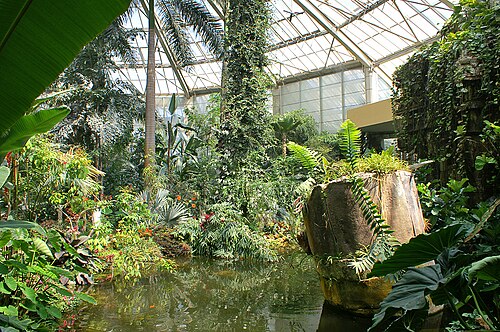
The garden, squeezed onto one hectare in the middle of the city, rises in terraces, and the glasshouses follow the same logic: six greenhouses of different periods, together about 1,000 m² on three levels. Each reproduces a distinct ecological situation: a fern house, a tropical canopy house where tall plants grow in the ground, pools for aquatic plants, a succulent house, a house for tropical herbaceous plants and a cycad house.
Access is through the university palace, by terraced spaces near a staircase flanked by centuries-old cypresses.
Plant collections
1 min
The fern collection, very renowned in the first half of the twentieth century with several hundred species, is being rebuilt; it includes tree ferns such as Cibotium regale and rarities such as Angiopteris evecta. In the tropical canopy house tall plants grow in the ground, among them 25 species of Ficus and Ravenala madagascariensis.
An aquatic house brings together ornamental water lilies, water hyacinths and papyrus (Cyperus papyrus). The succulents include 30 species of Euphorbia, among others. Bromeliads and orchids occupy the house for tropical herbaceous plants, and a further house presents cycads. In the open air the garden holds some 4,000 individuals representing nearly 2,000 taxa, with centuries-old trees such as a Lebanon cedar, cypresses and a coast redwood.
Visiting
1 min
The garden stands in central Genoa, on Corso Dogali behind the university palace, and is explored by terraces. Visiting the six greenhouses generally takes under an hour; groups can book guided visits through partner associations. The fern house, heir to the historic collection, and the fig-filled tropical canopy house are the two most striking stops.
The circuit is short and easy to combine with other visits in Genoa's historic centre. Since the garden is a teaching and research facility, plants carry their scientific names, which makes it as useful to students and amateur botanists as to casual visitors.
44.42° N, 8.93° E
Greenhouses nearby
More greenhouses — Italy
Do you have a good photo of this greenhouse? Suggest it for this page →