University of Leicester Botanic Garden Glasshouses
Oadby, Leicester (Leicestershire)

Sources checked October 2026
- Style
- Series of themed glasshouses with glazed roofs in a university botanic garden
- Dimensions
- Four glasshouses according to the university; the garden guide describes three (desert, alpine, warm-temperate and tropical)
- Status
- Open to the public, free entry; glasshouses closed at weekends, on bank holidays and over Christmas and New Year
The University of Leicester Botanic Garden, founded in 1921 and established at Oadby since 1947, shows its glasshouse plants in four glasshouses which, according to the university, display tropical, warm-temperate, alpine and succulent plants. The garden guide describes three: a desert house (cacti and other succulents), an alpine house that also holds a collection of species found wild only in the Balearic Islands, and a warm-temperate and tropical glasshouse where bananas, coffee, rice, sugar cane, mango and pineapple grow alongside palms, cycads and carnivorous plants. The whole sits within sixteen acres of gardens laid out around four houses of the early twentieth century.
Affiliate links — booking through Verrière helps fund our research, at no extra cost to you.
History
The University of Leicester Botanic Garden goes back to 6 October 1920, when the officers of the Botanical Section of the Leicester Literary and Philosophical Society were invited to set up a garden in the grounds of Leicester, Leicestershire and Rutland College, the forerunner of the university. Work began in early 1921 under the principal guidance of A. R. Horwood, in effect the first curator. Completed in 1925, the garden then comprised a woodland garden, medicinal, culinary and dye plants, a rock and water garden, British order beds and an experimental area of grasses.
In 1947, new buildings on the campus forced a move to Oadby, onto the grounds of four houses: Hastings (1902), Beaumont (1904), Southmeade (1928) and The Knoll (1907 or 1908, depending on the university's pages). The first three were designed by the architect Stockdale Harrison or his sons James and Shirley, the fourth by William Henry Bidlake. In its heyday the Beaumont garden, reputed to be the finest in Leicestershire, employed ten gardeners, five of them in the greenhouses: the site therefore had glasshouses long before the university. After The Knoll was bought in 1964 the boundaries between the four properties were removed as far as practicable, and by 1967-68 the present garden was taking shape.
The university now refers to four greenhouses. On 12 September 2023 the BBC reported that it planned to sell several student residences in Oadby, Hastings House among them, in order to reinvest partly in the 16-acre garden.
Architecture and engineering
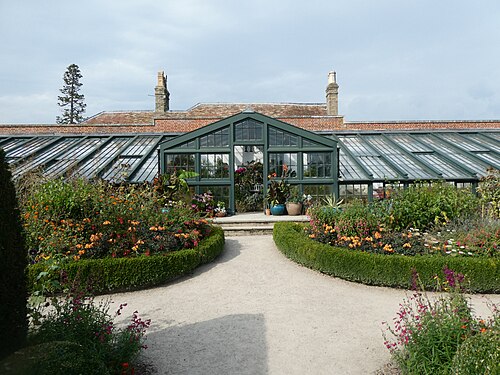
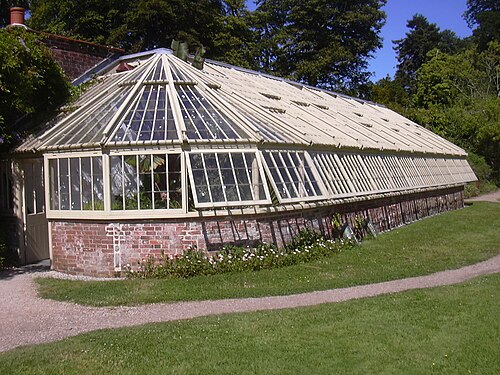
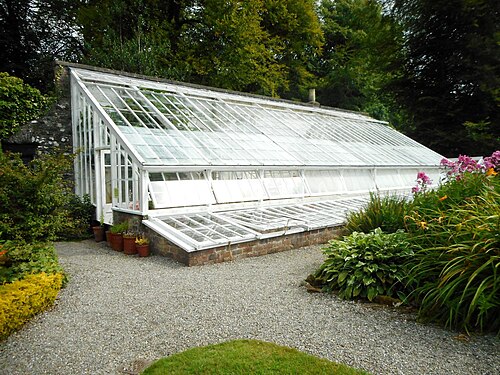
The university and the local press call these buildings "glasshouses"; none of the texts consulted gives the date of construction, the builder, the architect or the materials. The glazing shows in visitor photographs published on the Doc Brown site: the tropical and warm-temperate house has a glazed roof on a white metal frame, and the Desert House, captioned "cacti greenhouse", a glazed roof above the cacti. The pictures are undated but later than 2013, since the same page captions sculptures from 2012 and 2013.
The organisation is climatic. The "About us" page counts four greenhouses, for tropical, warm-temperate, alpine and succulent plants; the garden guide describes three: a Desert House, an Alpine House and one glasshouse combining a warm-temperate and a tropical section. The latter comes in the visitor route just before Hastings House, and the guide places a "Hastings Glasshouse" beside the order beds. The collaborative OpenStreetMap map draws two neighbouring footprints of about 285 m² each there, while a "Desert House" (about 74 m²) and a "Sub-Tropic House" (about 122 m²) lie 250 m to the north, near Beaumont House.
One detail hints at the interior volume: in 2023 an agave of more than 15 feet (about 4.6 m) had to be cut back because it was pushing against the roof of its greenhouse.
Plant collections
The desert house shows cacti and other plants that have adopted a similar way of life in very dry or salty environments: fleshy organs that store water, spines or sharp-pointed leaves, and a special mode of photosynthesis that takes in carbon dioxide at night rather than by day.
The alpine house gives one side to plunge beds holding a diverse array of alpines, the other to a collection of species that occur wild only in the Balearic Islands. This conservation collection is also a teaching resource for an undergraduate course.
The warm-temperate glasshouse includes the bird-of-paradise flower, a small collection of palms and cycads, and carnivorous plants: sundews, flytraps and pitcher plants. The tropical section recreates a rainforest and displays economically important plants: bananas, coffee, rice, sugar cane, mango and pineapple. A small display recalls Alfred Russel Wallace and Henry Walter Bates, two former residents of Leicester who contributed to the understanding of evolution.
In July 2023 an agave of more than 15 feet, which had appeared spontaneously after an earlier agave flowered and died in 1998, opened its flowers as large yellow pom-poms; like its kind, it was expected to die before the end of the year.
Visiting
The glasshouses stand in the 16-acre garden, entered from Glebe Road, where parking is free. According to the university's visitor page they are closed at weekends, on bank holidays, on university closure days and over Christmas and New Year, while the garden itself is open throughout the week; the site also closes in high winds or ice. A garden-recommendation site adds that the glasshouses and arboretum shut occasionally and advises checking opening times before travelling. Entry to the garden is free except on some event days, and the paths suit wheelchair users.
Nearby are the water garden, the sandstone garden with its Japanese maples, the limestone garden and its bristlecone pine, the hardy fuchsia collection (at its best from late August to October), the National Collection of Skimmia and twelve permanent sculptures. The Attenborough Arboretum, a five-acre satellite in the Knighton district, was opened on 23 April 1997 by Sir David Attenborough; its entrance is on Carisbrooke Road. Guided tours for groups can be booked.
52.61° N, 1.09° W
Greenhouses nearby
More greenhouses — United Kingdom
Do you have a good photo of this greenhouse? Suggest it for this page →
Sources (10)
- le.ac.uk/botanic-garden/about-us
- le.ac.uk/botanic-garden/about-us/garden-preview
- le.ac.uk/botanic-garden/about-us/history-of-the-garden
- le.ac.uk/botanic-garden/visitor-information
- le.ac.uk/news/2023/july/agave
- bbc.co.uk/news/uk-england-leicestershire-66777231
- docbrown.info/docspics/midlands/mspage33.htm
- supergardens.co.uk/gardens/leicester-botanic-garden/
- en.wikipedia.org/wiki/University_of_Leicester_Botanic_Garden
- openstreetmap.org/way/165743430
Affiliate links — booking through Verrière helps fund our research, at no extra cost to you.