Tropical Greenhouse of the University of Szeged Botanical Garden (SZTE Füvészkert)
Szeged, Csongrád-Csanád County
Entry updated on October 5, 2026
- Year
- 2014
- Style
- Contemporary greenhouse with two climate sections
- Dimensions
- Over 500 m²; interior height of at least 7.5 m
- Status
- Open to the public
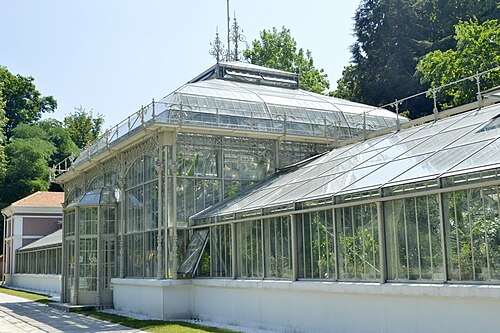
Opened to the public on 26 April 2014 in the University of Szeged Botanical Garden, founded in 1922, this greenhouse of more than 500 m² replaced the old, outdated tropical house while keeping in place plants that had grown there for some fifty years. Funded through a European programme at a cost of nearly 250 million forints, it combines two climates under an interior height of at least 7.5 m: a warm, humid section arranged around a multi-level pool, and a dry section where the cactus and succulent collection, previously closed to visitors, is now on display.
Affiliate links — booking through Verrière helps fund our research, at no extra cost to you.
History
1 min
The Szeged botanical garden dates from 1922, when the university, transferred from Kolozsvár (now Cluj-Napoca), received twenty cadastral holds of farmland from the city. Its first director, the botanist István Győrffy, began planting in 1925 with material gathered on collecting trips. An artesian well was sunk in 1928, a propagation greenhouse went up in 1929-30, and the first pond was finished in 1931, the year the garden issued its first seed-exchange list (Index Seminum). The Indian lotus arrived in 1932 from the Návay castle.
Under Pál Greguss, director from 1940, the garden acquired teaching collections (a rose garden, a rock garden, an arboretum and a systematic collection) and, between 1952 and 1958, greenhouses for tropical crop plants. Imre Horváth, who took over in 1965, enlarged the site by ten cadastral holds, laid out plant communities, the first such display in Hungary, and built a phytotron for research.
The present greenhouse grew out of a project led by Erzsébet Mihalik, director from 1996 to 2013, and funded under the Environment and Energy Operational Programme 2007-2013, through a call for the preservation of collection gardens and protected historic gardens. Built on the site of the old tropical house, it was handed over to the university on 31 January 2014 and opened to visitors on 26 April 2014, to coincide with Earth Day. An orchid house was added in 2020.
Architecture and engineering
1 min
The 2014 building covers more than 500 m² and has an interior height of at least 7.5 m. It is divided into two sections with separately controlled climates. The tropical side is kept at 22-24 °C and around 90 per cent humidity, and is organised around a heated concrete pool built on several levels to suggest the vegetation of tropical rivers and lakes. An internal gallery runs round the space so that visitors can look at the plants at canopy height, and a green wall 2.5 m high, enlivened by running water, carries the fern collection. The second section, cooler and dry, is given over to drought-adapted plants.
The project also renewed the heating plant: three new condensing boilers, backed up by mixed-fuel standby units, serve the greenhouse, and the heating of the whole institution, a garden of 17 hectares, was modernised at the same time.
Plant collections
1 min
The tropical section pairs useful plants such as cacao and banana with rainforest species, among them South African strelitzias and screw pines. The pool holds water lilies, papyrus, water hyacinths and the giant Amazonian water lily, while carnivorous plants are represented by pitcher plants and trumpet pitchers, and ferns clothe the green wall. The displays follow four themes: useful plants, rainforest flora, plant adaptations and threatened species. Much of the stock of the old greenhouse, some of it grown there for about fifty years, was kept in place during the rebuilding.
The dry section shows the garden's collection of cacti and succulents, which had previously been closed to the public. The orchid house opened in 2020 holds, according to the garden, 250 to 300 plants: nearly 90 species and 70 hybrids from 60 genera.
Visiting
1 min
The greenhouse stands in the university's Füvészkert in Újszeged, across the Tisza from the city centre. It is open all year and pairs naturally with the outdoor collections of the 17-hectare garden (rose garden, rock garden, Japanese garden, arboretum and systematic beds), which a two-hour visit covers without hurry. In high summer the Indian lotus, grown here since 1932, flowers on the ponds, and the orchid house extends the tour. Attendance has been rising steadily, from more than 30,000 visitors in 2017 to over 50,000 in 2024.
46.23° N, 20.16° E
Greenhouses nearby
More greenhouses — Hungary
All greenhouses — Hungary →
Do you have a good photo of this greenhouse? Suggest it for this page →