Tropical Glasshouses of Planten un Blomen (Tropengewächshäuser)
Hamburg
Entry updated on September 30, 2026
- Year
- 1963
- Architect
- Bernhard Hermkes
- Style
- 1960s modernism, glass hung from external hollow-box profiles
- Dimensions
- ≈2,800 m² ground area, 13 m maximum height
- Status
- Closed to the public since 2019; restoration scheduled for 2026–2029
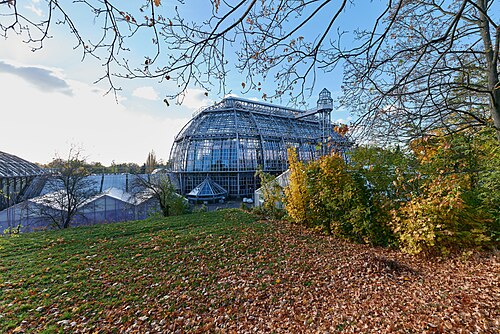
Designed by Bernhard Hermkes in 1962-63 and opened during the 1963 International Garden Exhibition (IGA), the Tropengewächshäuser of Planten un Blomen cover about 2,800 m² and reach 13 m in height. Five houses recreate distinct climates: tropical, subtropical, palm fern, cactus and fern. Free and open daily until 2019, they have been closed since because of their condition. In 2023 the Hamburg Senate approved 61 million euros for a restoration scheduled from 2026 to 2029.
Affiliate links — booking through Verrière helps fund our research, at no extra cost to you.
History
1 min
The tropical glasshouses were built in 1962-63 to designs by the architect Bernhard Hermkes and opened during the Internationale Gartenbauausstellung (IGA) of 1963, in the Planten un Blomen park in central Hamburg. Until 2019 they could be visited free of charge every day. Their condition then forced their closure.
In August 2023 the Hamburg Senate approved a restoration project costing 61 million euros. The plants are to move temporarily to a newly built facility at the Loki-Schmidt-Garten, the university's botanical garden, and the works are scheduled for 2026 to 2029. The houses and the neighbouring Mediterranean terraces are listed monuments. The sources consulted disagree on which IGA editions were held at Planten un Blomen (1953 and 1973 in one, 1963 in another); the opening of the glasshouses in connection with the 1963 edition is not in doubt.
Architecture and engineering
1 min
Bernhard Hermkes devised a building whose structural principle is remarkable: the glazed construction hangs from hollow box profiles placed on the outside, so that the interior is free of any columns. This leaves continuous volumes.
The complex covers about 2,800 m² of ground and reaches a maximum height of 13 m. It is made up of five distinct climate areas: a tropical house, a subtropical house, a palm-fern house, a cactus house and a fern house. The houses and the adjoining Mediterranean terraces are listed monuments. The sources consulted give neither precise materials nor the area of each house.
Plant collections
1 min
The plants are distributed among the complex's five climates: tropical vegetation, subtropical plants, cycads (Palmfarne), cacti and ferns. The sources consulted provide no species list and name no notable specimens; the park's botanical tradition itself reaches back to 1821, when Johann Georg Christian Lehmann planted a plane tree in what became the Old Botanical Garden.
During the closure and works the plants are to be accommodated at the Loki-Schmidt-Garten, the University of Hamburg's botanical garden, opened in 1979 on about 25 hectares and renamed in 2012 in honour of Hannelore "Loki" Schmidt.
Visiting
1 min
The glasshouses have been closed since 2019 and their restoration is scheduled through 2029: for now the site can only be seen from outside, and the progress of the works should be checked before a visit. The Planten un Blomen park itself remains a destination for a walk.
Nearby are the Wasserlichtkonzerte, programmed from May to September, the Japanese garden created in 1988 by Yoshikuni Araki and described as the largest in Europe, the rose garden of 1993 with some 300 varieties, and the Alter Botanischer Garten. Allow half a day for the park.
53.56° N, 9.98° E
Greenhouses nearby
More greenhouses — Germany
Do you have a good photo of this greenhouse? Suggest it for this page →