Fernery and Conservatory (Orangery), Tatton Park
Knutsford, Cheshire
Entry updated on October 5, 2026
- Year
- 1818 · fernery 1859
- Architect
- Lewis Wyatt (conservatory); George H. Stokes or Joseph Paxton (fernery)
- Style
- Neoclassical sandstone conservatory; Victorian brick, iron and glass fernery
- Dimensions
- Seven-bay conservatory front; L-plan fernery
- Status
- Open to the public (Tatton Park gardens)
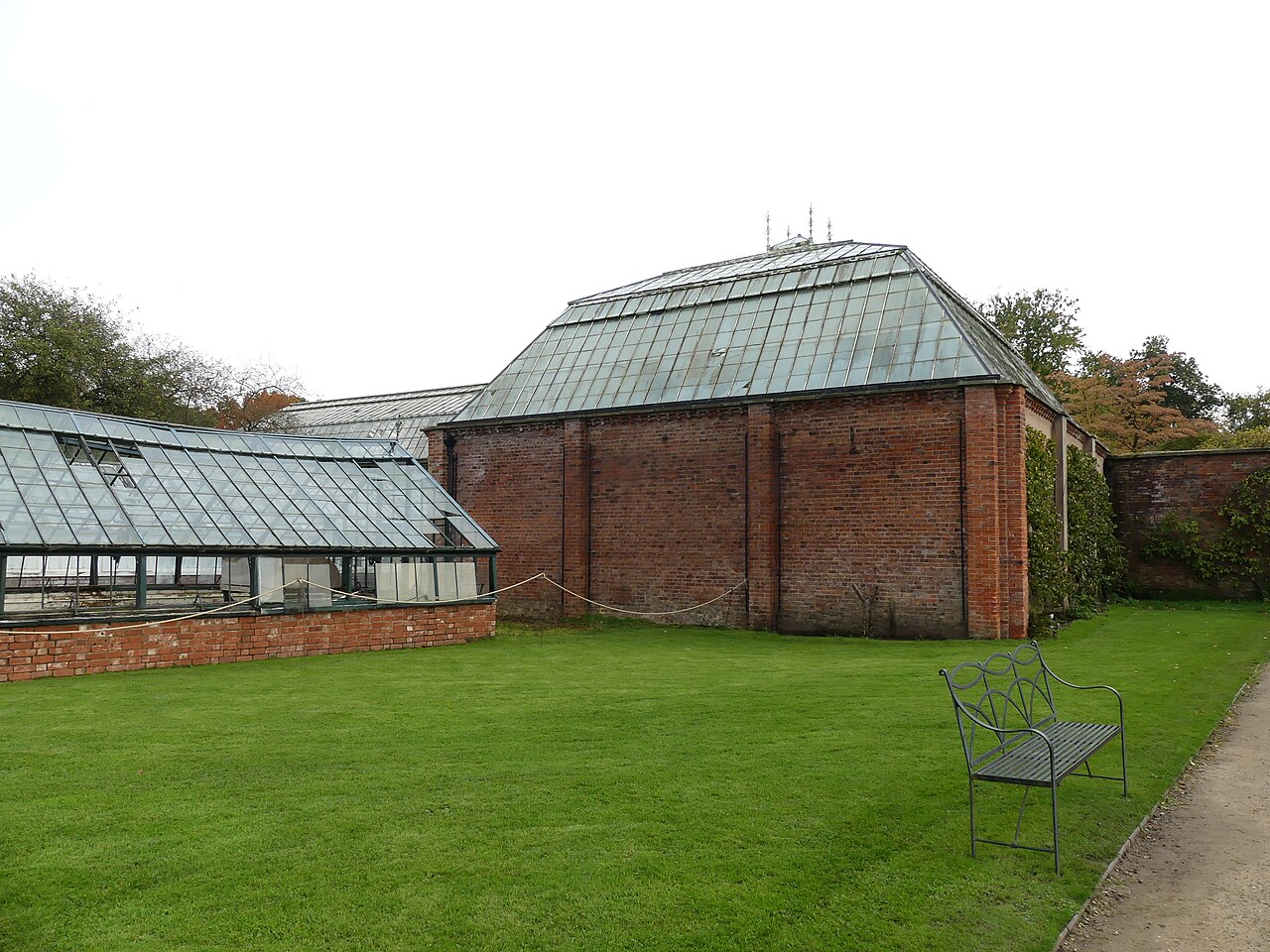
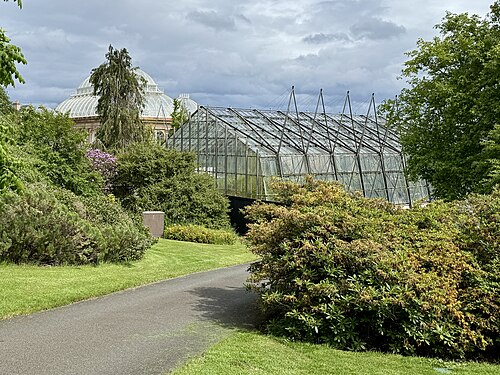
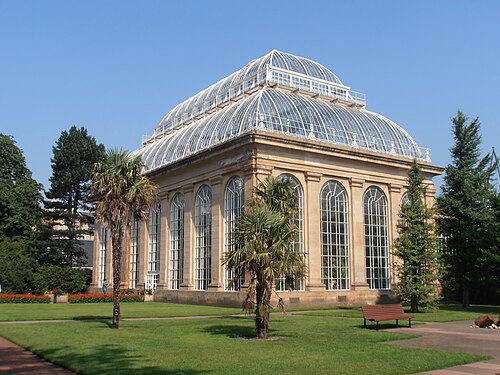
In the gardens of Tatton Park near Knutsford, the sandstone conservatory designed by Lewis Wyatt and completed in 1818 was originally joined to the Egertons' house by a glazed passage. A small stove house links it to the fernery built in 1859 for tree ferns from New Zealand: a tall, L-plan brick building roofed in iron and glass, credited, depending on the source, to George Stokes, Joseph Paxton's assistant and son-in-law, or to Paxton himself. Restored from 1992 to 1994 by Cheshire County Council and the National Trust, the three buildings received a Europa Nostra diploma.
Affiliate links — booking through Verrière helps fund our research, at no extra cost to you.
History
1 min
Tatton Hall, the Egerton family's house in Cheshire, was built between 1774 and 1818. In 1814 Lewis Wyatt designed the first formal garden for the present house, Charlotte's Garden, a kidney-shaped layout possibly drawn up with John Webb, followed by the sandstone conservatory, completed in 1818. Originally joined to the house by a glazed passage, it is also called the Orangery because oranges were grown in it for a time; its planting in the 1820s and 1830s is known from Thomas Edgerley's records.
In 1847 Joseph Paxton designed the Italian Garden on the terraces, laid out by Edward Milner. In 1859 a tall fernery was built just north-west of the conservatory to house tree ferns from New Zealand. Its authorship varies between sources: George Stokes, Paxton's assistant and son-in-law, or Paxton himself, the register of historic parks favouring Paxton, possibly with Stokes, while the listing dates it to around 1860. Its roof was raised in the late nineteenth century, the period from which the conservatory roof also dated, and that roof was collapsing by 1990.
From 1992 to 1994 Cheshire County Council and the National Trust jointly restored the conservatory, the fernery and the small stove house linking them, work recognised in 1994 by a Europa Nostra diploma. The gardens, owned by the National Trust, are run by Cheshire East Council. The fernery was used as a setting in the television series Brideshead Revisited.
Architecture and engineering
1 min
Lewis Wyatt's conservatory is a sandstone building on a stone plinth with a glass roof. Its cross plan shows in a seven-bay front whose end bays are angled; the three central bays project and are marked by monolithic pilasters carrying an entablature. It is listed Grade II.
The fernery, listed Grade II*, is L-shaped: a square hall at the west end, continued eastwards by a wing of the same height. Its red-brick walls, laid in English garden wall bond, are partly rendered, with stone dressings and a modillion cornice. In the wing, five and a half bays are formed by iron trusses resting on stone corbels; in the square hall, eight pierced iron arched braces, set at the corners and in the middle of each side, rise to a glazed central square, and four iron finials crown the roof.
Between the two, a small stove house provides the link. During the restoration its late nineteenth-century roof was reconstructed from a photograph, replacing a modern aluminium structure, while the fernery was completely re-roofed and repainted.
Plant collections
1 min
The fernery was designed for tree ferns from New Zealand and holds an extensive collection of ferns and tree ferns from New Zealand and Australia. The British Pteridological Society singles out Dicksonia, Cyathea and Woodwardia, shown in the humid setting of a restored Victorian fernery.
The conservatory takes its other name from the oranges once grown in it, and Tatton's glasshouses housed plants imported from Europe and further afield. During the 1990s restoration, the shape of the original planting beds was recovered from the planting records kept by Thomas Edgerley in the 1820s and 1830s.
In the estate's kitchen garden, other glasshouses show what used to be grown there, including a restored pinery-vinery for growing pineapples.
Visiting
1 min
The conservatory and fernery are part of the gardens of Tatton Park, a National Trust estate run by Cheshire East Council near Knutsford, registered at Grade II* on the national register of historic parks and gardens. A visit combines naturally with the estate's other gardens: the Italian Garden designed by Paxton in 1847, the Japanese garden created in 1910 by Alan Egerton, 3rd Baron Egerton, often described as the finest in the United Kingdom, the kitchen garden and its pinery-vinery, what survives of Lewis Wyatt's Charlotte's Garden, and the African Hut, azaleas and rhododendrons added by Maurice Egerton, 4th Baron Egerton.
53.33° N, 2.39° W
Greenhouses nearby
More greenhouses — United Kingdom
Do you have a good photo of this greenhouse? Suggest it for this page →
Sources (6)
- en.wikipedia.org/wiki/Tatton_Park_Gardens
- en.wikipedia.org/wiki/Listed_buildings_in_Tatton,_Cheshire
- britishlistedbuildings.co.uk/101139535
- europeanheritageawards-archive.eu/laureates-1978-2022/detail/conservatory-fernery-and-stov
- historicengland.org.uk/listing/the-list/list-entry/1000501
- ebps.org.uk/ferns/growing/where-to-see-ferns/