Noilly-Prat Tropical Greenhouse, Jardin botanique E. M. Heckel (Parc Borély)
Marseille, Provence-Alpes-Côte d'Azur
Entry updated on October 1, 2026
- Year
- 1870
- Style
- Nineteenth-century wrought-iron and glass conservatory, Baltard-inspired (nicknamed the "Eiffel greenhouse")
- Dimensions
- About 200 m², about 7 m high
- Status
- Closed to the public since 2004; restoration announced
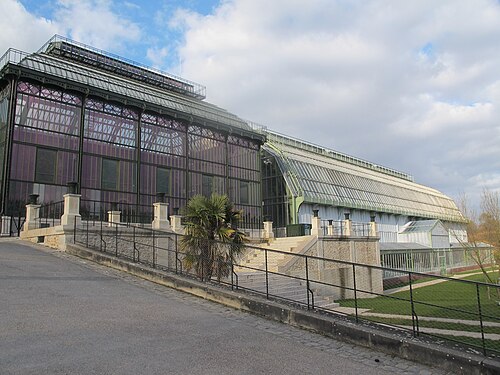
Built in 1870 in iron and glass as a winter garden for the Noilly-Prat family, this greenhouse was bought by the City of Marseille and re-erected in 1982 in the botanical garden of Parc Borély, where it was inaugurated in 1984 with an orchid show. It covers about 200 m². Closed to the public since 2004 after safety problems and a boiler failure, it has badly deteriorated and escaped demolition. A restoration project costing an estimated 2 million euros was announced for 2023; a permit mentioned for mid-2026 leaves the works pending.
Affiliate links — booking through Verrière helps fund our research, at no extra cost to you.
History
1 min
The greenhouse is said to have been built in 1870 as a private winter garden for the Noilly-Prat family, vermouth merchants, at their Montcalm château. Sources disagree on where the estate lay: Wikipedia places it in the Gard, whereas the Marseille tourist office mentions the Camargue; the local press speaks of construction "in the late nineteenth century". City officials nickname it the "Eiffel greenhouse", but no involvement of Gustave Eiffel is documented in the sources consulted.
In 1982, at the initiative of Mayor Gaston Defferre, the City of Marseille acquired the structure, which was dismantled and re-erected in the botanical garden within Parc Borély. The tourist office mentions a purchase price of 500,000 francs and an inauguration in 1984 with an orchid exhibition.
Since 2004 the greenhouse has been closed to the public on safety grounds, following a boiler failure. Threatened with demolition, it was saved, and a corrosion survey was carried out ahead of restoration. In 2020 the city announced a 2-million-euro project for the end of 2023, with a design approved by the architect of the Bâtiments de France. That schedule slipped: a permit mentioned for mid-2026 is cited by the tourist office.
Architecture and engineering
1 min
The wrought-iron and glass structure is described by Wikipedia as inspired by Baltard's pavilions and belongs to the nineteenth-century tradition of metal construction. The tourist office calls it a cathedral of glass and metal in the Eiffel manner. The corrosion survey carried out before restoration records a cast- and wrought-iron frame about 7 metres high; the covered area is around 200 m².
Like all greenhouses of its kind, the building relied on a boiler to keep a tropical climate, which explains the part played by the 2004 breakdown in its closure. Broken panes have multiplied and the frame is rusting, to the point that the structure is surrounded by safety barriers. The architect of the rehabilitation project is the firm Fabrica Traceorum, with the engineering consultancy A-Corros carrying out the diagnosis. The restoration aims to respect the building's historic character while giving it back a botanical function with public access.
Plant collections
1 min
Originally a winter garden, the building was later devoted to the tropical plants of the botanical garden and hosted an orchid exhibition at its 1984 inauguration. Despite the neglect, palms, figs and orchids survive inside according to the tourist office, and the local press notes that exotic plants now grow there unchecked.
Nearby, a separate greenhouse shelters more than 300 South African species suited to a Mediterranean climate but flowering in winter, according to Wikipedia. The city has stated that this South African house is to reopen to the public. A teaching greenhouse of 80 m², devoted to gardening and biodiversity, was also announced alongside the tropical house.
Visiting
1 min
The Noilly-Prat tropical greenhouse stands in the botanical garden, in the eastern part of Parc Borély, in Marseille's 8th arrondissement. It is currently closed and fenced off, so this entry documents a heritage structure awaiting restoration rather than a place that can be entered at present. Readers should check with the City of Marseille on the progress of the works before travelling.
A visit to the botanical garden, to the South African greenhouse when it is open and to the rest of Parc Borély can fill half a day. The contrast between the closed historic glasshouse and the working gardens around it is part of the interest of the site for enthusiasts of metal-framed heritage.
43.26° N, 5.38° E
Greenhouses nearby
More greenhouses — France
Do you have a good photo of this greenhouse? Suggest it for this page →