Glasshouses and Orangery of the Münster Botanical Garden
Münster, North Rhine-Westphalia
Entry updated on October 5, 2026
- Architect
- Unknown
- Style
- Classical orangery of 1840 and glasshouses rebuilt after 1945
- Dimensions
- 10 glasshouses, about 2,000 m²
- Status
- Open to the public (only some of the glasshouses)
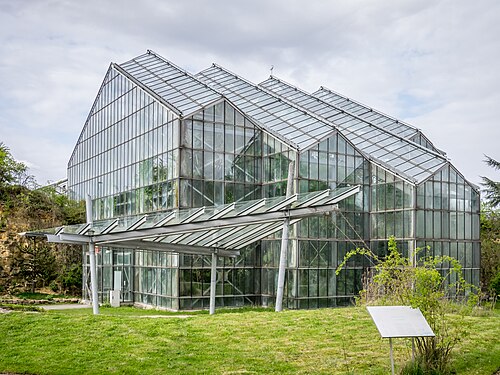
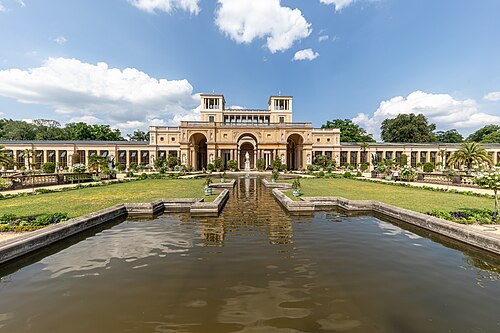
Founded in 1803 on the orders of Baron vom Stein in the former French parterre of Münster's palace, the university botanical garden had its first glasshouses by 1804. Its classical orangery of 1840, a listed monument, is still used to overwinter Mediterranean plants. All the glasshouses were destroyed in the Second World War and later rebuilt. The ten present houses, totalling about 2,000 m², include a large tropical house, a Victoria house, a succulent house and an epiphyte house.
Affiliate links — booking through Verrière helps fund our research, at no extra cost to you.
History
1 min
In 1803 Baron Heinrich Friedrich Karl vom und zum Stein, who had just taken over Münster's palace, decided to turn the former French parterre of its grounds into a botanical garden with glasshouses and collection beds for the medical faculty. The first glasshouses were built in 1804, and a first seed catalogue appeared in 1827. The orangery, still standing, dates from 1840.
Under the directorship of Friedrich Wilhelm Beneke, between 1915 and 1935, a tropical house was built for the first time; English Wikipedia dates it to 1935. The building carries relief heads of the directors of the period. The botanist Carl Correns was among the garden's directors, from 1909 to 1915.
The Second World War destroyed every glasshouse. Rebuilding was swift: according to German Wikipedia, five houses were standing again by 1949 and the garden had returned to something like its pre-war state by 1952, whereas English Wikipedia places the rebuilding of five houses in 1952. More recent additions include a stream, a meadow and a bog in the 1990s and a medicinal garden in 2005.
Architecture and engineering
1 min
The botanical garden covers about 4.6 hectares behind the palace, within the large park that Johann Conrad Schlaun planned on a geometric star-shaped layout, only partly carried out and reshaped in the 19th century by Peter Joseph Lenné and Joseph Clemens Weyhe. The glasshouses are grouped together in one part of the garden.
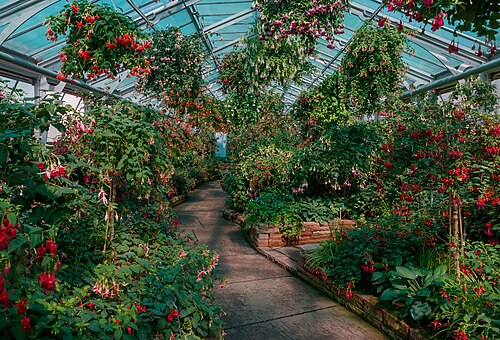
The oldest building is the classical orangery of 1840, a listed monument. True to its original purpose, it shelters frost-tender Mediterranean plants in winter and hosts temporary exhibitions. Around it, ten glasshouses cover about 2,000 m², of which only some are open to visitors, five or six depending on the source. They include the large tropical house, heated all year round, the Victoria house, named after the Victoria water lily, the succulent house and an epiphyte house, along with houses for the flora of the Canary Islands, the Cape and carnivorous plants.
Plant collections
1 min
The garden grows some 8,000 species. The Victoria house shows Victoria regia alongside useful plants of the tropics and subtropics such as coffee, papaya and pineapple. The succulent house illustrates how plants adapt to hot, dry zones, with species from the southern United States, Mexico and the Andes, and the epiphyte house displays close to 150 epiphytic plants.
Further houses present the flora of the Canary Islands, the Cape, Australia and New Zealand and the Mediterranean, as well as spore-bearing plants and medicinal plants. The garden also keeps research collections, including 230 of the 280 known Pelargonium species, spikemosses, carnivorous plants and parasitic plants. It owns orange trees more than two hundred years old.
Visiting
1 min
The garden lies directly behind Münster's palace, and admission is free. One to two hours is enough for the open glasshouses and the outdoor garden; the tropical house, warm even in winter, makes this a good visit in the colder months. Some 200,000 people come each year. The walk continues naturally into the palace park, originally designed by Johann Conrad Schlaun, grounds that the townspeople were first allowed to enter freely in 1788, by order of Elector Max Franz.
51.96° N, 7.61° E
Greenhouses nearby
More greenhouses — Germany
Do you have a good photo of this greenhouse? Suggest it for this page →