"Zielony Raj" Orangery, Polish Academy of Sciences Botanical Garden (Powsin)
Warsaw (Powsin), Masovia
Entry updated on October 5, 2026
- Year
- 2001–2003
- Style
- Dutch-system multi-span display glasshouses, taller than production greenhouses
- Dimensions
- About 2,000–2,200 m², depending on the source
- Status
- Open to the public
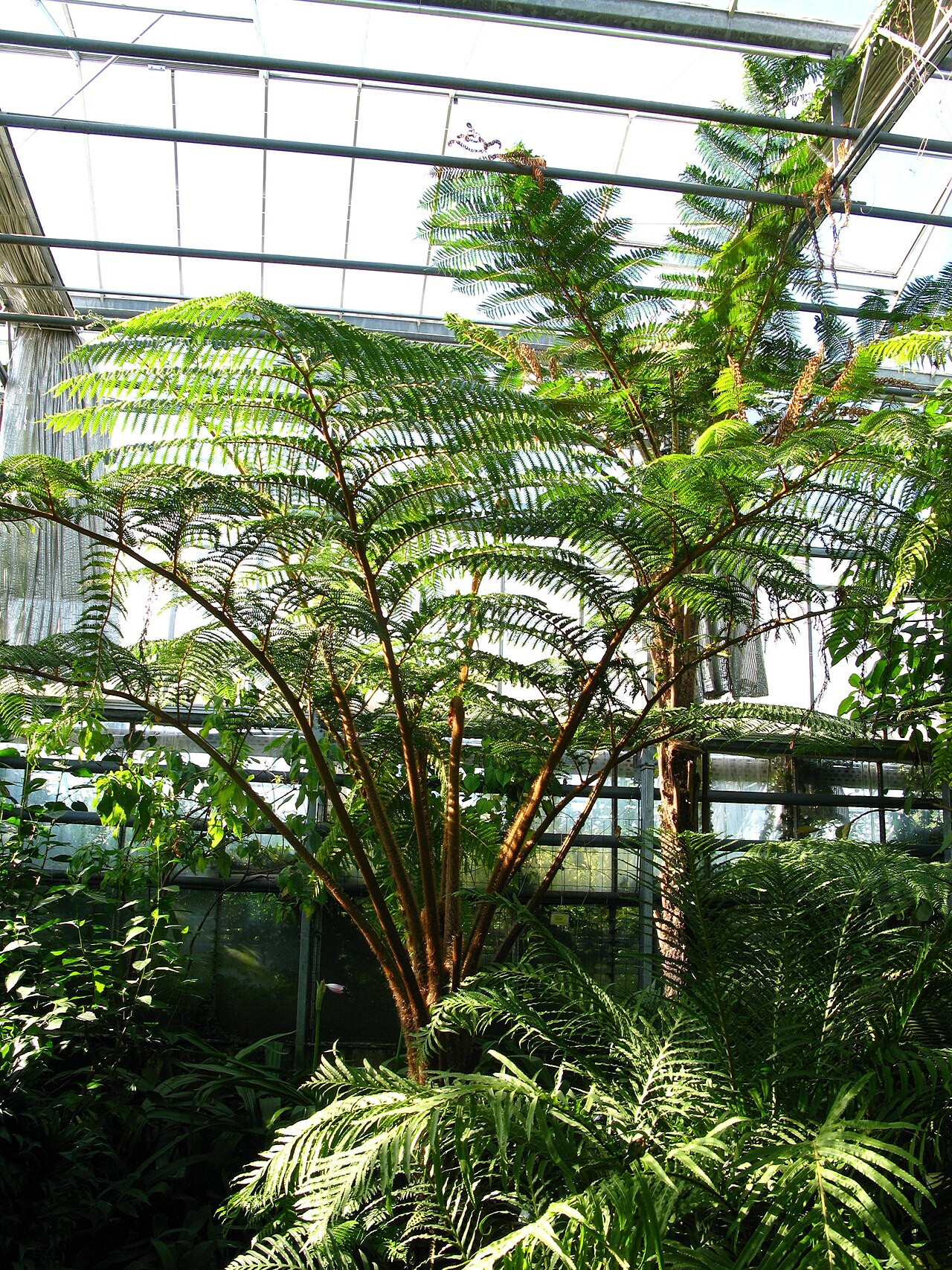
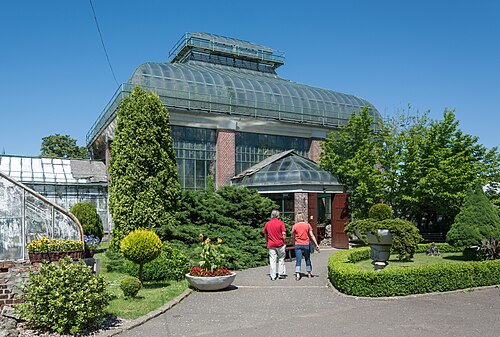
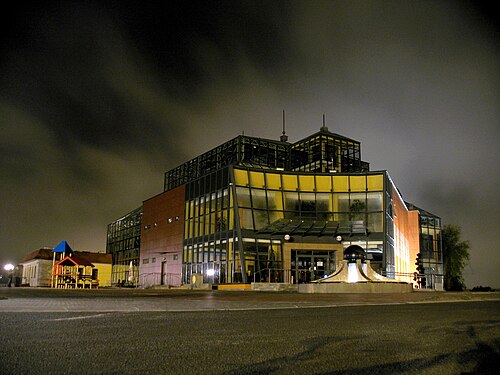
Opened in 2003 in the Polish Academy of Sciences Botanical Garden at Powsin, in the south of Warsaw, this display glasshouse was built from 2001 to 2003 on the Dutch multi-span model, but taller than production greenhouses. Across 2,000 to 2,200 m², depending on the source, five sections with different climatic needs hold some 1,500 species and varieties: Poland's largest citrus collection, 40 varieties of Japanese camellias that flower in winter, tree ferns, succulents and cacti. Its name, "Green Paradise", was chosen by a public vote.
Affiliate links — booking through Verrière helps fund our research, at no extra cost to you.
History
1 min
The idea of a large modern botanical garden for Warsaw goes back to 1928, when Professors Bolesław Hryniewiecki and Roman Kobendza tried to bring it about. A first plan, in 1948, placed the garden south of the city, on the grounds of a former golf club and the Powsin estate; a Central Botanical Garden, set up in 1957 as an institute of the Polish Academy of Sciences, was dissolved after ten months. The present garden was created on 1 July 1974 by decision of the government and the Academy; Bogusław Molski was its first director until 1989, and 40 ha were bought near Klarysew in 1976–1977. The public was admitted from 12 May 1990.
The glasshouses have their own chronology. The first, inherited with the buildings of the Janówek manor, dates from the early 1930s. In 1978–1979 the garden set up a 40 m² experimental glasshouse at Poland's Arctowski station in Antarctica, for growing vegetables and for botanical research; at Powsin itself, glasshouse construction began in 1979, and a second house, divided into two sections, followed in 1993. In 2001 the oldest glass structure was demolished and a new display house was built by 2003. Brought into use in December 2003, it was named "Zielony Raj" after a public vote. Since 2011 the institution has been called the Polish Academy of Sciences Botanical Garden – Centre for Biological Diversity Conservation.
Architecture and engineering
1 min
"Zielony Raj" belongs to the family of Dutch-system block, or multi-span, glasshouses, in which several glazed bays stand side by side. Those at Powsin were designed taller than ordinary production greenhouses. To accommodate the largest plants without raising the glass structure, a sunken area was created in the centre, where tall specimens are planted.
The floor area is given as about 2,000 m² by Wikipedia and as 2,200 m² in an Academy text published in 2024. The space is divided into five sections with distinct climatic requirements, covering tropical, subtropical and Mediterranean zones: the subtropical section holds the citrus and the camellias, the tropical section the tree ferns, and other parts house the cacti, succulents and Mediterranean flora. The glasshouse stands in a 40 ha garden, about 30 ha of which are open to visitors, with collections lying between 87 and 102 m above sea level.
Plant collections
1 min
Some 1,500 species and varieties from warm climates are grown under glass. The citrus collection, the largest in Poland, numbers 32 taxa of the genus Citrus, among them lemons, oranges, grapefruits, mandarins, pomelos and Buddha's hand. The Japanese camellias, represented by 40 varieties, flower in winter, and the useful plants also include coffee and tea.
Tropical ferns, including Platycerium, grow alongside a collection of tree ferns of the genera Dicksonia, Cyathea and Cibotium, described as the richest in Poland, together with aroids, epiphytic bromeliads and orchids. The succulents are represented by Euphorbia, Gasteria, Haworthia, Aloe, Agave, Plumeria and Nolina, as well as yuccas and dracaenas, beside cacti of many shapes. The house also shelters Wollemia nobilis, which until recently was known only from fossils.
Visiting
1 min
The glasshouse stands in the Powsin botanical garden, in the south of Warsaw, within a 40 ha estate of which about 30 ha can be visited: an arboretum of more than 2,500 species and varieties on some 6 ha, a national collection of over a thousand rose varieties, Polish flora, and useful and medicinal plants. Allow an hour for the glasshouse and half a day for the whole garden. Winter, when the camellias flower, shows the glasshouse at its best, while the rose garden and arboretum are better seen in the warmer months. Open since 1990, the garden has received more than four million visitors.
52.11° N, 21.10° E
Greenhouses nearby
More greenhouses — Poland

Do you have a good photo of this greenhouse? Suggest it for this page →
Sources (5)
- ogrod.pan.pl/szklarnie
- pl.wikipedia.org/wiki/Polska_Akademia_Nauk_Ogr%C3%B3d_Botaniczny_%E2%80%93_Centrum_Zachowa
- propertydesign.pl/architektura/104/ogrod_botaniczny_pan_w_powsinie_ma_50_lat,47673.html
- zielonyogrodek.pl/ogrod/wizyty-w-ogrodach/893-ogrod-botaniczny-w-powsinie
- openstreetmap.org/way/48088228