Glasshouses, Winterbourne House and Garden
Edgbaston, Birmingham (West Midlands)

Entry updated on October 5, 2026
- Year
- 1903
- Style
- Edwardian lean-to glasshouse with later university glasshouses
- Dimensions
- 20 m lean-to greenhouse
- Status
- Open to the public (University of Birmingham botanic garden)
In the Arts and Crafts garden laid out by Margaret Nettlefold in Edgbaston, the walled kitchen garden of 1903 keeps an original 20 m lean-to greenhouse, rebuilt in 2006. After the estate was left to the University of Birmingham in 1943-1944, the garden became the university's botanic garden and gained further glasshouses: a mid-twentieth-century brick-and-glass orchid house, a cedar alpine house of 2006, an arid house and a carnivorous plant house. The site has been open to the public since 2010.
Affiliate links — booking through Verrière helps fund our research, at no extra cost to you.
History
1 min
In 1902 the industrialist John Sutton Nettlefold acquired a ten-acre plot of meadow on Edgbaston Park Road for a family home. With his wife Margaret, née Chamberlain, he commissioned the local architect Joseph Lancaster Ball in 1903, and the red-brick Arts and Crafts house was finished in 1904. Margaret Nettlefold designed most of the garden herself, drawing on Gertrude Jekyll and her book Wood and Garden. The walled kitchen garden and its lean-to glasshouse date from 1903.
John Nettlefold moved away because of ill health in 1917, and in 1919 Margaret sold the property to the Wheelock family. In 1925 the businessman John Nicolson, a keen gardener, bought it and added a pergola, a Japanese bridge and a tea house in the 1930s. On his death he left the house and garden to the University of Birmingham; sources date the bequest to 1943 or 1944.
The house became a hall of residence for women students, and the garden was adopted as the university's botanic garden and used for research by the Department of Botany. The modern glasshouses belong to this university period, starting with the mid-twentieth-century orchid house. In 2006 the original lean-to was rebuilt and an alpine yard re-established with a new glasshouse. The restored house and garden opened to the public in 2010, and the garden is registered at Grade II.
Architecture and engineering
1 min
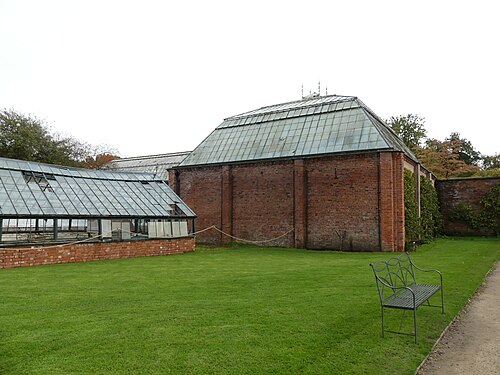
The 1903 walled kitchen garden, abutting the north side of the house, is roughly square, about 35 m across, with red-brick walls about 2.7 m high, one of them a wavy crinkle-crankle wall. The original glasshouse leans against the west half of the north wall: some 20 m long, it runs downhill with the slope rather than standing on a levelled terrace. The register of historic gardens calls it a good-quality lean-to; it was rebuilt in 2006.
East of the walled garden, where the Nettlefold children once had a sand pit, stands the orchid house of brick and glass, dating from the mid-twentieth century and the largest of the modern glasshouses. Beyond it, the alpine yard re-established in 2006 has a cedar glasshouse. An arid house and a carnivorous plant house complete the group: one Edwardian glasshouse and four built after the university took over.
Plant collections
1 min
Each glasshouse has its own speciality. The Gilbert Orchid House holds tropical orchids, tillandsias and other bromeliads; most of the orchids are epiphytes that draw moisture from the humid air through their aerial roots. The Alpine House is known for its lewisias, which flower profusely through March and April. The Arid House grows cacti and succulents, among them Agave americana 'Mediopicta Alba', which a member of the garden team names as a favourite for its architectural form. Another house is given over to carnivorous plants.
Around the glasshouses, the seven-acre garden keeps its Jekyll-inspired colour-themed borders, a sunken rock garden, geographical beds and a collection of Anthemis accredited under the National Plant Collection scheme.
Visiting
1 min
The glasshouses stand in and around the walled kitchen garden, north of the house, whose rooms are also open and furnished in Edwardian style. March and April are a good time to see the lewisias in flower in the Alpine House. The seven-acre garden continues with a tunnel-shaped nut walk, a pleached lime walk, the Japanese bridge and access to Edgbaston Pool, a Site of Special Scientific Interest. A tea room, a second-hand bookshop and working historic printing presses round off the visit. The glasshouses of Birmingham Botanical Gardens, also in this atlas, are about 1.5 km to the north.
52.45° N, 1.92° W
Greenhouses nearby
More greenhouses — United Kingdom
Do you have a good photo of this greenhouse? Suggest it for this page →