Tropenhaus am Rennsteig – Klein Eden (Tropical House)
Kleintettau (Tettau), Bavaria
Entry updated on October 5, 2026
- Year
- 2011–2014
- Architect
- Unknown
- Style
- Production and research glasshouse heated by the waste heat of a glassworks
- Dimensions
- About 3,500 m² under glass; 800 m² exhibition
- Status
- Open March to November; guided tours on registration
Built from 2011 in Kleintettau beside the Heinz-Glas glassworks, whose process heat it recovers, this glasshouse of about 3,500 m² was conceived as a reference project for using low-temperature waste heat. Its research asks whether tropical fruit can be grown profitably under glass in Central Europe, in a nearly closed loop with an integrated fish farm. Opened to visitors on 13 June 2014, it holds some 220 plant varieties and genera, among them papaya, passion fruit and star fruit, together with an 800 m² exhibition on the useful plants of the tropics.
Affiliate links — booking through Verrière helps fund our research, at no extra cost to you.
History
1 min
The Tropenhaus am Rennsteig, known as Klein Eden, stands in Kleintettau, a village in the municipality of Tettau in Upper Franconia. The site was chosen for a reason: the glasshouse was built beside the Heinz-Glas works, whose process heat it uses, in a village where the European Flacon Glass Museum (Europäisches Flakonglasmuseum), opened in December 2008, traces almost 350 years of glassmaking in the Frankenwald.
Construction began in 2011. The project was designed as a reference installation for the efficient use of low-temperature waste heat. According to the Wikipedia article on Kleintettau, which draws on a Süddeutsche Zeitung report of 4 August 2011, it represented an investment of five million euros, of which the European Union provided three million and the Free State of Bavaria 500,000 euros from its environmental fund.
The glasshouse opened to visitors on 13 June 2014. It has kept a dual role of production and research, the latter focused on how well tropical crop plants suit cultivation under glass in Central Europe, whether that cultivation can pay its way, and how high-yield biological production processes can be standardised. The operators state the aim of running entirely without purchased energy.
Since then several television channels, among them ProSieben (Galileo), ZDF (Plan B), ARTE, Sat.1 and Kabel eins, have featured it in reports on exotic fruit grown in Bavaria. The operators' website also advertises placements for the voluntary ecological year (Freiwilliges ökologisches Jahr).
Architecture and engineering
1 min
The Tropenhaus is a working facility rather than a showpiece conservatory. According to Wikipedia, the area under glass amounts to about 3,500 m². The complex combines a production glasshouse, where the crops grow, with a visitor house holding an 800 m² exhibition; a research area also lets visitors watch the scientists at work.
Heating comes from the process heat of the neighbouring Heinz-Glas glassworks, low-temperature heat that would otherwise be lost. The operators say the heat available could in theory warm up to 100,000 m² of glasshouses, nearly thirty times the present area.
The system works as a polyculture in an almost closed loop: water from the integrated fish farm, passed through an aquaponic filter, is used to fertilise and irrigate the crops, while rainwater covers the water supply. The sources consulted name no architect and describe neither the frame nor the type of glazing.
Plant collections
1 min
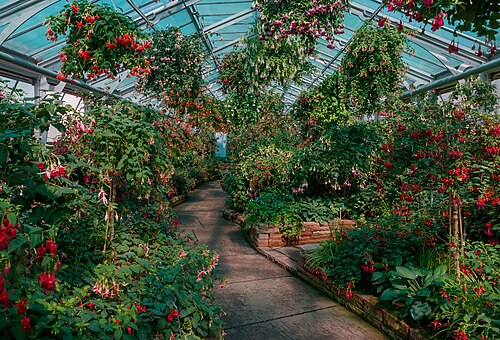
According to the operators, the production glasshouse holds some 220 plant varieties and genera. Tropical fruit predominates: papaya, passion fruit (maracuja), star fruit, tropical citrus, guava and dwarf bananas. Alongside them grow herbs and spices such as lemongrass, kaffir lime leaves, ginger, galangal and chillies.
The exhibition 'Faszination Tropen – erleben', set out over 800 m² in the visitor house, is devoted to the useful plants of the tropics and is explored with an audio guide. A few animals live there too: tortoises, budgerigars and spiny mice.
The fish farm is part of the growing system itself, since its water feeds the plants; the sources consulted do not say which species are raised.
Visiting
1 min
The Tropenhaus lies in Kleintettau, in the municipality of Tettau (Kronach district), at the place called Klein Eden, next to the glassworks that heats it. The season runs from early March to late November. Visits are mainly guided and must be booked in advance, including for groups outside the usual hours; a group tour lasts about an hour, and the exhibition can be explored with an audio guide.
In the same village, the European Flacon Glass Museum, devoted to the history of the glass perfume bottle and to the glassmaking tradition of the Frankenwald, makes a natural complement to the visit.
50.47° N, 11.28° E
Greenhouses nearby
More greenhouses — Germany
Do you have a good photo of this greenhouse? Suggest it for this page →