MUSE Tropical Greenhouse (Museo delle Scienze)
Trento, Trentino-Alto Adige
Entry updated on October 1, 2026
- Year
- 2013
- Architect
- Renzo Piano
- Style
- Contemporary steel-and-glass greenhouse integrated into a museum
- Dimensions
- About 600 m², glazed walls up to 15 m high
- Status
- Open to the public, inside the museum (new routes reported under way in 2025)
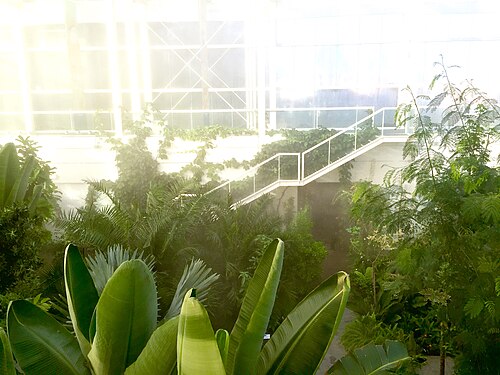
Located at the western end of MUSE, the Trento science museum designed by Renzo Piano and opened in July 2013, the tropical greenhouse covers about 600 m² under steel-and-glass walls rising to 15 m. It recreates a piece of the Udzungwa Mountains in Tanzania, with a waterfall, a lake, rock walls and three settings: the Kilombero valley, tropical forest and a highland plateau. Temperatures hover around 30 °C with 70 to 80% humidity. Plants, birds, amphibians and fish illustrate the museum's research on the biodiversity of Africa's Eastern Arc mountains.
Affiliate links — booking through Verrière helps fund our research, at no extra cost to you.
History
1 min
The tropical greenhouse is part of MUSE, the Trento science museum designed by Renzo Piano, which opened to the public on 20 July 2013 and was officially inaugurated on 27 July of the same year. It occupies the western end of the building and represents about 600 m² of the museum's roughly 12,600 m² of space.
Its subject is a specific ecosystem: the Udzungwa Mountains in Tanzania, an afromontane forest of Africa's Eastern Arc. The choice extends the museum's scientific activity in that region: an ecological monitoring and environmental education centre was established there in 2006, and the greenhouse is linked to the museum's section on tropical biodiversity. One specialist source mentions research collaboration with local Tanzanian communities since the 1990s.
The greenhouse has evolved since opening: its plant collection has grown from about 130 species in an older source to more than 200 according to a recent article, which also reports new animal introductions. The same article says a refit is under way in 2025, with new thematic routes and educational panels centred on conservation of the Udzungwa ecosystem.
Architecture and engineering
1 min
The greenhouse is part of the ensemble designed by Renzo Piano. It is enclosed by steel-and-glass walls rising to 15 m and covering about 600 m². The glazed structure is placed at the western end of the museum.
Inside, the tropical microclimate is held at about 30 °C and 70 to 80% humidity, reinforced by a lake and a large waterfall that greets visitors at the entrance. The setting reproduces three zones of the Udzungwa Mountains: the Kilombero valley, tropical forest and a highland plateau, with rock walls, streams and a cultivated area. A recent article mentions two waterfalls.
The label of bioclimatic greenhouse used by some specialist sites refers to this climate regulation and the pairing of the glazed structure with water basins. The sources consulted give no details of the framing or of the heating and ventilation systems.
Plant collections
1 min
The greenhouse shows more than 200 plant species according to a recent article, against about 130 in older sources. The genera Ficus, Dracaena and Philodendron form its backbone. More than a hundred species of African violet (Saintpaulia) grow on the rock walls. Visitors also see papyrus, a sausage tree (Kigelia africana), traveller's palm, orchids, African conifers, six species of vanilla including Vanilla imperialis, cacao trees, one of which fruited for the first time, bananas, coffee plants and giant water lilies.
An agricultural section brings together coffee, sugar cane, cinnamon and hibiscus; plants are presented for their food, medicinal and cosmetic uses.
The fauna numbers thirteen animal species, among them amphibians, birds and fish: Livingstone's turaco, the white-backed duck, and passerines such as finches and warblers.
Visiting
1 min
The greenhouse is visited inside MUSE, the museum designed by Renzo Piano in Trento. It forms part of the museum route: allow about an hour for the greenhouse alone, considerably more if combined with the natural-science galleries.
The interior climate is held at about 30 °C, so the visit does not depend on the season; the refit reported for 2025 suggests checking the state of the routes before coming. The museum's section on tropical biodiversity and the research carried out in Tanzania helps explain why the Udzungwa were chosen as the greenhouse's subject.
46.06° N, 11.11° E
Greenhouses nearby
More greenhouses — Italy
Do you have a good photo of this greenhouse? Suggest it for this page →