Historic Glasshouses of the Greifswald University Botanic Garden
Greifswald, Mecklenburg-Western Pomerania
Entry updated on October 3, 2026
- Year
- 1886
- Style
- Late-19th-century glasshouses on a riveted steel frame
- Dimensions
- 14 glasshouses, 1,333 m² of glazed area
- Status
- Open to the public
Completed in 1886 when the botanic garden of the University of Greifswald, founded in 1763 as a medicinal garden, moved to a new site, these riveted steel-framed glasshouses are among the few structures of their kind preserved in Germany; the palm house, with its warm and cold houses, is a monument of national importance. Closed in 2014 because of corrosion and structural defects, they were restored from June 2019, as faithfully to the original as possible, and reopened in mid-June 2022. The 14 glasshouses total 1,333 m² of glazing and concentrate on tropical ecosystems.
Affiliate links — booking through Verrière helps fund our research, at no extra cost to you.
History
1 min
The botanic garden of the University of Greifswald was founded in 1763 by the master of arts Samuel Gustav Wilcke as a medicinal plant garden (hortus medicus). In the second half of the 19th century, building around its original site left it increasingly cramped, and Professor Julius Münter argued for a move. Following his plans, a new garden of two hectares was laid out in the Fettenvorstadt, between Soldmannstraße and Grimmer Straße, and completed in 1886 with its glasshouses, consisting essentially of a cold house, a palm house and a warm house. Their construction belongs to the age of metal structures opened by London's Crystal Palace in 1851, to which puddled steel had brought new possibilities.
The warm, humid climate eventually attacked the glass and the frame: in 2014, corrosion and structural defects forced the closure of the glasshouses to the public for safety reasons. A petition gathered more than 7,000 signatures in three months. The restoration, begun in June 2019, cost about 4 million euros according to the university (3.5 million according to Wikipedia), provided by the federal government's culture and media budget (1.4 million), the state of Mecklenburg-Western Pomerania (over 2 million), the university itself (350,000 euros) and private donors (120,000 euros). The glasshouses reopened in mid-June 2022.
Architecture and engineering
1 min
The glasshouses rest on a steel frame joined with rivets. The original complex was organised around three main houses: the cold house, the palm house and the warm house. The palm house and its two adjoining houses are protected as a monument of national importance, not least because of their rarity: the state office for culture and monument preservation of Mecklenburg-Western Pomerania regards them as one of the few steel structures of this kind to have survived. The garden now has 14 glasshouses with a total glazed area of 1,333 m², more than half of which are open to visitors.
The 2019-2022 restoration aimed at a reconstruction faithful to the original. The steel girders were restored and, wherever possible, riveted again; badly corroded wall supports were replaced with new girders, and the appearance of the facades was restored. Modern heating controls were installed to manage the warm, humid climate that had caused the structures to deteriorate.
Plant collections
1 min
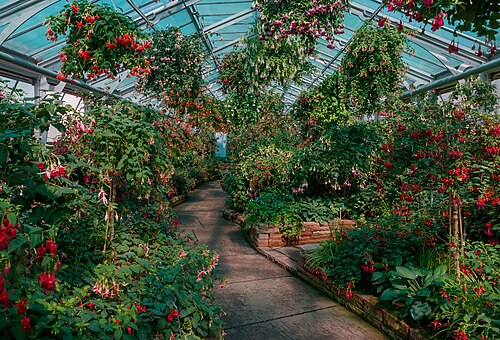
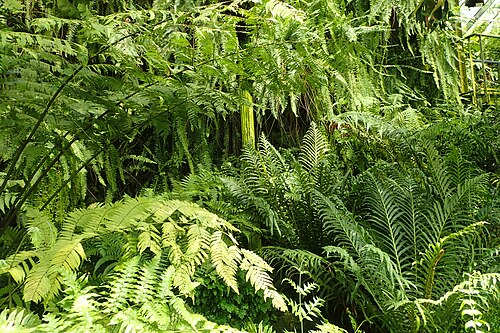
Since their restoration, the historic glasshouses have focused on tropical ecosystems. The tropical house evokes the rainforest with its epiphytes and orchids. The palm house holds the large plants: palms, bamboos and wild bananas. The cycad house (Palmfarnhaus) brings together primitive seed plants and ferns.
These displays sit within a garden whose origins go back to the medicinal garden founded in 1763, and whose other glasshouses, partly open to visitors, complement a visit to the three historic houses. The site's interest is twofold, botanical and architectural: tropical plants grow here beneath a riveted frame of the late 19th century.
Visiting
1 min
The glasshouses stand in the botanic garden on Münterstraße, in the Fettenvorstadt district, on a two-hectare plot between Soldmannstraße and Grimmer Straße. More than half of the 14 glasshouses are open to visitors; the palm house, the tropical house and the cycad house form the heart of the visit, and the restoration makes it possible to look closely at the riveted joints of the frame.
The university also runs an arboretum on a separate site, which allows visitors to continue exploring its plant collections in the open air.
54.09° N, 13.41° E
Greenhouses nearby
More greenhouses — Germany
Do you have a good photo of this greenhouse? Suggest it for this page →