Przelewice Gardens Orangery (Oranżeria w Przelewicach)
Przelewice, West Pomerania
Entry updated on October 5, 2026
- Year
- 2010-2011
- Architect
- Patrycja Tokarska (interior design)
- Style
- Fire-gutted farm barn converted into an orangery with a two-thirds glazed roof
- Status
- Open to the public
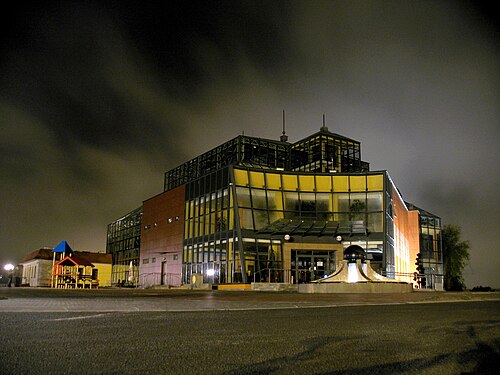
Created in 2010–2011 within the walls of a former barn burnt out in 1997, on the home farm of the Przelewice estate, this orangery opened on 12 April 2011 with a collection of Mediterranean plants. Two thirds of its roof are glazed, the rest keeping its tiles so that the building's outline is unchanged, an adaptation that earned a distinction in Poland's national 'Zabytek Zadbany' heritage competition in 2012. Renovated after the regional government took over the garden, it now houses a tropical zone, succulents, insects and a butterfly house.
Affiliate links — booking through Verrière helps fund our research, at no extra cost to you.
History
1 min
The Przelewice estate in West Pomerania gained a palace and a landscape park in 1805, commissioned by August Heinrich von Borgstede to designs by A. W. Hildebrand. Prince August of Prussia acquired it in 1821, and in 1922 the Berlin industrialist Conrad von Borsig bought the property; between 1933 and 1938 he turned the park into a dendrological garden of more than 500 species. After 1945 the garden passed through several public managers before the municipality of Przelewice took it over (in 1993 according to the garden, 1994 according to Polish Wikipedia).
The orangery was born from a ruin. A barn on the estate's home farm, destroyed by fire in 1997, had kept only its walls. The plan to convert it, prepared from 2005, was set out in documentation in 2006 to secure EU funding under the 'Village renewal and development' programme. Work began in autumn 2010 and cost 624,000 złoty, of which the municipality paid 270,000; the interior was designed by Patrycja Tokarska. The orangery opened on 12 April 2011 with an exhibition on the nature of Greece, and in 2012 the conversion received a distinction in the 'Zabytek Zadbany' competition, in the category for adapted historic buildings.
In 2020–2021 the West Pomeranian regional government took over the garden and set up the cultural institution 'Ogrody Przelewice'. A programme worth close to 80 million złoty, funded by the European Union and the region, renovated the palace, manor house, granary and orangery, inside which a butterfly house was created; the new features were opened to visitors in April 2024.
Architecture and engineering
1 min
The builders chose to keep the character of the barn rather than put up a new glasshouse. The external and internal elevations were repaired, cornices and parts of the gable walls rebuilt, the window frames remade, and the original openings reused as entrances. The key intervention was the roof: two thirds of its surface are glazed, while the remaining third keeps a traditional covering of clay tiles. The pitch of the roof slopes was retained, so that from outside the building still reads as one farm building among others in the yard.
The renovation launched after 2021 provided for fitting out office, exhibition and technical rooms and for installing systems to control climate, sunlight and ventilation. The upper floor now holds a small open-air-museum display on megaliths: a reconstructed Neolithic hut with figures and tools, one stop on the regional 'Megalithic Route – Gates of Time'.
Plant collections
1 min
When it opened in 2011, the orangery showed more than 200 varieties of Mediterranean plants, among them pistachios, acanthus, bay laurels, evergreen oaks, olives, camellias, pomegranates, stone pines and roses. The space evoked an olive grove, a Tuscan landscape, an Italian street, a vegetable and herb garden, a pool and a rose-covered gazebo.
Since the renovation the display has shifted. A tropical section brings together orchids, ferns, citrus, bananas and palms, a short step from a Mediterranean garden. Other sections are devoted to araucarias and other specimens presented as trees from distant ages, to strelitzias, to bulbous plants representing the flora of southern Africa, and to succulents and cacti. An educational area shows stick insects, locusts, fungus-farming ants, rose chafers, millipedes and crickets, while the butterfly house has dozens of tropical species from several parts of the world flying freely.
Visiting
1 min
The orangery stands in the estate's former home farm next to the palace, at the edge of a dendrological garden of more than 30 hectares that, according to the regional government, holds some 2,000 species of trees, shrubs and herbaceous plants. It offers shelter in poor weather and suits a visit in any season, since the management announced in 2024 that the garden would open all year round. Allow at least half a day to combine the glasshouse with the Japanese garden, the meadows and the tree collections planted by Conrad von Borsig, who is buried in the garden. The orangery's upper floor, devoted to megaliths, links the visit to the prehistoric sites of the region.
53.10° N, 15.08° E
Greenhouses nearby
More greenhouses — Poland
Do you have a good photo of this greenhouse? Suggest it for this page →
Sources (6)
- ogrodprzelewice.pl/ogrod/oranzeria/
- ogrodprzelewice.pl/ogrod/historia-ogrodu/
- pl.wikipedia.org/wiki/Oran%C5%BCeria_w_Przelewicach
- pyrzyce.pl/asp/otwarcie-oranzerii-w-przelewicach,10,artykul,1,2339
- radioszczecin.pl/1,470505,nowe-atrakcje-ogrodu-w-przelewicach-wideo-zdjeci
- wzp.pl/kultura-i-turystyka/kultura/instytucje-kultury/ogrody-przelewice-zachodniopomorskie