Display Glasshouses of the University of Innsbruck Botanical Garden (Schaugewächshäuser)
Innsbruck (Hötting), Tyrol
Entry updated on October 5, 2026
- Year
- 1977–1979
- Architect
- Unknown
- Style
- Group of modern display glasshouses extended in stages (1977-2002)
- Dimensions
- About 759 m² of display glasshouses; tropical house over 12 m high
- Status
- Open to the public (glasshouses open on a few afternoons a week)
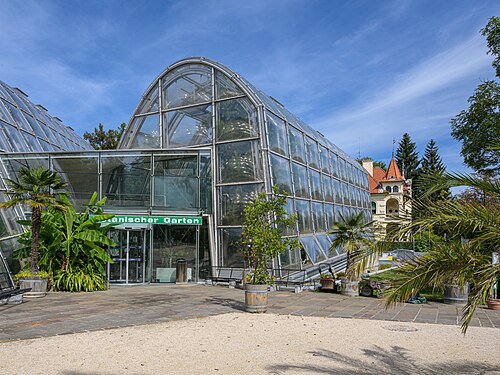
Founded in 1793 and on its present site in the Hötting district since 1909-1910, the University of Innsbruck Botanical Garden has a group of display glasshouses of about 759 m² within its two hectares. Three glasshouses were built there in 1977-1979, followed by a succulent house in 1993, a glasshouse for container plants in 1997 and an alpine house in 2002. The route leads from a tropical house over 12 m high and an epiphyte house to a fern house, cactus and succulent houses and a Mediterranean section.
Affiliate links — booking through Verrière helps fund our research, at no extra cost to you.
History
1 min
The University of Innsbruck Botanical Garden was founded in 1793 on the grounds of the former Jesuit college, which had been dissolved. It flourished in the mid-nineteenth century under the botanist Anton Kerner von Marilaun; according to German Wikipedia, the garden's first glasshouse was built in that period, in 1860.
In 1909-1910 the garden moved to its present site in the Hötting district, where the new Botanical Institute opened in 1913; Wikipedia credits the botanist Emil Heinricher with creating the new garden. According to English Wikipedia, the first glasshouse on this site dates from 1909. Major redevelopment took place between 1948 and 1965, and between 1929 and 1935 the university laid out an alpine garden on the Patscherkofel.
The present display glasshouses were built in stages: three glasshouses in 1977-1979, a succulent house in 1993 and a glasshouse for container plants in 1997, according to English Wikipedia. An alpine house (Alpinhaus), used to grow delicate and rare mountain plants from around the world, was completed in 2002. The garden has kept evolving around the glasshouses, with the alpine rock garden reworked in 1987-1990, the scent and touch garden opened in 1999 and the medicinal and useful plants garden redesigned in 2022-2024.
Architecture and engineering
1 min
The display glasshouses (Schaugewächshäuser) form a compact group in the northern part of the garden, which covers two hectares at an altitude of about 600 m. The university gives their area as 759 m², plus 542 m² of propagation houses closed to the public.
The group brings together several climates. The large tropical house, about 287 m² and over 12 m high according to English Wikipedia, is planted to reproduce the layered structure of a rainforest; a warm, humid house is reserved for epiphytes. There are also a small fern house of about 70 m², cactus houses of about 330 m² and a house combining cacti, succulents and Mediterranean plants of about 280 m². Added together these areas exceed the university's figure, so the sources do not quite agree.
The 2002 alpine house has a notable technical feature: its foundations lie about 1 m below ground level, which reduces cooling in winter and slows warming in summer. The sources consulted do not name the architects of the individual glasshouses.
Plant collections
1 min
The garden grows more than 5,000 species in all. In the tropical section, the epiphyte house gathers epiphytes, orchids and bromeliads, while the large tropical house shows flowering and useful plants, among them coffee, cacao, cotton and mango. The fern house holds epiphytes, climbing ferns and water ferns.
Among plants of dry habitats, the cactus collection numbers between 500 and 650 species depending on the source, and the succulent collection more than 550, mainly from South Africa, South America and the Canary Islands; cacti and spurges from the Americas and Africa grow side by side. The Mediterranean section brings together eucalyptus, bottlebrush, olive, myrtle and dragon tree.
An educational trail, 'Bau und Funktion der Pflanzen' (structure and function of plants), links stations in the glasshouses devoted among others to the banana, epiphytes, screw pine, papyrus, mimosa, bamboo, cassava, kalanchoe, citrus, butcher's broom, cacao and philodendron.
Visiting
1 min
The garden lies in the Hötting district at Sternwartestraße 15, next to the Department of Botany. The outdoor garden is open every day, but the display glasshouses can be visited only on a few afternoons a week, from Thursday to Sunday, all year round; guided tours of the tropical houses can be arranged by appointment.
Allow an hour for the glasshouses, and more for the alpine rock garden, the systematic garden and the scent and touch garden, described as the first in Austria with every plant labelled in Braille. The Patscherkofel alpine garden, also run by the university, rounds off the discovery of mountain plants.
47.27° N, 11.38° E
Greenhouses nearby
More greenhouses — Austria
Do you have a good photo of this greenhouse? Suggest it for this page →
Sources (8)
- uibk.ac.at/de/botany/botanical-garden/
- uibk.ac.at/de/botany/botanical-garden/botanischer-garten-innsbruck-hotting/tropische-und-s
- uibk.ac.at/de/botany/botanical-garden/uber-uns/allgemeine-informationen/
- uibk.ac.at/de/botany/botanical-garden/uber-uns/offnungszeiten/
- aux.uibk.ac.at/bauundfunktion/
- de.wikipedia.org/wiki/Botanischer_Garten_der_Universität_Innsbruck
- en.wikipedia.org/wiki/Botanical_Garden_of_the_University_of_Innsbruck
- openstreetmap.org/way/97785470