Greenhouse for Tropical Crops, Witzenhausen (Gewächshaus für tropische Nutzpflanzen, University of Kassel)
Witzenhausen, Hesse

Entry updated on October 5, 2026
- Year
- 1965-1966
- Architect
- Unknown
- Style
- 1960s university teaching glasshouse, extended in 1987 and 1995
- Dimensions
- About 1,200 m²; palm house of 240 m², 10 m high
- Status
- Open to the public (on certain afternoons)
In Witzenhausen the German Colonial School, founded in 1898, built a glasshouse for tropical useful plants as early as 1902 to train its students as farmers. Rebuilt larger in 1937 and wrecked in 1945, the collection moved in 1965-66 into a 1,200 m² building divided into three climate zones, including a palm house 10 m high. Linked to the DITSL institute and used by the University of Kassel, the glasshouse shows some 480 species: food plants, spices, medicinal, dye and fibre plants, coffee and cocoa.
Affiliate links — booking through Verrière helps fund our research, at no extra cost to you.
History
1 min
At the end of the 19th century the Deutsche Kolonialschule für Landwirtschaft, Handel und Gewerbe, the German Colonial School for Agriculture, Trade and Industry, was founded in 1898 in the buildings of a former monastery on Steinstraße in Witzenhausen. Until 1944 it trained farmers bound for the tropics, and the growing of tropical crops was central to the teaching: in 1902, only four years after the school opened, it built its first glasshouse for tropical useful plants, stocked from the botanical gardens of Göttingen and Bonn, from gardens in Kassel and Frankfurt and with plants sent by former students.
In 1937 a larger glasshouse replaced it on the same site; the sources describe in this context a complex of about 640 m² divided into a tropical house, a temperate house and two warm houses. In 1945 the glazing was shattered by fire from American troops, and most of the plants froze in the winter of 1945-46.
The German Institute for Tropical and Subtropical Agriculture (DITSL), founded in 1957, carried on the work. Decided in 1964, a new 1,200 m² glasshouse was built in 1965-66 for about 500,000 marks, funded by the DITSL and agriculture ministries, and leased in 1966 by the engineering school, which became part of the new University of Kassel in 1971. Seminar rooms were added in 1987 and a research wing in 1995. The centenary was celebrated on 11 October 2002. Today the glasshouse serves the university's teaching and research while remaining linked to the DITSL.
Architecture and engineering
1 min
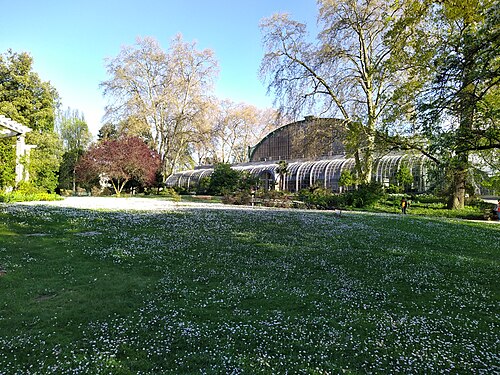
The present building, completed in 1965-66, covers about 1,200 m² and is divided into three climate zones. According to the description given by Wikipedia, it consists of a palm house of 240 m², 10 m high, and four houses of 225 m² and 5 m high each: the coffee house, the cocoa house, a room for field crops and an orangery. None of the sources consulted names the architect or describes the frame in detail.
The complex is made up of three parts built at different dates: the display area with its work room of 1965, a 300 m² multipurpose area with a seminar room and staff rooms added in 1987, and a 150 m² research house with walk-in climate chambers built in 1995. This arrangement reflects the building's double role, at once a shop window open to the public and a working tool for an agricultural faculty.
Plant collections
1 min
The glasshouse holds some 480 species of useful plants from the tropics and subtropics, shown in many varieties and provenances: food plants, spices, medicinal, dye, fragrance, energy and fibre plants. Coffee and cocoa each have a house of their own, and cocoa is the theme of family afternoons that follow the bean from the tree to the chocolate spread.
The staff also address the colonial legacy of the collection: they research where the plants came from, avoid discriminatory plant names and stress that every plant has a cultural, social, economic and political side. The glasshouse takes part in the WeltGarten Witzenhausen centre for global learning, which brings together six partner institutions at three learning sites. An outdoor teaching garden, notably devoted to vegetables, complements the collection from May to September.
Visiting
1 min
The glasshouse stands at 19 Steinstraße, the street where the Colonial School settled in a former monastery in 1898. It opens on only a few afternoons a week, all year round, and a public guided tour called 'Einmal zum Äquator und zurück' (to the equator and back) runs every Saturday; group tours can be booked. From May to September the teaching garden opens on the same days and offers its own tour along the vegetable rows. Schools, confirmation classes and children on university holiday programmes are offered dedicated workshops, on cocoa or paper for example.
51.34° N, 9.86° E
Greenhouses nearby
More greenhouses — Germany
Do you have a good photo of this greenhouse? Suggest it for this page →
Sources (6)
- uni-kassel.de/fb11agrar/en/sections-facilities/gewaechshaus-fuer-tropische-nutzpflanzen/ei
- uni-kassel.de/fb11agrar/fachgebiete-/-einrichtungen/gewaechshaus-fuer-tropische-nutzpflanz
- idw-online.de/en/news52575
- en.wikipedia.org/wiki/Gew%C3%A4chshaus_f%C3%BCr_tropische_Nutzpflanzen
- museen.de/gewaechshaus-fuer-tropische-nutzpflanzen-witzenhausen.html
- kita-global.de/das-tropengewaechshaus-in-witzenhausen/