Großes Tropenhaus and Victoria House, Halle Botanical Garden
Halle (Saale), Saxony-Anhalt
Entry updated on October 5, 2026
- Year
- 1872–1873
- Architect
- Rudolf Steinbeck (Great Tropical House)
- Style
- Tall hipped-roof glasshouse behind a brick front; original iron frame, rebuilt in timber in 1938, renovated in 2006
- Dimensions
- ≈3,000 m² under glass in all
- Status
- Open to the public from April to October
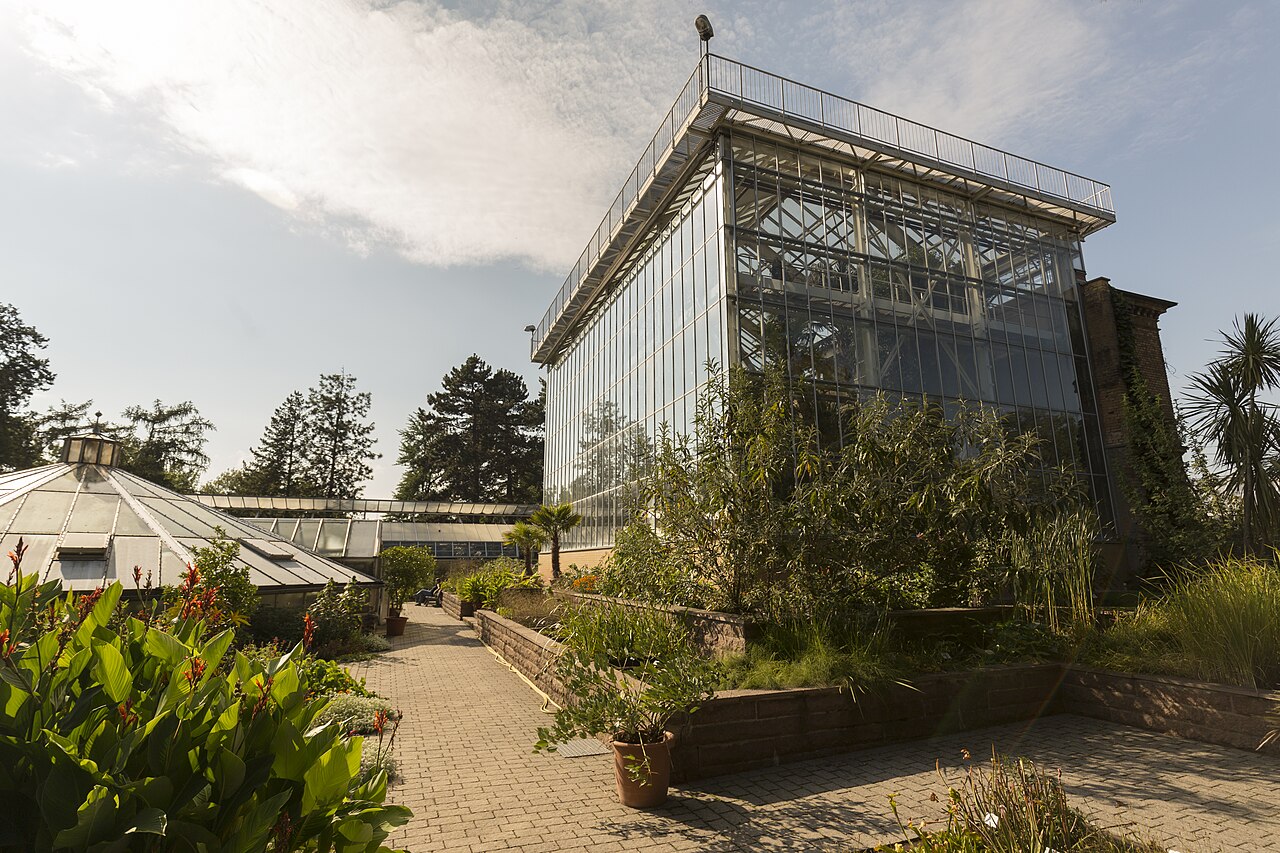
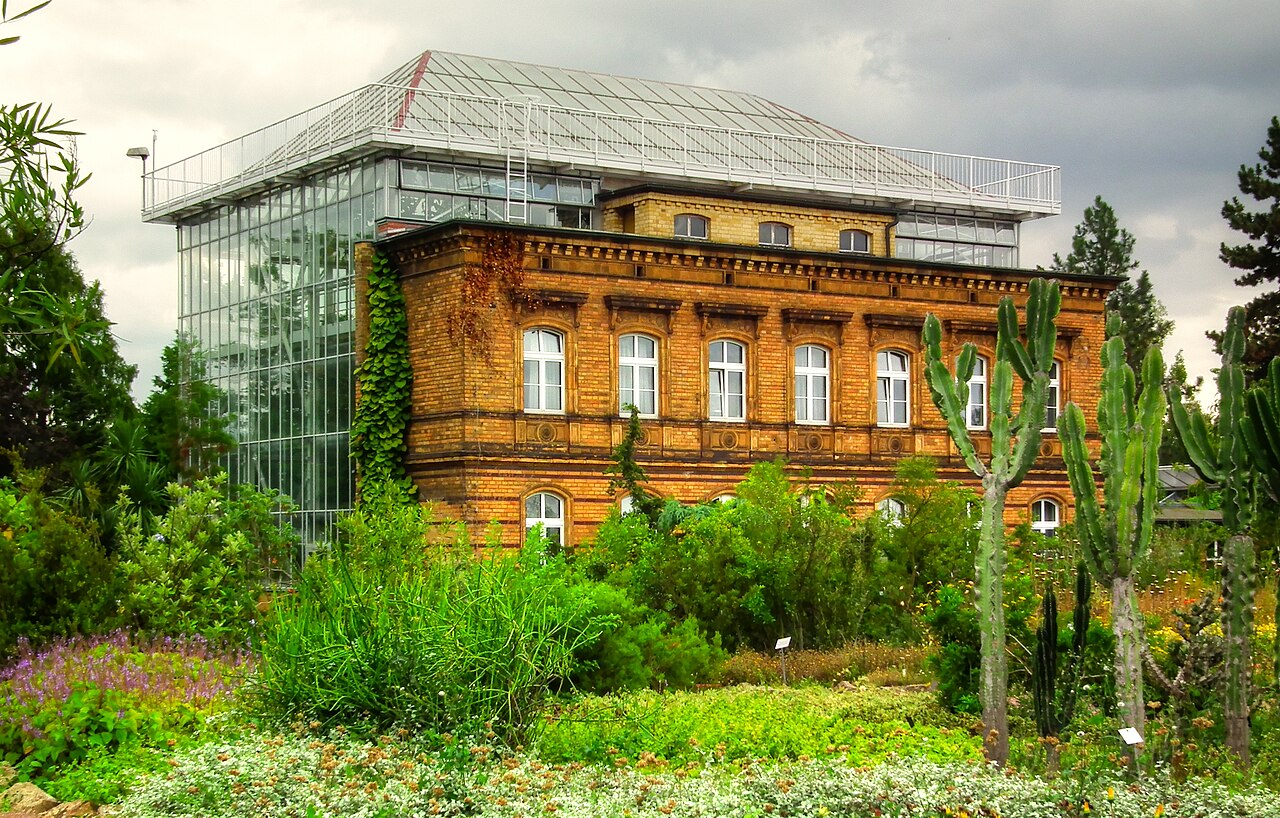
Founded in 1698 as Prussia's first medicinal garden, the botanical garden of Martin Luther University Halle-Wittenberg grows some 12,000 species, a large share of them under about 3,000 m² of glass. Its centrepiece is the Great Tropical House (Großes Tropenhaus), a tall hipped-roof glasshouse built in 1872-1873 to designs by the architect Rudolf Steinbeck, rebuilt in timber in 1938, reconstructed again in 1988 and renovated in 2006. Next to it stands the Victoria House, completed in 1902, home to the Amazonian giant water lily, orchids and mangrove plants.
Affiliate links — booking through Verrière helps fund our research, at no extra cost to you.
History
1 min
Halle's botanical garden was created in 1698, four years after the university was founded, as the medical faculty's garden of medicinal plants (hortus medicus), laid out on part of the Elector's gardens north of the Moritzburg. In 1787 the chancellor Karl Christoph von Hoffmann and the director Philipp Caspar Junghans secured an enlargement of the grounds, and the first glasshouses and an observatory designed by Carl Gotthard Langhans followed in 1788. Under Kurt Sprengel, whose annual seed catalogue appeared from 1797, and then under Diederich Franz Leonhard von Schlechtendal, director from 1833, the garden won an international reputation.
The Great Tropical House (Großes Tropenhaus), also called the Palmenhaus, was built in 1872-1873 by the architect Rudolf Steinbeck, with two annexes on its east and west sides. The Victoria House was completed in 1902. As early as 1938 the rusted iron frame and heating pipes forced a first reconstruction, in which the steel-and-glass structure was turned into a timber-and-glass one. That solution was kept when the house was rebuilt in 1988, when the two annexes were demolished and not replaced. Further glasshouses were added after the Second World War, including those for succulents and for evergreen plants.
In time the timber rotted and the single glazing let heat escape. A new renovation began in summer 2006, funded by the university, the Saxony-Anhalt lottery company Lotto-Toto and the garden's friends' association; by the autumn the scaffolding had come down to reveal the new envelope.
Architecture and engineering
1 min
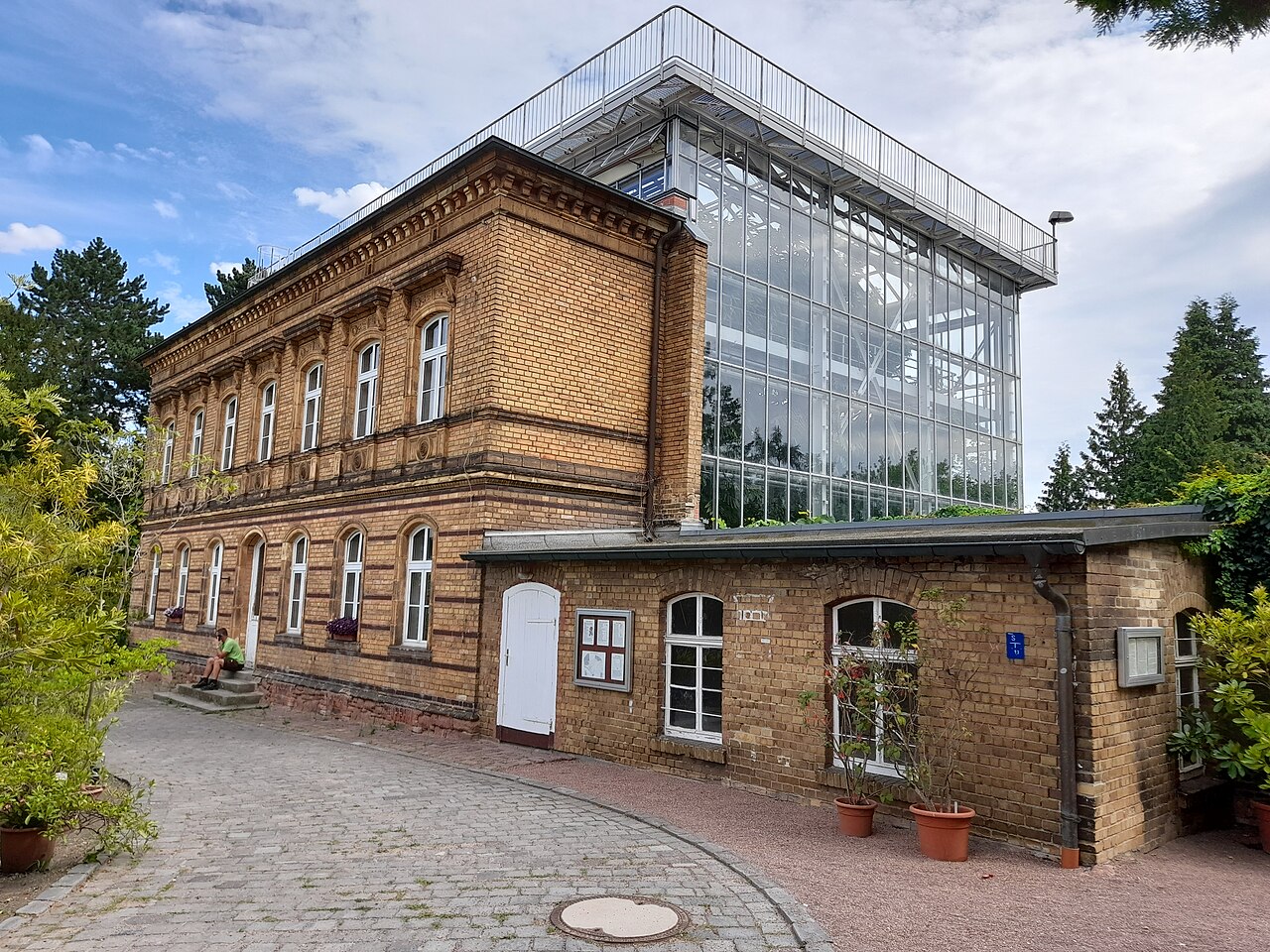
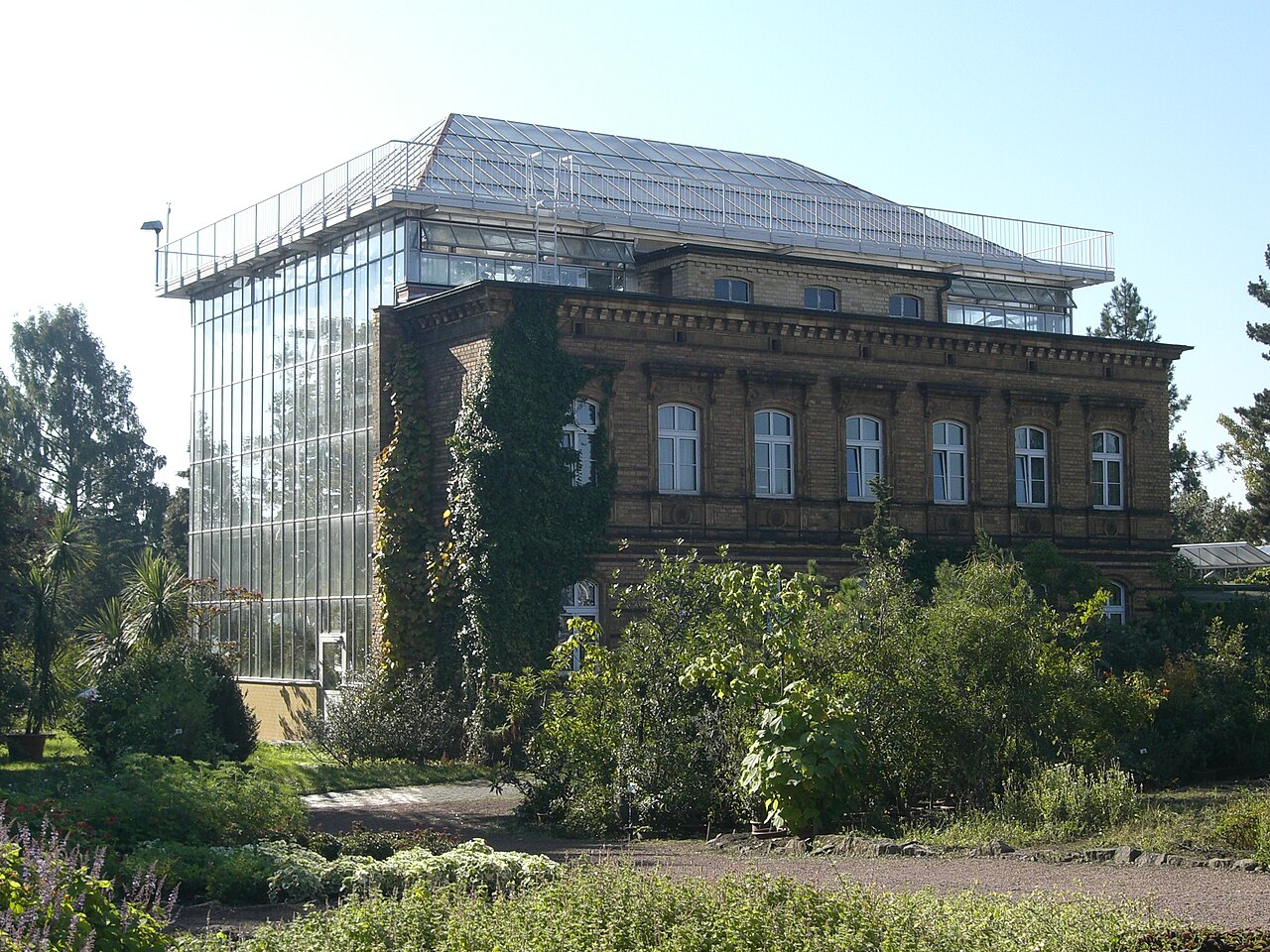
Halle's register of monuments describes the Great Tropical House as a tall glass volume under a hipped roof, fronted by a two-storey brick facade; the same listing covers the observatory of 1788, the botanical institute building and the garden's service yard. Originally, small panes were set into an iron frame, and a postcard from around 1900 still shows the western annex with the boiler house behind it.
The timber version of 1938, rebuilt in 1988, suffered from the climate inside: rotting wood, poorly insulating single glazing and roof ventilation left to just two fans, so that heat trapped under the roof scorched some plants in summer. The 2006 works, planned by the firm GEFOMA and carried out by GTD Gewächshaustechnik Dresden, are recorded in photographs showing the steel structure being repainted, aluminium members fitted on the south side, heavy insulating glass installed and the base faced with clinker brick. Taken together, the garden's glasshouses cover about 3,000 m².
Plant collections
1 min
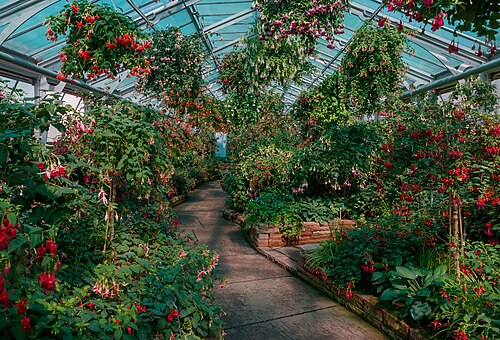
The garden grows about 12,000 species, some 6,000 of them in the glasshouses according to the Gartenträume network. The Great Tropical House brings together lianas, epiphytes and useful plants such as banana, coffee, pepper and vanilla. The Victoria House shows the Amazonian giant water lily after which it is named, along with orchids, mangrove plants and collections of tropical aquatic plants of the genera Echinodorus and Cryptocoryne.
Other houses complete the circuit: an arid house for cacti and succulents from the Americas and Africa, with a section devoted to Madagascar, a house of evergreen plants, an aquatic plant house, a Mongolia house and an Erdhaus (earth house) where carnivorous plants can be seen. Before the 2006 renovation, a pomegranate and a fig planted against the south face of the Great Tropical House thrived on the heat escaping through its poorly insulated glass.
Visiting
1 min
The garden covers four to five hectares in the centre of Halle, north of the Moritzburg, with its entrance on Am Kirchtor; it belongs to Saxony-Anhalt's Gartenträume tourism network and to the city's Kulturmeile. It opens only in the warmer months, from April to late October, and most of its paths are wheelchair-accessible.
The five display houses (evergreens, succulents and cacti, tropical house, Victoria House and aquatic plants) can be seen together with the outdoor garden and Langhans's observatory, the emblem of the site, which stands close to the Great Tropical House. A visit can continue at the neighbouring Moritzburg art museum or at other city sights such as the cathedral and the Francke Foundations.
51.49° N, 11.96° E
Greenhouses nearby
More greenhouses — Germany
Do you have a good photo of this greenhouse? Suggest it for this page →
Sources (7)
- botanik.uni-halle.de/botanischer_garten/geschichte/
- www2.biologie.uni-halle.de/bot/boga/aktuell/tropenhaus_reko.html
- botanik.uni-halle.de/botanischer_garten/
- de.wikipedia.org/wiki/Botanischer_Garten_Halle
- en.wikipedia.org/wiki/Botanical_Garden_of_the_University_of_Halle-Wittenberg
- gartentraeume-sachsen-anhalt.de/de/gartentraeume-parks/botanischer-garten-halle.html
- dubisthalle.de/botanischer-garten-in-halle-oeffnet-gewaechshaeuser-fuer-besucher