Great Vine House, Hampton Court Palace
Hampton, London (Richmond upon Thames)
Entry updated on October 5, 2026
- Year
- 1969 · vine planted 1768
- Style
- Aluminium glasshouse enclosing the iron frame of an early 20th-century house
- Dimensions
- Vine 4 m around the base; longest rod 36.5 to 40 m depending on the source
- Status
- Open to the public (Hampton Court Palace gardens)
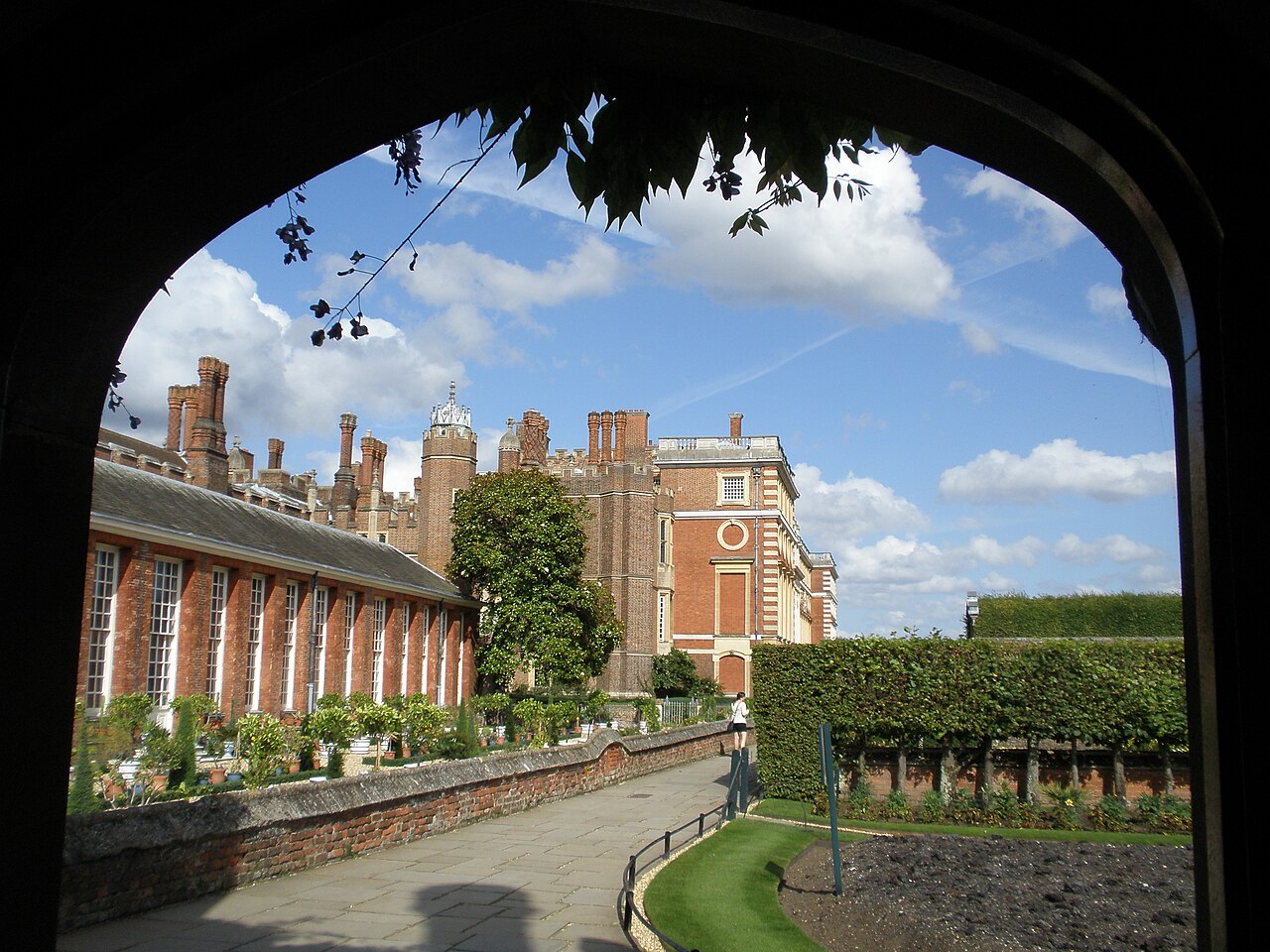
In the gardens of Hampton Court Palace, a 'Schiava Grossa' or 'Black Hamburg' vine planted in 1768 under the direction of Lancelot 'Capability' Brown, from a cutting taken at Valentines Mansion in Essex, now measures 4 metres around the base. It lives under an aluminium glasshouse of 1969, the fifth or sixth on the site, built over its predecessor because the vine had become entwined in its structure: the iron frame of the early 20th-century house was kept inside. Its crop, about 272 kg of black grapes a year, is sold at the palace in September.
Affiliate links — booking through Verrière helps fund our research, at no extra cost to you.
History
1 min
The Great Vine was planted at Hampton Court in 1768 under the direction of Lancelot 'Capability' Brown, then the palace's Chief Gardener, from a cutting taken at Valentines Mansion in Essex. It grew slowly: by 1887 it was still only 1.2 metres around the base.
In the nineteenth century its grapes were kept for the court: Queen Victoria had them sent to Windsor Castle or to Osborne House on the Isle of Wight. Edward VII, who reigned from 1901 to 1910, decided that the Royal Household no longer needed them and that they could be sold to visitors.
The vine has had five or six successive glasshouses. The early twentieth-century one, of wood on an iron frame, needed replacing by 1969, but the vine had become so entwined in its structure that it could not be taken down, so the new aluminium glasshouse was built over the old one. From 1983 to 2019 the vine was looked after by Gill Strudwick, the last to hold the title of Vine Keeper. In 2001 it gave its best crop ever, 383 kilograms. The British Guild of Tourist Guides presents it as the oldest known grapevine in the world, while Historic Royal Palaces, which runs the palace, describes it as the largest.
Architecture and engineering
1 min
The present glasshouse, put up in 1969, is an aluminium building made specially for the vine, the fifth or sixth glazed shelter it has known. Its construction followed an unusual method: the dormant vine was protected with polythene sheeting, then the glass and timber frame of the old house were removed, leaving the vine and the iron framework of the early twentieth-century structure in place. The new aluminium envelope was assembled around them, so that it now encloses that older framework.
The whole glasshouse is given over to this single plant. Under the glass, the trunk measures 4 metres around the base, against 1.2 metres in 1887, and the longest rod is 36.5 metres according to the guides' association and 40 metres according to Historic Royal Palaces.
Plant collections
1 min
The glasshouse holds a single plant. The Great Vine is Vitis vinifera 'Schiava Grossa', also known as 'Black Hamburg', which bears black dessert grapes. The average crop is about 272 kilograms a year; the record, 383 kilograms, dates from the autumn of 2001.
The bunches are ripe after the August Bank Holiday and go on sale in the palace shop in early September. Their history is tied to the court: once sent to Queen Victoria at Windsor or Osborne House, the grapes have been offered to visitors since the reign of Edward VII. For thirty-six years, from 1983 to 2019, Gill Strudwick tended the vine.

Visiting
1 min
The Great Vine house is part of the gardens of Hampton Court Palace, in the London Borough of Richmond upon Thames, and is seen in the course of a garden visit. Late summer is the best time: the 'Black Hamburg' bunches ripen after the August Bank Holiday and are sold in early September in the palace shop, a custom dating from Edward VII. The rest of the year the glasshouse shows the trunk, 4 metres around, and the iron framework kept in 1969. A visit combines with the palace itself and its other gardens, run by Historic Royal Palaces.
51.40° N, 0.34° W
Greenhouses nearby
More greenhouses — United Kingdom
Do you have a good photo of this greenhouse? Suggest it for this page →