Schmetterlingshaus (Butterfly House) in the Elbauenpark
Magdeburg, Saxony-Anhalt
Entry updated on October 5, 2026
- Year
- 2000
- Style
- Glazed tropical pavilion
- Dimensions
- 360 m²
- Status
- Open to the public, including in winter
On the north side of the Elbauenpark, the park created for the 1999 Bundesgartenschau on the east bank of the Elbe, this 360 m² glass pavilion opened in August 2000 to counter the fall in visitor numbers that followed the show. Depending on the year, 150 to 300 butterflies of fifteen to twenty-five species from four continents fly at around 28 °C among orchids, bromeliads and anthuriums, alongside stick insects, giant grasshoppers and geckos. Refurbished during the Covid closure and reopened in 2021, it also welcomes visitors in winter.
Affiliate links — booking through Verrière helps fund our research, at no extra cost to you.
History
1 min
The ground now occupied by the Elbauenpark, in the north of Magdeburg on the east bank of the Elbe, was long a floodplain meadow shaped by the river. From the mid-nineteenth century it housed barracks; after the Second World War rubble from the destroyed city centre was dumped there, and the Red Army occupied it until the early 1990s. The site was then transformed for the 25th Bundesgartenschau, which opened in 1999 south of the Herrenkrugpark and whose Millennium Tower (Jahrtausendturm) became a new landmark of the state capital.
The butterfly house did not exist during the show. It opened in August 2000, when the park management was looking for an answer to the sharp drop in visitor numbers that followed the end of the Bundesgartenschau.
The closure imposed by the Covid-19 pandemic was used for a complete refurbishment of the interior: new path edging, rocks repositioned, natural stone, 10,000 litres of potting soil, 1,200 tropical plants and a large waterfall. The park announced the reopening on 23 July 2021, twenty-one years after the inauguration. Since then the pavilion has also received visitors in winter, until the park's season begins in April; in December 2023 the management playfully described it as a 'Club Tropicana' on the Elbe.
Architecture and engineering
1 min
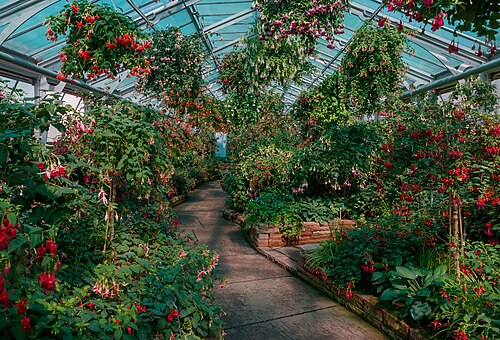
The butterfly house is a 360 m² glass pavilion on the north side of the park. Neither its architect nor the details of its structure appear in the sources consulted, which mainly describe the interior layout. A path of about sixty metres winds between trees up to 4 m tall; a small pond with fish, crossed by a wooden footbridge, and, since 2021, a large waterfall punctuate the route.
The climate is that of a tropical forest: 28 to 29 °C and 90 per cent humidity according to Wikipedia, around 28 °C according to the park, even in the depths of winter. During the 2021 refurbishment a large net was stretched beneath the roof to protect the butterflies. The number of visitors inside the pavilion at any one time is limited to fifty, a cap suited to so small a glasshouse.
Plant collections
1 min
According to Wikipedia, 200 to 300 butterflies of about twenty-five species fly in the pavilion; they arrive as pupae from a British farm, and some are bred on site. Figures vary with the year and the source: about 150 butterflies of fifteen species at the 2021 reopening, about 200 butterflies of some twenty species from four continents according to Saxony-Anhalt's garden network. The species mentioned include the blue morpho, the Indian leaf butterfly, the Atlas moth, which the park describes as the second-largest butterfly in the world, owl butterflies, the tree nymph and several swallowtails.
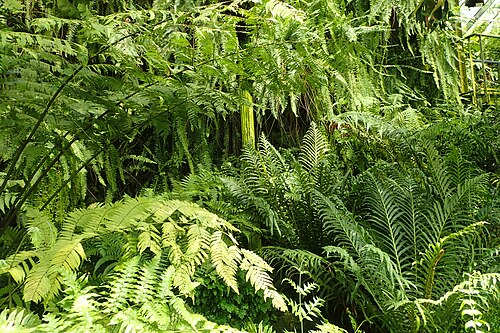
The planting, renewed in 2021 with 1,200 tropical plants, includes orchids, bromeliads and anthuriums. Other animals share the glasshouse: stick insects, giant grasshoppers, a Madagascar day gecko, iguanas, small fish and birds.
Visiting
1 min
The butterfly house stands on the north side of the Elbauenpark, in the north of Magdeburg; a bus stop is named after it. In season, admission is included in the park ticket, and the pavilion stays open in winter. The route inside is short, but watching the butterflies encourages a longer stay. A visit combines well with the Millennium Tower, the lake stage and the gardens of the former Bundesgartenschau, or with the neighbouring Herrenkrugpark; in the city, the Gruson glasshouses offer another tropical outing.
52.14° N, 11.68° E
Greenhouses nearby
More greenhouses — Germany
Do you have a good photo of this greenhouse? Suggest it for this page →