Zielona Góra Palm House
Zielona Góra

Sources checked September 2026
- Year
- 1961
- Style
- Modernist glasshouse-restaurant, rebuilt 2006-2008
- Dimensions
- ≈62.6 m long, 20.5 m high, 3,358 m² of floor space
- Status
- Open to the public
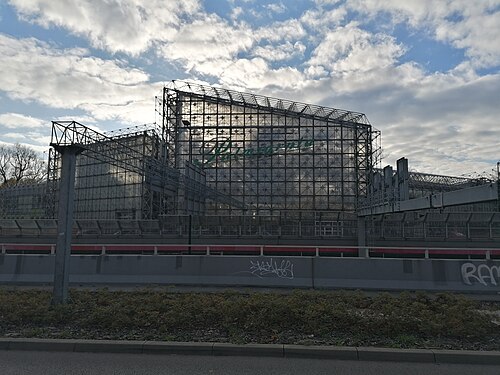
Opened on 1 May 1961 on the site of August Grempler's 1826 winery buildings, the Zielona Góra Palm House was extended several times (1964, 1967-1968), then wholly rebuilt in 1985 and again in 2006-2008 — each time by reconstructing the shell around the plantings to preserve them. The present building is about 62.6 m long and 20.5 m high, with 3,358 m² of floor space. It holds some 150 tropical and subtropical species, including a Canary Island date palm reckoned among the tallest under glass in Europe, plus seven aquariums, the largest holding about 10,000 litres with catfish sharks, sturgeon and piranhas. It also operates as a restaurant and café.
Affiliate links — booking through Verrière helps fund our research, at no extra cost to you.
History
The Palm House crowns Winne Wzgórze, the 'Wine Hill', on a site bound up with Zielona Góra's wine-making tradition. In 1818 a vintner's house was built there for August Grempler, a wine industrialist who in 1826, with two partners, founded what local sources describe as the first sparkling-wine factory in Germany. After 1945 the vineyards passed to the Lubusz Wine Factory, and the building later went to the city's parks department.
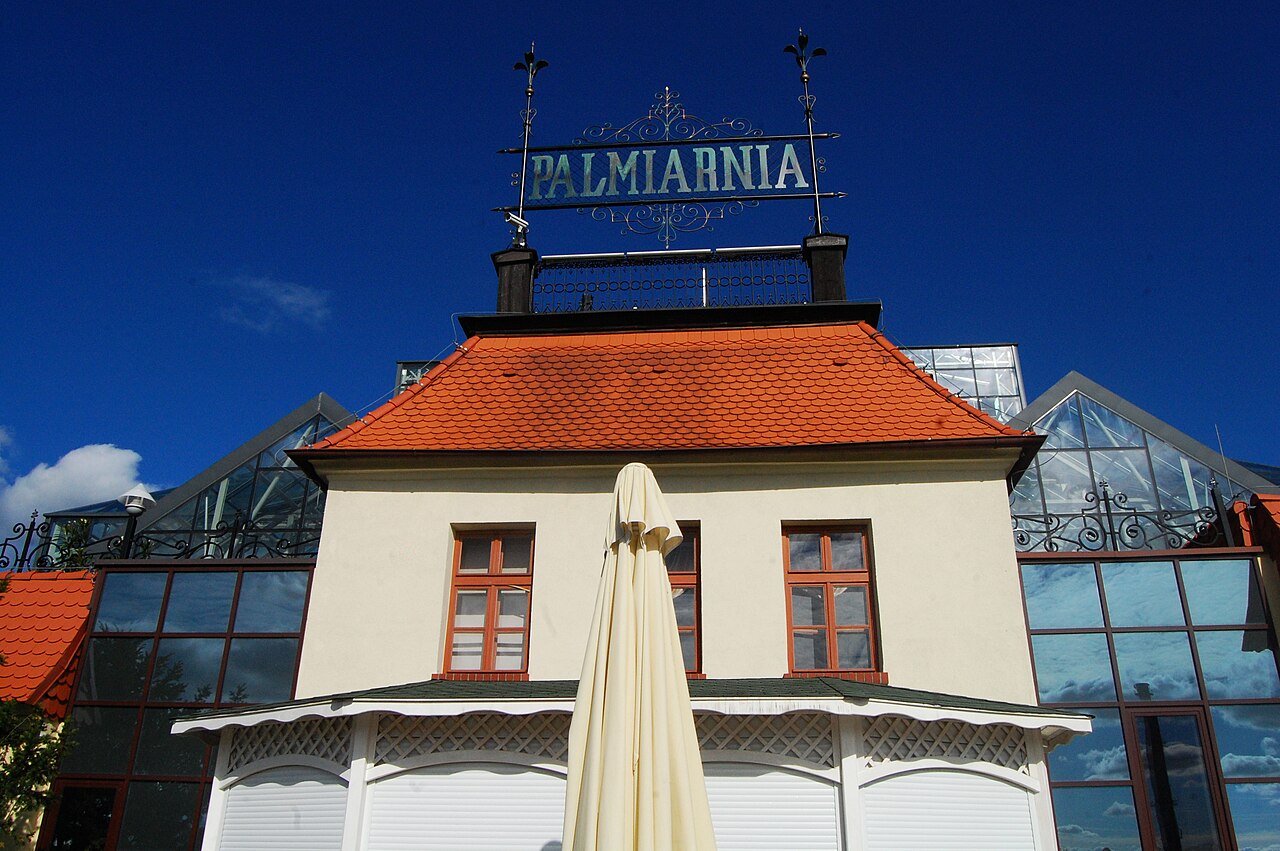
A small glasshouse of exotic plants was set up behind the vintner's house, and the 'Palmiarnia' café opened on 1 May 1961 with about 220 m² of floor space. Its popularity led to extensions: a wing on the Podgórna Street side in 1964, which raised capacity from 80 to 230 seats, and further halls in 1967–68, whose steel roof frame was closed in mid-January 1968.
The growth of the date palms prompted a rebuild decided in May 1982 and finished in autumn 1985, amid chronic shortages. Designed by the engineer Henryk Mańka, it set new foundations a metre or a metre and a half outside the old structure and capped the standing glasshouse with a second roof. The great palm nevertheless pushed through the roof, leading to the 2006–08 rebuild: a new shell was raised over the old one, which was then demolished, and the Palm House reopened in June 2008. Replacement of the air-filtration system and the installation of heat pumps were scheduled for late 2026.
Architecture and engineering
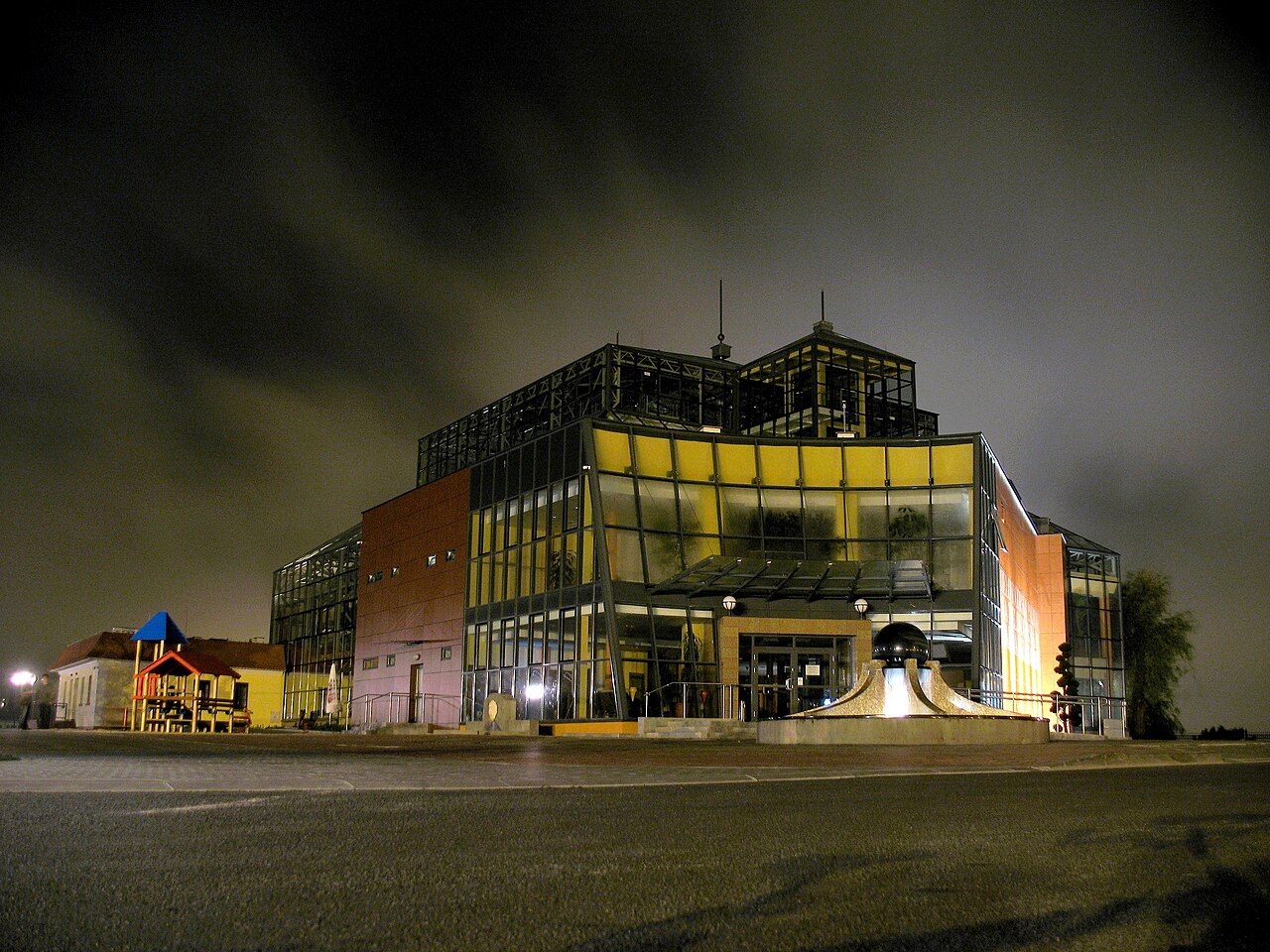
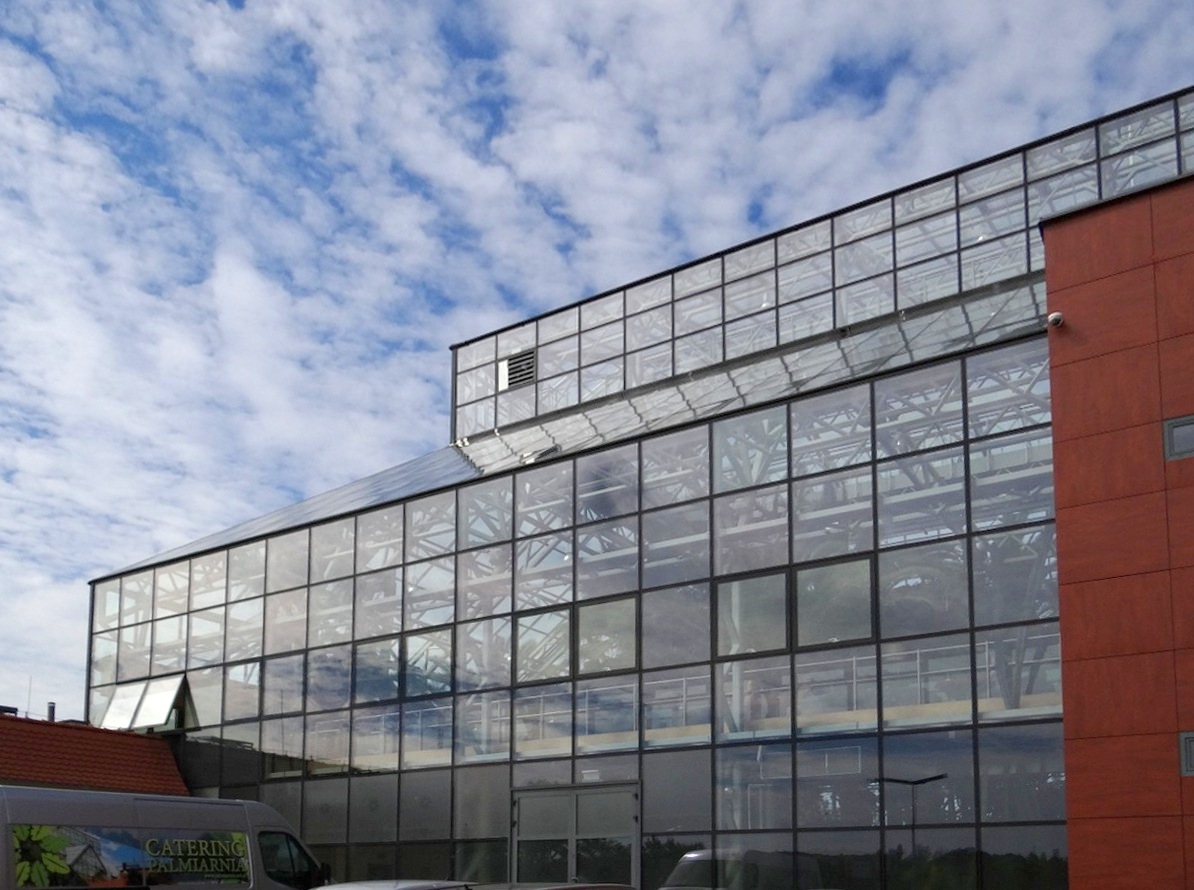
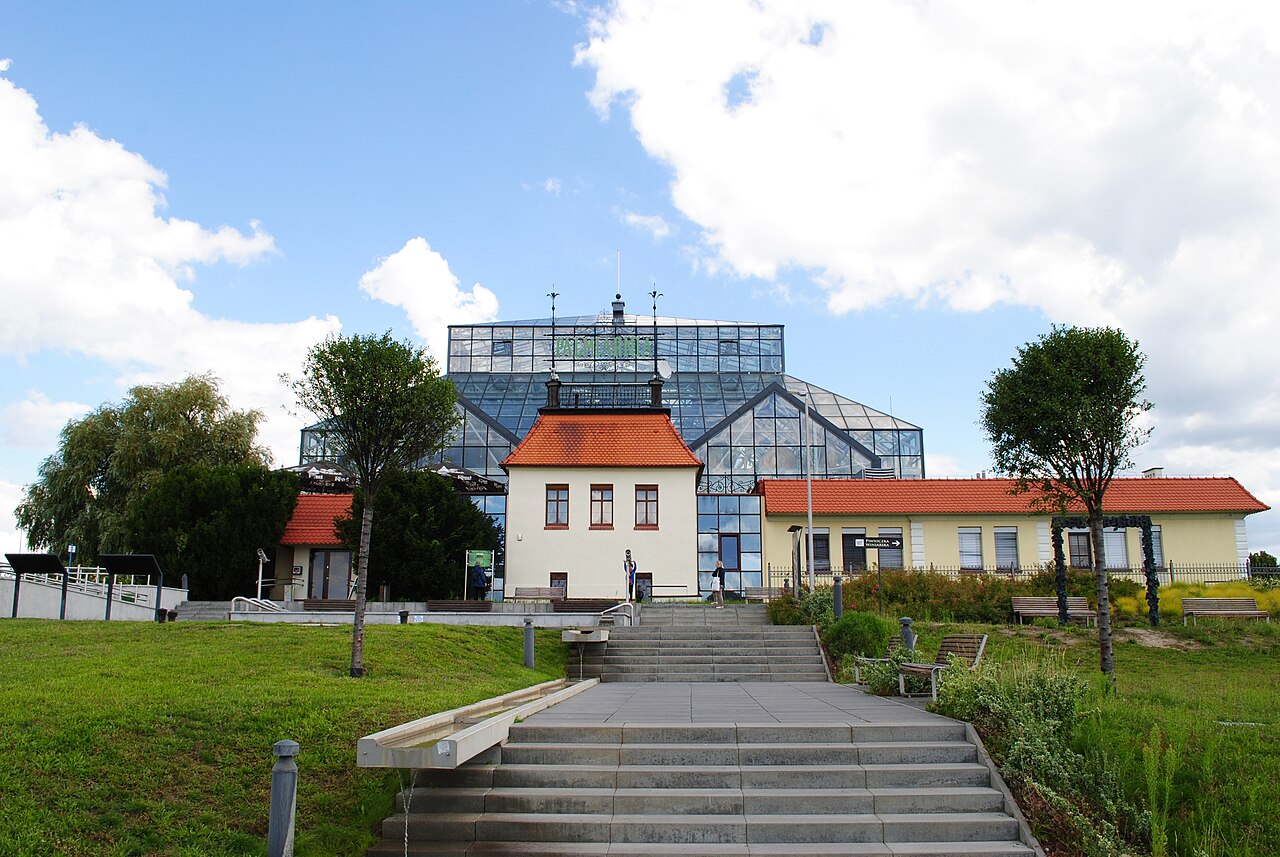
The 2008 building is 62.58 m long, 43.80 m wide and 20.48 m high, with a volume of 23,530 m³ and 3,358 m² of usable floor space. Under one glass roof it combines a winter garden, a restaurant hall and function rooms, alongside the nineteenth-century vintner's house that survives next to it.
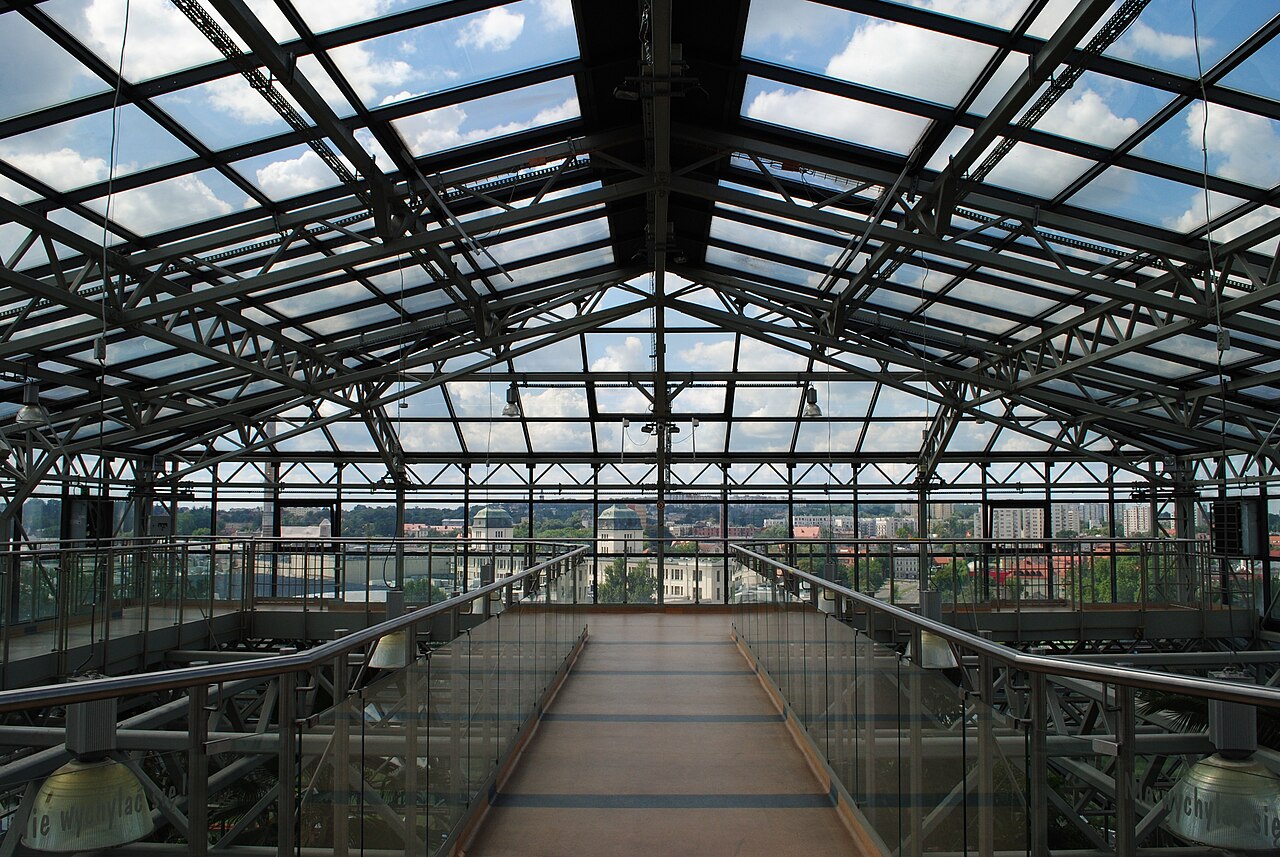
Its form is the product of successive raisings, each dictated by the growth of the palms. In 1985 the new load-bearing frame was erected outside the old one on independent foundations so as not to disturb the plantings; in 2006–08 the same principle allowed the new glasshouse to be built over its predecessor. A glazed terrace offers a panoramic view of the city.
The indoor climate relies on an air-handling and filtration system, whose modernisation, including the replacement of twenty-five climate convectors, is to be co-funded by the Zielona Góra combined heat and power plant.
Plant collections
The glasshouse holds some 150 species of tropical and equatorial plants, including trees and shrubs such as figs, cacao and citrus. Its centrepiece is a Canary Island date palm that the Palm House bills as the tallest grown under glass in Europe; it was this tree's growth that forced the building's successive raisings. Part of the ornamental planting is refreshed every quarter under a contract with a nursery in Kiełpin.
Seven aquariums complement the plants, the largest holding about 10,000 litres according to the venue. They are stocked with exotic fish, among them sterlet and piranhas. A waterfall adds movement to the winter garden.
Visiting
The Palm House overlooks Wine Park (Park Winny), on Wrocławska Street in Zielona Góra. The surrounding park combines a replanted vineyard, a wine cellar, a hedge maze and a playground; on the nearby steps stands Hans Krückeberg's sculpture 'Boy with a Foal'.
As much a place to eat as to stroll, the glasshouse houses a restaurant, a café and cultural events, and its glazed terrace offers one of the best views of the town. A visit pairs naturally with a walk through the vines of Wine Hill, a reminder of the town's wine-making past.
51.94° N, 15.51° E
Greenhouses nearby
Architecture nearby
More greenhouses — Poland
Do you have a good photo of this greenhouse? Suggest it for this page →
Sources (7)
- palmiarnia.net.pl/historia-palmiarni/
- przyjaznazielonagora.pl/przewodnik/palmiarnia-zielonogorska
- polska-org.pl/511272,Zielona_Gora,Palmiarnia.html
- gazetalubuska.pl/jak-rosla-palmiarnia/ar/7970990
- slowtravel.pl/palmiarnia-w-zielonej-gorze/
- zielona-gora.pl/zielonogorska-perelka-do-odnowy/
- wikidata.org/wiki/Q11802398
Affiliate links — booking through Verrière helps fund our research, at no extra cost to you.