Sammlungsgewächshaus (Collection Glasshouse), Hohenheim Gardens
Stuttgart-Hohenheim (Plieningen), Baden-Württemberg
Entry updated on October 5, 2026
- Year
- 2014
- Architect
- Unknown
- Style
- Contemporary glass collection house with seven climate compartments
- Dimensions
- 600 m²
- Status
- Open to the public on certain afternoons
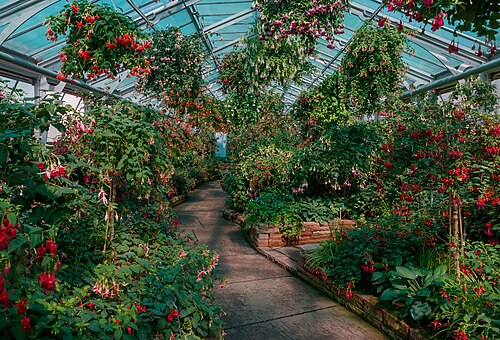
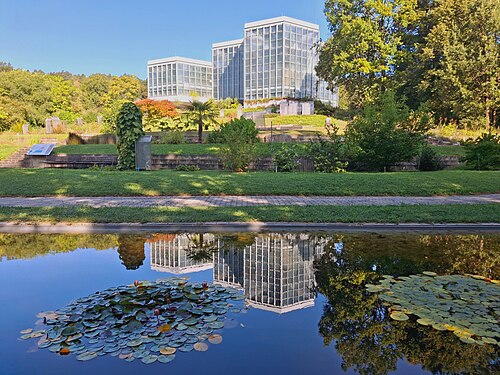
Opened in summer 2014 in the University of Hohenheim's botanical garden on the southern edge of Stuttgart, this 600 m² glasshouse is the latest in a line that runs back to the 'Eiserne Haus' of 1789, where Duke Carl Eugen of Württemberg grew pineapples, and to Oskar von Kirchner's botanical glasshouses of 1896. Under a roof of safety glass, seven compartments hold humid tropical vegetation, carnivorous plants, cacti, bromeliads and ferns, crop plants, African desert plants and some 160 species of begonia.
Affiliate links — booking through Verrière helps fund our research, at no extra cost to you.
History
1 min
The Hohenheim Gardens, on the southern edge of Stuttgart, now cover more than 30 hectares and make up the largest part of the University of Hohenheim's campus. Their oldest core, the Exotic Garden, was laid out from 1776 as an English-style landscape garden by Duke Carl Eugen of Württemberg and his favourite, later his wife, Franziska von Hohenheim.
It was within this garden that the estate's first heated glasshouse, the so-called 'Eiserne Haus' (Iron House), went up in 1789. The duke kept a collection of around a thousand pineapple plants there. More than a century later, in 1896, the botanist Oskar von Kirchner had new glasshouses built with a scientific purpose, and the cool-house and warm-house collections he began have been maintained ever since.
The collection then moved several times. According to the university, it was transferred in 1962–63 to buildings that were later replaced by the student refectory, and in 1973–74 to glasshouses near the Langer See, the gardens' lake. The present building on the Erna-Hruschka-Weg opened in summer 2014 and brings the botanical garden's living glasshouse collection together under one roof, serving teaching and research as well as visitors. None of the sources consulted names the architect or the client body for the building.
Architecture and engineering
1 min
The collection glasshouse covers 600 m², a figure given both by the university and by German Wikipedia. It is a functional building: the roof is glazed with single panes of toughened safety glass, while the walls, also glazed, are insulated to reduce heat loss.
Inside, the house is divided into seven compartments with their own climates: humid tropical vegetation, carnivorous plants, cacti, bromeliads with ferns and aquatic plants, tropical crop plants together with begonias, African desert plants, and finally a propagation area reserved for the gardeners. This layout lets saturated tropical air and dry desert sections sit side by side.
A climate computer controls heating, ventilation, air humidity, misting, shading and supplementary lighting. Watering draws on a 65 m³ rainwater cistern, which limits the use of mains water.
Plant collections
1 min
The university's page on the glasshouse puts its holdings at about 1,500 species, while the general description of the botanical garden speaks of a warm-house collection of about 2,000 species; the two figures do not quite match.
Three groups stand out. The begonias number about 160 species, which places Hohenheim among the largest collections of the genus in Germany. The cacti account for 220 species and the peperomias for around forty. Around them are carnivorous plants, epiphytes, bromeliads, ferns and aquatic plants, as well as orchids.
Two sections follow a geographical theme, one evoking the tropical vegetation of East Africa and the other the plants of African deserts, and a further one is devoted to tropical crop plants. Members of the university can also request access to the collection for teaching and research.
Visiting
1 min
The glasshouse stands in the botanical garden, part of the Hohenheim Gardens in the Plieningen district of southern Stuttgart. The gardens are open free of charge all year, but the glasshouse opens only on a few afternoons each week, with a summer break in some years, so it is worth checking the university's website before setting out.
A visit combines easily with the Exotic Garden, Duke Carl Eugen's former English garden, where follies such as the Spielhaus and the Römisches Wirtshaus survive, and with Hohenheim Palace, which now houses the university. Further south, the recent landscape garden opens views towards the Swabian Jura.
48.71° N, 9.21° E
Greenhouses nearby

More greenhouses — Germany

Do you have a good photo of this greenhouse? Suggest it for this page →