Tropicarium, Tübingen University Botanical Garden
Tübingen, Baden-Württemberg

Entry updated on October 5, 2026
- Year
- 1969
- Architect
- Hermann Blomeier
- Style
- Modern glass-and-steel glasshouse with a hexagonal roof on a single central concrete column
- Dimensions
- 2,800 m², up to 15 m high
- Status
- Open to the public
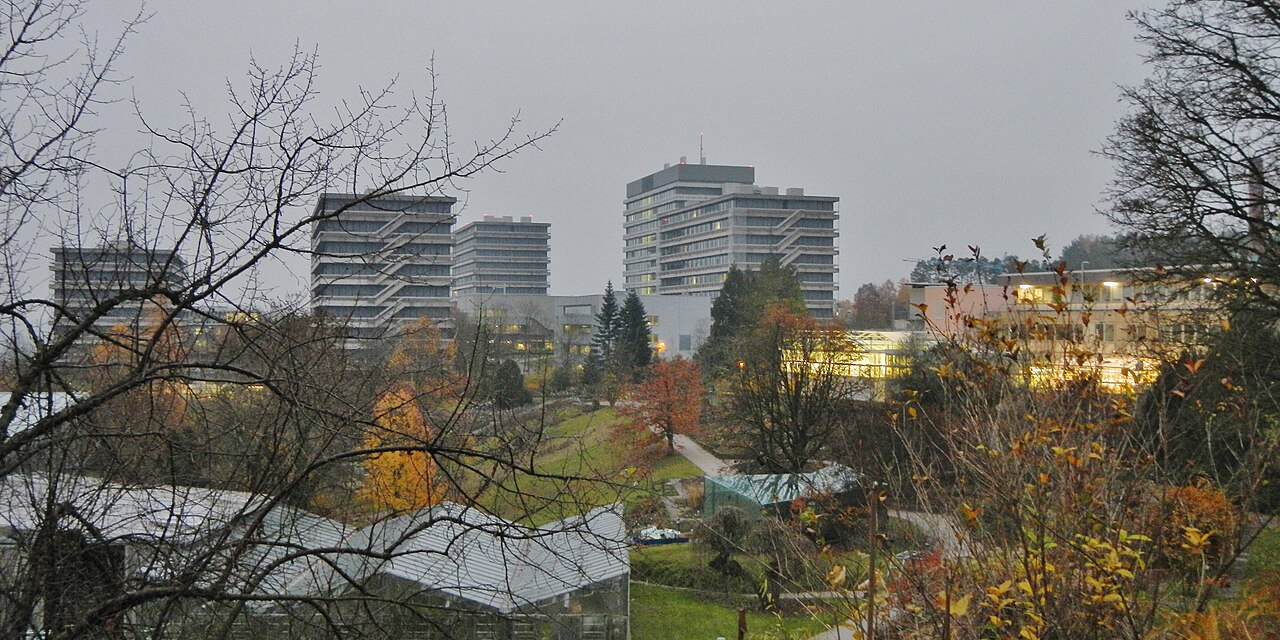
The landmark of the botanical garden opened in 1969 on the Morgenstelle, north of Tübingen, the Tropicarium designed by Hermann Blomeier houses a tropical lowland rainforest over 2,800 m² and up to 15 metres high. Its glass roof, divided by steel members into six hexagons of different heights, rests on a central concrete column largely hidden by plants, so that it appears to float. Repaired from 2009 onwards, it shows New World plants along the façades, Old World species in the centre, a bed of tropical ferns and a section of tropical crops.
Affiliate links — booking through Verrière helps fund our research, at no extra cost to you.
History
1 min
Tübingen University's botanical garden used to occupy a site in the town centre, today's Old Botanical Garden, in use from 1804 to 1968. A large stone-and-glass glasshouse was built there in 1839 and replaced in 1866 by a modern cast-iron and glass structure known as the Palmenhaus. Having become too small, the garden was abandoned for a new site on the Morgenstelle hill, and the 1866 glasshouse was demolished in 1970.
The new garden, whose scientific planning was overseen by director Karl Mägdefrau, opened on 8 May 1969. The Tropicarium, designed by architect Hermann Blomeier, came into use the same year and has since become the garden's architectural landmark.
After some forty years of service, major repairs began in spring 2009. The warm, humid air the plants need and their heavy watering had let water penetrate the concrete, setting off carbonation so advanced that the load-bearing column had subsided and had to be propped; cracks had also opened at the building's joints. Working for the Baden-Württemberg state property administration, a firm from Remseck renewed the waterproofing of the edges, penetrations and the external gutter that collects irrigation water.
Architecture and engineering
1 min
The Tropicarium is a glass-and-steel glasshouse whose form derives from a botanical model. Its roof is made of six hexagons of different heights; according to the garden, Hermann Blomeier probably took his cue from the umbel of cow parsley, a member of the carrot family. Steel members divide the glass roof into hexagons, and the whole rests on one massive central concrete column, so that the silhouette suggests an open umbrella. Because the column is largely hidden by vegetation, the roof seems to hover in space.
The floor slab is reinforced concrete and the façades are fully glazed. The building covers 2,800 m² and reaches 15 metres at its highest point, enough to recreate several layers of the rainforest. A small platform, reached by a spiral staircase, gives a view down onto the canopy. The Tropicarium is part of a group of glasshouses which, according to Tüpedia, covers more than 3,000 m² near the garden's northern entrance.
Plant collections
1 min
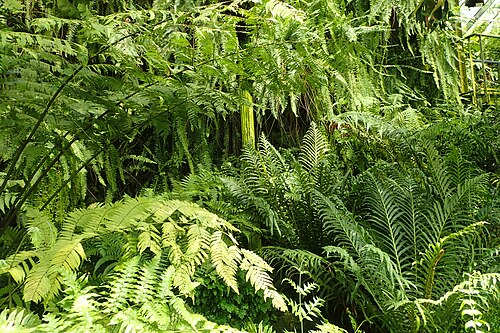
Most of the house is given over to tropical lowland rainforest arranged by continent: New World species line the façades and Old World plants fill the centre. To the right of the entrance a bed sets out tropical ferns by classification, while in the west a staircase leads to the section of useful plants, from pineapple to sugar cane; coffee, cocoa, cinnamon, pepper, bananas and a nutmeg tree also grow in the house.
The garden points to many curiosities: the giant bamboo Dendrocalamus giganteus, Strongylodon macrobotrys, which flowers only irregularly, Passiflora vitiifolia, in bloom almost all year, and Aristolochia arborea, whose flowers sit at ground level and mimic a fungus to lure the small gnats that pollinate them. Calliandra haematocephala, Hedychium spectabile, the blue lotus Nymphaea caerulea and the Panama hat plant Carludovica palmata, which looks like a palm but belongs to another family, round out the collection.
Visiting
1 min
The Tropicarium stands near the northern entrance of the botanical garden on the Morgenstelle campus, north of central Tübingen. The garden covers about ten hectares and holds more than 10,000 plant species.
A visit continues naturally into the neighbouring houses: the succulent house, the Canary Islands house, the subtropical house and the aquariums of tropical water plants. Allow an hour for the glasshouses, more for the arboretum and the rhododendron valley, which brings together some 75 cultivars and over 170 wild species and is best seen in spring. The Tropicarium's platform is worth the climb for its view of the hexagonal roof.
48.54° N, 9.04° E
Greenhouses nearby

More greenhouses — Germany
Do you have a good photo of this greenhouse? Suggest it for this page →