Tropical Glasshouses of the Ulm University Botanical Garden (Tropengewächshäuser)
Ulm (Oberer Eselsberg), Baden-Württemberg
Entry updated on October 5, 2026
- Year
- 1997
- Architect
- Unknown
- Style
- Contemporary university glasshouses
- Status
- Open to the public on certain afternoons
The Ulm University Botanical Garden, founded in 1981 on a former shooting range on the Oberer Eselsberg plateau, gained two tropical glasshouses in 1997, since supplemented by further extensions. Standing at the garden's upper entrance, above the apothecary garden, they comprise a lowland rainforest house, a montane rainforest house and a teaching glasshouse. They hold tropical crop and medicinal plants such as cacao, vanilla and coffee, together with epiphytes, ferns, gesneriads and bromeliads, for students and visitors alike.
Affiliate links — booking through Verrière helps fund our research, at no extra cost to you.
History
1 min
Ulm University's botanical garden is a recent creation. Permission to lay it out was granted in 1981 by Baden-Württemberg's Ministry of Science and Art, on a former shooting range adjoining the university buildings on the Oberer Eselsberg to the south-east. The site was reshaped in 1980–81 with some 150,000 m³ of spoil from the construction of the university hospital. The garden now covers about 28 hectares.
As a central scientific institution of the university, it is tied to the Faculty of Natural Sciences, notably to biology and the Institute of Botany. Its tasks combine research, teaching and the upkeep of documented plant collections with a public role: the garden serves as a place of recreation for Ulm's residents and as an outing for visitors to the region.
The tropical glasshouses came later. According to German Wikipedia, two tropical houses were built in 1997, followed by further extensions. The university now presents three glasshouses: a teaching glasshouse, a lowland rainforest house and a montane rainforest house. Their collections grow steadily through research trips and plant exchanges with other botanical gardens. The sources consulted do not name the architect or give the area under glass.
Architecture and engineering
1 min
The glasshouses form a group of single-storey buildings at the garden's upper entrance, beside the administration building; the apothecary garden, laid out in 2001, steps down in terraces just below. The sources consulted do not describe their structure or materials.
Their arrangement follows an ecological logic. The lowland house refers to a climate with an average annual temperature of 25 to 30 °C, more than 2,000 mm of rain spread evenly through the year, and twelve hours of daylight and twelve of darkness. The montane house, by contrast, evokes forests between 1,000 and 2,500 metres above sea level, lighter, cooler and laden with moisture, where clouds driven by the trade winds pile up against east-facing slopes.
Walking from one house to the other makes the contrast in temperature and vegetation tangible. The lowland house also serves as a 'living laboratory' for teaching and research, with posters made by students in tropical ecology practicals on display.
Plant collections
1 min
The lowland rainforest house gathers tropical crop and medicinal plants: cacao, vanilla, the rubber tree, neem and ylang-ylang. Among the most conspicuous plants are bananas, Ceylon cinnamon, jade vine and several species of strangler fig.
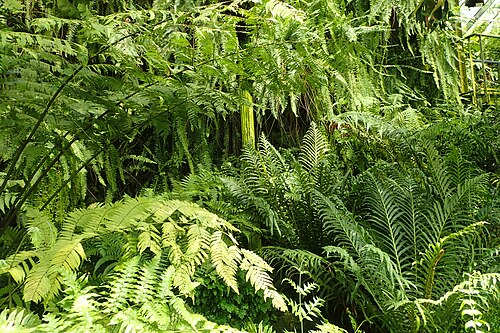
The montane rainforest house shows the wealth of epiphytes, mosses and ferns typical of these habitats. Orchids, bromeliads, fuchsias, passion flowers, gesneriads and aroids grow alongside useful plants such as coffee, avocado and mate. Tree ferns, which favour cool, moist conditions, are its most striking feature.
The whole is designed for students and visitors alike, with particular attention to the uses of tropical plants.
Visiting
1 min
The glasshouses stand at the upper entrance of the botanical garden, on the Oberer Eselsberg campus north-west of Ulm's centre. The garden itself is open every day, but the glasshouses welcome the public only on a few afternoons a week and one Sunday a month; they also open during events such as the autumn festival.
A visit continues through the garden's 28 hectares: the apothecary garden with its 200 or so medicinal plants, the arboretum, the cottage garden, the fern valley, the rose garden and the daylily garden, flower meadows and wetlands.
48.42° N, 9.96° E
Greenhouses nearby

More greenhouses — Germany
Do you have a good photo of this greenhouse? Suggest it for this page →
Sources (6)
- uni-ulm.de/einrichtungen/garten/
- uni-ulm.de/einrichtungen/garten/garten/gewaechshaeuser/
- uni-ulm.de/einrichtungen/garten/garten/gewaechshaeuser/tieflandregenwaldhaus/
- uni-ulm.de/einrichtungen/garten/garten/gewaechshaeuser/bergregenwaldhaus/
- de.wikipedia.org/wiki/Botanischer_Garten_Ulm
- openstreetmap.org/way/187656103